

Pat Albert
Nashville punk pioneer
By Stephen Trageser
These days, being a rock or punk band from Nashville has a certain cachet. Groups like Bully, JEFF the Brotherhood and Diarrhea Planet are well-known around the United States and internationally, and they’re greeted with a hero’s welcome whenever they play here. That wasn’t the case in the early 1980s, when Pat Albert co-founded and played bass in Committee for Public Safety, one of Nashville’s first punk bands. He described the situation to Tracy Moore in a 2006 Scene story on our city’s Reagan-era rock. “Back then,” Albert said, “if you saw a guy walking down the street with a mohawk or a leather jacket, you’d pick him up before some Lynyrd Skynyrd fan hit him with a beer bottle.”
Albert made his living as a master motorcycle mechanic. But he maintained a passion for outsider art, and kept playing alongside musicians like Dave Cloud and Paul Booker — people who kept the city known as the home of commercial country music as weird as possible, keeping a path clear for those later, better-known rockers to take off when their time came.
Scene staffer Matt Bach had a long friendship with Albert, playing with him in a group called Trauma Team as well as the band that formed around Dead Boys guitarist Cheetah Chrome when he moved to Nashville at the end of the 1990s. Albert was living in Auburn, Ky., when he died on Dec. 3 after a brief bout with cancer, and Bach wrote a remembrance for us.
“All the anecdotes and history show a common thread that ran throughout Pat’s life,” says Bach. “That of being a nice, charming person and having a beautiful intellect. He could make friends with anyone, and he also commanded their respect. Pat loved to discuss revolutions — French, Spanish, American, etc. I was lucky to end up with all of his books about those topics and more. I would say his books generally focused on the downtrodden and underdogs of society. Pat related to these folks, and perhaps saw himself that way. I think I learned more about culture and its shifting dynamics than I could ever hope to read in a book. Pat was a true genius in ways that had nothing to do with music. This made him all the more special to me.”
Ben Eyestone
Drummer, rock ’n’ roller
By D. Patrick Rodgers
Ben Eyestone was a phenomenal drummer. I mean, just an incredibly gifted guy, as good with a subtle country shuffle as he was with a booming, four-on-the-floor rock beat — and it was a lot of fun to watch him play.
Eyestone moved to Nashville with his band The Lonely H about six or seven years back, and since then he’d become a local rock-scene fixture, working at East Side bar and venue The 5 Spot and playing with truly top-notch country and rock acts including Little Bandit and Nikki Lane. He was a kindhearted guy, irreverent and rakish and vexingly handsome.
“I have cancer,” Eyestone posted on Facebook on July 9, shortly after being diagnosed with stage 3 colon cancer. “Don’t worry. I’m gonna kick its ass.”
Heartbreakingly, Eyestone died just days after that. He was 28. But that final post, that simple expression of fearless determination, spoke volumes about Eyestone. He was matter-of-fact. He was hopeful. He kicked ass.
Greg Trooper
Songwriter
By Ken Paulson
Greg Trooper loved to tell about the time he embarrassed himself in front of Bruce Springsteen.
“Troop,” who died in January at age 61 from pancreatic cancer, was at a party in his home state of New Jersey and found himself in the kitchen face-to-face with Springsteen in the kitchen. Trying to make a connection with the idol of any Jersey boy, he blurted out “I have a band too!”
Greg would laugh loudly with each retelling of his humiliation, but it turned out he didn’t really need that band. All Greg Trooper needed was a guitar and a place to play it.
I remember one special holiday party in 2002 with a small group sitting around his living room in Nashville. Amy Rigby had played a new song “Are We Ever Gonna Have Sex Again?” No one could follow that except Greg, who pulled out a new song of his own, “Muhammad Ali (The Meaning of Christmas).”
“I am the greatest,” he said with a grin, “But he was talking about you, not about him, and was teaching me the meaning of Christmas,” he sang.
Greg taught us all about living and dying. His music, his wife Claire and son Jack were the loves of his life, and he pursued his art with passion and conviction.
His songs were recorded by Vince Gill, Steve Earle and Billy Bragg; his producers included Dan Penn, Buddy Miller and Garry Tallent. From “Ireland” to “Everywhere,” his was always a voice of heart, hope and honesty. He was a man of great conviction, and when he sang Neil Young’s “Ohio” at one of the First Amendment Center's free speech and music celebrations, you could tell he was still outraged about the “four dead in O-hi-o.”
In 2015, friends were startled when news came of Greg’s illness. He had to scale back, but made his way back to the road and began recording his next album. We lost him in the midst of those final recording sessions.
Greg dealt with his illness with grace, and with gratitude for his loving family and friends. Thankfully, we still have his music and we will never forget his heart. That, too, is the meaning of Christmas.
Billy Wayne Goodwin Jr.
Bartender and unofficial ambassador
By Stephen Trageser
During a decade in which the romantic vision of Nashville as a town where everyone knows everyone has rung a little more hollow, Billy Wayne Goodwin Jr. was someone you could reliably bet had done something nice for the person you just met. The Macon, Ga., native and hard rock aficionado showed his pride in his adopted hometown in the humblest way: He made himself a fixture. From behind the bar at the Red Door Saloon in Midtown, and later The 5 Spot and Duke’s in East Nashville, he dispensed drinks as well as trustworthy and respected advice.
“He was a very professional bartender, knew how to make people feel at ease from minute one,” recalls Joseph Plunket, co-owner of Duke’s. “That’s the trade, he was great at it. And a great guidepost for people visiting this neighborhood. Tell ’em where the cool shows are at, where to go, what to check out in town. He was a very good ambassador. Even if he was a little grumpy, he was super good at that, ushering people around to get to check out cool things in this town.”
Part of why people close to Goodwin trusted him was his unwillingness to trade in bullshit.
“He was terribly surly on first meeting,” remembers Brandy Goldsboro, DJ and “band mom” for Thee Rock N’ Roll Residency. She’d made friends with Goodwin at Red Door, around 2008. “Very intriguing. Once you got through his outer shell, he was the most caring, (brutally) honest person I’ve ever known. He would do anything he could for anyone, and was super dependable.”
Plunket’s first memory of Goodwin exemplifies that generosity.
“Probably about four, five years before I even lived here,” says Plunket, “he was the only person who came to see my old band at the Springwater one night. That’s how I met him. He let us stay at his house.”
Following Goodwin’s death, folks whose lives he’d touched organized multiple benefit shows to offset expenses for his family and contribute to a college fund for Bunny, Goodwin’s teenage daughter.

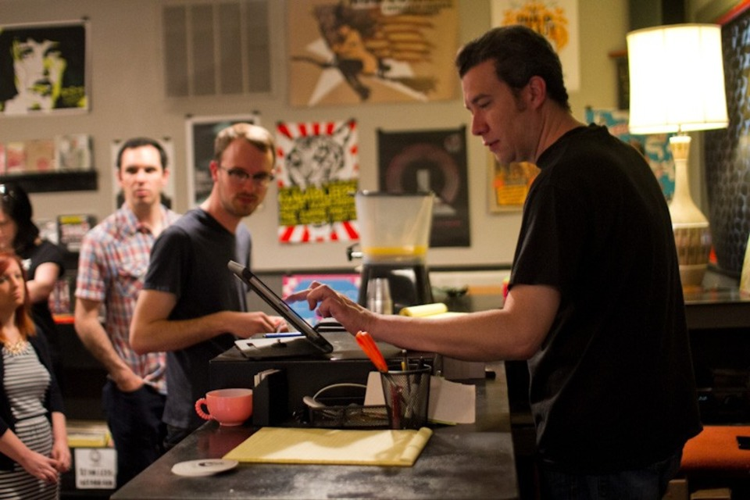
Jeff Pettit at Fond Object on Record Store Day 2014
Jeff Pettit
Fond Object co-founder, DJ, record collector, rock ’n’ roll booster
By D. Patrick Rodgers
The caption of Jeff Pettit’s final Instagram post — which he shared just a week before his sudden death this summer — couldn’t have summed him up better: “TFW when you are hanging at your friendly local record store/bar and you advise them to put on the Cult and they do and everyone rocks the fuck out.”
Pettit, who co-founded East Nashville records-and-more spot Fond Object, posted a selfie with the aforementioned caption while he was flipping through wax at Vinyl Tap, another East Side spot. The avid punk rock wonk wasn’t being territorial, but was rather signal-boosting another independently owned music vendor, capping off the post with hashtags including “#DJingAllTheTime” and “RockWins.”
Pettit, an Austin transplant sometimes playfully known as “El Jefe,” opened Fond Object’s first location in 2013 along with partners Jem Cohen, Coco Hames and Poni Silver of The Ettes, as well as artist and printmaker Rachel Briggs. A committed audiophile also known for his frequent DJ gigs and rock-scene boosterism, Pettit provided the record shop’s initial stock with his collection of more than 20,000 LPs. He and Cohen opened a second Fond Object location downtown in March of this year. Pettit was known for his encyclopedic rock knowledge, his collection of punk T’s, his affinity for Pee-Wee’s Big Adventure and his two beloved cats.
The Wisconsin native was found unresponsive at Fond Object’s East Nashville location on the afternoon of Aug. 12. He was 46, and as far as any of his friends or co-workers knew, he hadn’t been suffering from any illnesses or health issues. News of Pettit’s death came as an enormous shock to the East Nashville music community, and to everyone else who’d grown accustomed to seeing the record clerk at both of the shop’s locations. For those of us who knew Pettit as a tough nut to crack — but a big softie once you did crack him — it’s still a bit difficult to enter either of the shops knowing we won’t be greeted by his boisterous laugh.
The crew at Fond Object takes its informal motto from a recurring three-word farewell on the 1960s British television show The Prisoner, a favorite of Pettit’s. It’s impossible for us to read the phrase and not hear it in his voice, and so that’s the phrase we’ll leave him with.
Be seeing you.

Jessi Zazu
Jessi Zazu
Musician, artist, activist
By D. Patrick Rodgers
A 14-year-old girl by the name of Jessi Wariner graces the cover of the Aug. 14, 2003, issue of the Nashville Scene. The photo was taken before she co-founded Those Darlins and before she took on the nomme de rock Jessi Zazu. She’s wearing outsized patchwork bell-bottoms with her hair in pigtails, and the bass guitar she’s playing is about as tall as she is. She’s a young student at the Southern Girls Rock ’n’ Roll Camp — now just the Southern Girls Rock Camp — a program that teaches young women the ins and outs of the music business, from writing and performing to promoting shows and running sound.
That wasn’t the last time Jessi Zazu would show up in the pages of the Scene. In fact, she’d go on to be featured on our cover two more times. Zazu wowed critics and fans alike with Those Darlins, a band that evolved from a quirky, country-indebted trio of clogging, Carter Family-covering firecrackers to a savvy and nuanced indie-rock quartet whose records fetched raves from Spin and Rolling Stone and, naturally, the Scene. As a frontwoman, she was a firebrand, full of power and ferocity — she had an intensity as a performer that was at once both grand and intimate. Zazu was also a talented painter, a vocal advocate, and an engaged and engaging member of the Nashville community.
In September, Zazu died at age 28 after a long public bout with cervical cancer. She was making music and art up until her death — her art exhibit with her mother Kathy Wariner, Undefeated, opened at Julia Martin Gallery in June. Her song “Ain’t Afraid” became a rallying cry after her diagnosis, and she was known for her work with groups like Showing Up for Racial Justice.
In December 2016, Zazu decided to make her diagnosis public via a YouTube video in which she discusses her illness and her music and buzzes off her long chestnut locks. The seven-minute clip is just one of many examples of bravery and creativity Zazu left behind. In it, she’s unbelievably fearless.
“I feel like I’m going to live,” she says in the video. “And even if I don’t live, then I wasn’t supposed to live. And I want everyone to know that I am a fighter, and I will never give up.”
And she never did.
Norro Wilson
Songwriter and producer
By Edd Hurt
That classic country record you just heard in the car — I’ll go ahead and pick one for you, Tammy Wynette’s 1970 hit single “He Loves Me All the Way” — sounds so easy and so condensed in form that you might be fooled into thinking that creating old-school country music was a simple matter. “But it is one thing to abbreviate by contracting, another by cutting off,” wrote Francis Bacon in his 1625 essay “On Dispatch.” A sharp phrase-maker himself, Bacon understood the value of concision, which leads me to the work of songwriter, singer, producer and song plugger Norro Wilson.
That’s Wilson making calculations behind the backdrop of “He Loves Me All the Way,” ensuring that every second counts. Each moment does in George Jones’ 1974 single “The Grand Tour,” in dozens of other songs Wilson co-wrote and, for that matter, in the superb music Wilson cut himself.
Born in Scottsville, Ky., on April 4, 1938, Wilson sang gospel before he moved to Nashville, where he worked as a harmony singer and song plugger. He brought his skills to bear on a series of singles he cut during the ’60s and early ’70s. Produced by Ray Stevens in January 1965, Wilson’s “Where the Action Is” sounds like P.J. Proby imitating Clyde McPhatter. He hit the country chart in 1970 with his rendition of Tom T. Hall’s “Do It to Someone You Love,” a good single. Even better is 1973’s “Everybody Needs Lovin’,” an example of rockabilly-tinged Nashville country pop.
Working with producer Billy Sherrill, Wilson created hits for Wynette, George Jones and Charlie Rich. Written with Sherrill and Rory Bourke, Rich’s 1973 single “The Most Beautiful Girl in the World” hit No. 1 on that year’s country, adult contemporary and pop charts. The recording was the apotheosis of the pop-country aesthetic he shared with Sherrill.
In his later years Wilson produced Sammy Kershaw’s 1991 full-length Don’t Go Near the Water and Jones’ 1993 High-Tech Redneck with producer Buddy Cannon, who observed how Wilson, a noted wit, would oversee what was going on out in the studio. “He’d put a stool up right out in the middle of the band and set out there like he was part of the band, and he kept those guys laughing,” said Cannon. “I think that comes through in what they play.” Keeping Bacon’s maxim in mind, Wilson undoubtedly knew the precise, epigrammatic moment when everything sounded just right.
Gregg Allman
Singer and songwriter
By Edd Hurt
A callow fan who had bought into the mystique of R&B, I had by 1976 dismissed the music of The Allman Brothers Band as derivative. That goes to show how much you know when you’re 17.
On one hand, I was right: The Allman Brothers Band plowed the same blues-rock field a thousand other groups had trod in the preceding decade. Fundamentally, though, I was wrong. Divorced from the record-business hype the band needed to make it — and which had contributed to the subsequent decline and fall of the band’s singer, songwriter and keyboardist Gregg Allman — the Allmans were a solid group whose jazz and blues leanings were embodied by guitarist Duane Allman and his brother Gregg, who always seemed a little recessive to me. I still think this is true, but not for the same reasons I had back then.
The Rolling Stone Illustrated History of Rock & Roll appeared in 1976. I bought the book and read Harper Barnes’ chapter on The Allman Brothers. Its first sentence is a model journalistic lede: “The sad thing about the Allman Brothers Band is that, by the time they became really popular, they were no longer very good.” Barnes is referring to the 1971 death of Duane Allman in a motorcycle accident in Macon, Ga., which deprived the group of its best musician. Already an adept of the band’s 1971 live full-length At Fillmore East, I had noted the absence of Duane Allman on some parts of their 1972 Eat a Peach, but the tracks that stood out were Gregg’s. His “Ain’t Wastin’ Time No More” and “Melissa” evoke a vanished utopia of Southern rock. Supremely melancholy, his singing on Eat a Peach turned in on itself.
Allman forged ahead after the deaths of his brother and the band’s bassist, Berry Oakley. Cut during his well-publicized marriage to pop singer Cher — the Nashville native’s show-business acumen never matched his musical gifts — Allman’s 1977 full-length Playin’ Up a Storm is, nonetheless, his masterpiece. Playin’ Up a Storm delivers him into the warm embrace of jazzy New Orleans-style soul music, where he really belonged. He sings impeccably on the record’s “Let This Be a Lesson to Ya,” which he wrote with New Orleans legend Mac Rebennack (aka Dr. John). He’s not recessive — the track swings joyously.
Allman made the charts again a decade later with the single “I’m No Angel” and wrote a self-revealing autobiography, 2012’s My Cross to Bear. I feel bad about misjudging him. He was one of the great Southern soul men.

Don Warden
Don Warden
Manager and steel guitar player
By Devon O’Day
I was just a kid, singing into my jump-rope microphone on my Naugahyde ottoman stage.
“Coat of Many Colors” was belted out with gusto as I watched a very young Dolly Parton on our TV. Porter and Dolly were appointment television for me. Little did I know that Parton and the man who played that crying steel guitar on the show, Don Warden, would ever be a part of my reality.
Everyone in my neck of the woods knew Don as the guy who played on Louisiana Hayride. When Dolly left the show to become, well, Dolly, Don the steel player went with her to manage her career. Flash-forward a couple of decades to me producing Gerry House’s show on WSIX; he tasked me with getting Dolly to call us. “Just call Don Warden,” he said. “It doesn’t matter who it says manages her — Don is your guy.” And he was. Don was Dolly’s friend, business daddy and right hand. “Mr. Everything,” as Dolly called Don, was an Army vet, founding member of the Porter Wagoner Trio, inductee into the Steel Guitar Hall of Fame, recipient of Dolly’s Angel Award, and a man who spent almost 50 years taking care of Dolly Parton. Even when Hollywood managers stepped in, if you ever needed Dolly for something, you had to go through Don.
And on that last stage they shared in 2008, when she gave him the Angel Award, she acknowledged how much he’d been just that. In March, at the age of 87, Don Warden earned the wings to be Dolly’s guardian angel for real. I’m sure if you really need Dolly for something, somewhere her celestial firewall still stands sentry in a very sparkly suit.

Glen Campbell
Glen Campbell
Country legend
By Edd Hurt
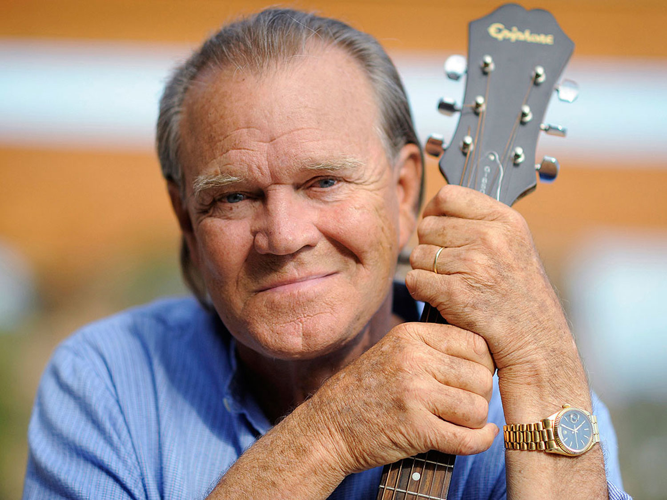
Glen Campbell remains a mysterious figure in pop music, and the mystery only deepens when you pause to consider how well you know his recordings. Every pop, country, folk, soul and rock fan can hum his famous late-’60s records, most of them written by pop genius Jimmy Webb.
Campbell’s singing on Webb’s “Galveston,” “Wichita Lineman” and “By the Time I Get to Phoenix” is exquisite, underplayed and full of mystery. Who, you may wonder, is this traveler, and where is this America he seeks so passionately? The wistfulness of these records, and of Campbell’s 1968 version of Nashville tunesmith Chris Gantry’s “Dreams of the Everyday Housewife,” was, at the time, overpowering. Like the contemporaneous recordings of Harry Nilsson, Campbell’s great hits describe a landscape that is both synecdoche and reality. The possibility that America is a rootless country — a long stretch of road that leads nowhere — transpires in these songs, just as it does in Francis Ford Coppola’s 1969 film The Rain People, one of the saddest movies of the decade.
Quite possibly, Campbell felt this wistfulness, this dislocation. But he was as optimistic as his guitar playing was luxurious, and he sang seemingly effortlessly. He was an elegant guitarist whose work on The Everly Brothers’ mid-’60s recordings — “So Lonely” and “Bowling Green” among them — would have by itself cemented his reputation. But it was his destiny to embody the folk-country-pop aesthetic of his era.
Campbell’s music represents Arkansas meeting Los Angeles in the songwriting town of Nashville, from whence one of his other canonical hits, 1967’s “Gentle on My Mind,” came via its composer, John Hartford, and music publisher Chuck Glaser. As one of Campbell’s record producers, Julian Raymond, told me in 2011, Campbell preferred to hear demos of potential songs as demos, not as records. This, Raymond told me, enabled Campbell to hear them without being distracted by production values or performance quirks that might have impeded his deep appreciation of their commercial potential.
In other words, Campbell was a pop artist of a very pure kind. There’s no Glen Campbell aesthetic other than the aesthetic of being very good at what he did. I saw him just once, in 2012 at the Ryman in Nashville during his final tour. He displayed symptoms of the Alzheimer’s that would kill him, but he played brilliantly. I could tell by looking at him that he had traveled quite a distance, but I didn’t feel wistful about it anymore. In fact, it felt good.
Jesse Boyce
Versatile musical phenomenon
By Ron Wynn
Idiomatic brilliance and consistent excellence were Jesse Boyce’s trademarks throughout a remarkable lifetime and career, but his considerable achievements aren’t necessarily the first things most people who knew him remember. Instead, they recall his inspirational and motivational skills, willingness to mentor and encourage, and insistence that nothing, whether it was industry politics or medical challenges, would stop him from completing his quests and following his dreams.
Boyce, who died in August at age 69, wasn’t a Nashville native. But he became such a vital member of the local music community that it was easy to forget he actually grew up in North Carolina and got his early musical training in South Carolina. He combined a savvy knowledge of what worked in the secular world with a strong faith fortified by a bachelor’s degree in theology and Christian education from American Baptist College, as well as extensive study in Vanderbilt University’s Master of Divinity program and at the Memphis Theological Seminary. But Boyce was also a graduate of Leadership Music Nashville, earning the equivalent of a master’s degree in recording industry and community leadership.
He was Little Richard’s bassist for decades. Just a short list of people he worked with ranges from Duke Ellington and Cannonball Adderley to Clarence Carter and Wilson Pickett, Shirley Caesar and Albertina Walker, Moses Dillard and the FAME Gang. The masterful film Muscle Shoals includes details of his tenure in the heralded FAME Studios. Boyce was co-producer for Cynthia Wilson’s gospel classic New Songs of Zion, as well as sole producer on the Ben Hill UMC Mass Choir’s celebrated Prayers From the House Prayers From the Heart and the Dove-nominated Clifton Davis LP Say Amen.
Equally impressive are credits that include writing and/or co-producing songs by Sam Moore, Ben E. King, David Ruffin, The Temptations (the song “Firefly” from the platinum LP A Song for You) and Linda Clifford (No. 1 dance hit “Let It Ride”), plus his work as lead vocalist for the group Spunk and contributions to both Dillard & Boyce and Boyce, Levine & Tufo (BLT). But Boyce focused on his community legacy in the latter part of his life, creating entities and operations whose scope extended far beyond the commercial marketplace. He founded the firm Sovereign Music Group, and provided much of the impetus that resulted in the creation of the Midtown Music Academy for at-risk children.
Boyce’s battle with the disease that ultimately took his life dated back to 2003, when he underwent surgery to treat advanced prostate cancer. His final project was The Messenger, credited to Jesse Boyce and Vision, in 2013. The poignant story of Boyce’s refusal to let health problems defeat him was spotlighted in the documentary short “Intentional Healing.” It was shown at both the Nashville Film Festival and The International Black Film Festival of Nashville. Boyce was depicted working his song “Dance Again,” backed by Phil Hughley, aka Gtar Phil, and the duo Black Violin.
As always, Jesse Boyce looked to the future, but never neglected or forgot the past.
Jo Walker-Meador
Country music pioneer
By Kay West
In 1958, Jo Walker-Meador became the first salaried employee of the Country Music Association. She had ended up in the music business not by design but by default. The Orlinda, Tenn., native went to Peabody with the intent of becoming an English teacher and basketball coach, but got sidetracked and ended up doing neither. Instead, not long after the birth of her daughter, the stay-at-home mom was lured into the newly formed trade organization by D Kilpatrick, manager of the Grand Ole Opry.
“I didn’t know anything about country music,” she said in a 2012 interview for the Nashville City Paper. “D convinced me that I would like it in the long run. I knew they were looking for a man to be executive director, and I didn’t think anything about that. Most other associations and groups were led by men. That was long before women’s liberation days, so it just wasn’t a thought that a woman would be looked at.”
Indeed, the CMA Board hired WSM’s Harry Stone as the first executive director a few months later, but when funding wasn’t sufficient to support two employees, Stone left. “There just wasn’t the money to pay both of us, and since I was making lots less, they kept me,” said Walker-Meador. “And I could type. I was a Gal Friday, someone to set up the office, do the administrative work and take care of the memberships.”
As Walker-Meador took care of business, built relationships — among them an enduring and supportive friendship with music industry powerhouse Frances Preston, also hired in 1958 to open the Nashville office of BMI — and served as “interim director,” the CMA Board continued seeking a man for the position. It took one of the scarce women on the board to see what was right under everyone’s noses. “Jo’s doing all the work,” said Grand Ole Opry star Minnie Pearl, aka Sarah Cannon. “Why don’t we hire her?”
Among the institutions created during Walker-Meador’s 29-year tenure were the Country Music Hall of Fame and Museum, the CMA Awards (the inaugural in 1967 at Municipal Auditorium, and first televised in 1968 from the Ryman) and Fan Fair in 1972 (now known as the CMA Music Fest). Under her diplomatic leadership — and skillful management of the large ego-and-testosterone-fueled board — country music went global and attracted major national and international sponsors. But everything she did was accomplished with grace, elegance, style, respect, charm and hospitality — and steely reserve. “We had to scratch and claw for everything back in those days,” Grand Ole Opry member Bill Anderson has frequently said. “But Jo could scratch and claw without anyone knowing they had been scratched and clawed.”
Walker-Meador retired in 1991, and the banquet in her honor hosted by Brenda Lee was attended by more than 1,000 people. In 1994, the CMA established the Jo Walker-Meador Award, which recognizes outstanding achievement in advocating for country music outside of the United States. In 1995, she was inducted into the Country Music Hall of Fame.
Throughout her career and busy retirement, Walker-Meador provided the mentorship to young women in the industry that was not available to her back in the nascent days of Music Row, and continued her involvement with the organization she built until her death. Sarah Trahern, named the CMA’s executive director in 2013, spoke eloquently of her predecessor’s lasting impact at a funeral attended by country music’s living legends and icons. “She was one of the first people I called when I got the job, and I called her regularly for advice. She frequently came to the office to talk with our staff about her career with the CMA. We all benefited from her generosity and wisdom.”



