

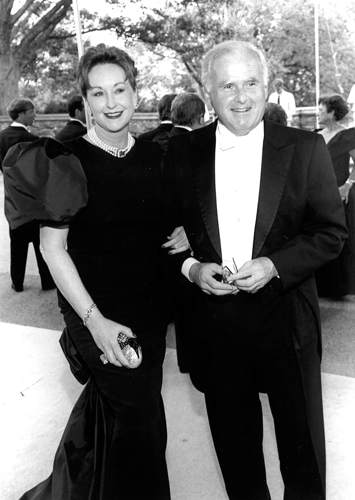

Kitty Moon Emery
Sports Authority chair
By Keel Hunt
Kitty was a connector.
Over many decades in the city, she connected people and ideas and worlds, meaning Nashville’s very different universes of the music business, traditional business and sports. Very few people can straddle all those divides, but Kitty Moon Emery did and did it well.
When I met her in the 1980s, Kitty was an enterprising executive of the video production company Scene III. She became an important entrepreneur of the burgeoning business of music videos, the stock in trade of a rising cottage industry in the infancy of MTV.
Kitty started her own connecting early as part of a neighborhood family institution, Moon Drug Store. Her parents, Clyde and Hazel Moon, were the owners of the Harding Road pharmacy, which was located near the old Belle Meade Theater. Generations of children and adults on the West Side would go to the movie and, either before or after or both, pop into Moon’s for ice cream. Kitty and her lifelong friend and “sister” Lady Bird — they weren’t really sisters — earned tips handling the holiday gift-wrapping for Moon’s.
In adulthood she was a steel magnolia. She chaired the Metro Sports Authority when Nashville’s professional sports scene began booming in the middle 1990s. It’s hard to count all the civic organizations that relied on her connections and leadership.
Pat Emery, the nice-guy developer of downtown and Cool Springs, was the big handsome love of her life. Together they may as well have been the “Connected Power Couple” sent up from Central Casting. They even met at the Chamber of Commerce board meeting one afternoon. (Kitty chaired the Tourism Committee, Pat was chair for Economic Development.)
The loss of Kitty Moon Emery this year left a hole in the way Nashville leaders meet, and how the city works together.

Howard Stringer
Philanthropist
By Ellen Lehman
Howard Stringer never missed an opportunity to brighten the day of others. He would share his “joke of the day,” or he’d call to “check in,” or he’d “drop by to visit.” And if you were really lucky, you might even rate one of his signature cocktails.
Howard imbued in us all certain helpful rules: “Never waste a crisis,” “Never bury a lead,” “Beware unintended consequences” and “Always remember, no good deed goes unpunished.”
Howard’s bravery and conviction made things happen, such as the integration of the 20 Tennessee textile plants he ran for Colonial Corporation of America. He and his wife Hope also worked to create better futures for Laotian families who settled in this community. They helped champion several efforts to get young children the tools to succeed in school and in life. They created scholarships. They worked to level playing fields, including making health care more accessible, legal aid possible and trying to make sexual assault a thing of the past.
But more than that, Howard walked his friends through the crises and consequences just as heroically as he did the opportunities and outcomes. Howard never feared the unknown, he never saw a problem. Instead, he saw challenges and chances to make a difference. He believed in the power of one person and their ability to have an impact. And he lived that truth.
Linda Costello
Financier, adviser, mentor
By Matt Wiltshire
You could trust Linda Costello.
Many companies and people did, and their trust was repaid with sage advice and genuine friendship. Over her 30-plus-year career as a senior investment banker, Linda worked for leading firms in New York and Nashville, including Dean Witter, J.C. Bradford, UBS, Avondale Partners and Iroquois Capital.
Investment banking can be a pretty wild industry. Sure, Gordon Gekko is a caricature, but even so, investment bankers probably don’t rank too highly on most people’s lists of most trustworthy professions. But Linda demonstrated that the best bankers build long, successful careers by providing wise counsel that always puts the client’s interests first. Linda stood out as an expert in providing debt capital for growing private companies, and there’s a long list of firms that were able to thrive thanks to the capital that she helped them secure.
Linda also stood out as a staunch Democrat. She was passionate about making the world around her a better, more fair place. She was a teacher. After graduating Phi Beta Kappa from Wellesley College — a place she was very proud of — she taught high school French for a time. But she remained a teacher even after she earned her MBA from Columbia Business School in New York and entered the finance world. I was one of many young, eager investment bankers whom Linda patiently taught. There were lessons in discounted cash flows and how to structure mezzanine debt. But the more important lessons — the subtly delivered ones — were about how to treat a client, how to work respectfully with a colleague, and how to hold yourself to a higher standard.
While those of us who worked with Linda benefited from her lessons, her family benefited from her love and devotion. You could tell from the twinkle in her eye and the relaxed tone of her stories that she was happiest when she was with her husband Bill at their place on Long Island. She bragged frequently about her daughter Sarah and was immensely proud of her stepsons Nick and Will and their families. She was devoted to the many West Highland terriers and Labrador retrievers she owned over her life.
Linda once relayed a colleague’s description of Mary Barra, the trailblazing CEO of GM. “She’s very methodical, very logical, very fair,” she said. “She challenges the status quo pretty well. She’s provocative. ... She’s an outstanding listener. And I guess she kind of has a consensus approach, but when it’s not coming together, she gets concise and she’s pretty decisive.”
He could have been describing Linda.
C. David Stringfield
Baptist Hospital executive
By Willy Stern
Perhaps the most bizarre aspect to covering C. David Stringfield was that all of the bizarre stories ended up being true. The since-disgraced CEO of Nashville’s Baptist Hospital really was just that odd, and just that awful.
Stringfield actually did the following:
- Drank so much carrot juice that his skin tone turned orange.
- Hired a former U.S. Secret Service agent to sweep his office suite for “bugs” planted by his supposed enemies.
- Started business meetings by having all present — no matter their faith — take a knee and pray publicly to Jesus Christ.
- Called young nurses into his office in the middle of the night looking for sexual favors.
- Spent hospital funds to tail a local journalist who was reporting on improprieties at his hospital.
- Kept on the payroll a “bag man” whose responsibilities included pressuring contractors doing work at Baptist to do jobs for free at Stringfield’s Green Hills home. Keep in mind: Stringfield paid the bag man with monies essentially stolen from the Christian-based not-for-profit health center.
- Found himself unceremoniously fired by the board at Baptist Hospital after this newspaper reported a on a host of possible criminal activities perpetuated by Stringfield and his henchmen.
Stringfield’s death was as odd as his life. At age 77, Stringfield drove his Lexus onto a railroad crossing near Fort Lauderdale, Fla., just as the northbound Amtrak train arrived. The Broward County Sheriff’s Office said the train struck the passenger-side rear fender of Stringfield’s car and spun it around into a metal pole.
Suicide? Accident? Who knows? Ultimately, does it really matter?
Stringfield’s abuse of power at Baptist Hospital probably was criminal. Since Baptist’s not-for-profit status fell under the purview of the Internal Revenue Service, any investigation of his activities would have fallen to the IRS. An agency investigator whispered in my ear in the late 1990s that the agency was dropping the criminal matter after Stringfield had been fired and had left town in disgrace. The IRS thought he could do no more harm, and this judgment proved correct.
After Baptist let him go in 1998, there was cheering in the hospital hallways. He soon moved to Florida. It’s unclear whether Stringfield had a single friend in the world. He brought his abandonment on himself, to be sure, but he always seemed more pathetic than venal in his dotage.
Stringfield returned to Nashville from time to time, since his contract gave him free health care for life at the hospital now called St. Thomas-Midtown. The docs made merciless fun of him behind his back on these visits.
Stringfield may have been the loneliest subject I reported on in more than 35 years as a newsman.



