
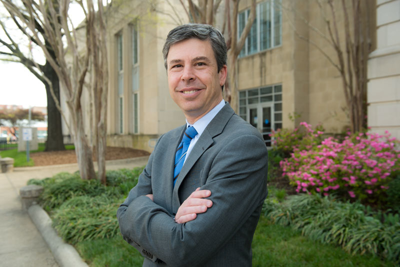

Andy Berke
Chattanooga Mayor Andy Berke is a bit of a wonk.
It’s not surprising, really, that someone who went to Stanford and then the University of Chicago Law School would have an interest in the academic details of policies. But compared to the adoring memes and fawning social media posts that Nashville’s Megan Barry or Knoxville’s Madeline Rogero inspire, Berke doesn’t get a lot of love. He’s personable — he is a politician, after all — but he’s somewhat reserved.
Still, Berke was overwhelmingly re-elected to a second four-year term in March, with 64 percent of the vote, despite rumors of an affair with a top aide. (Both Berke and aide Lacie Stone deny the affair; her estranged husband has repeatedly claimed he saw text messages implicating the pair.)
For most politicians, in most cities, that would be a mandate to do whatever one wanted. But Chattanooga is not most cities.
Here’s where I should say that I’m from Chattanooga. And I didn’t just grow up there — since college I’ve moved back three separate times for periods of one to two years. I have a lot of friends still in the city, and I try my best to keep up with local politics. Over the years I’ve realized that Chattanoogans seem to have a love-hate relationship with their mayors, no matter who is at the helm of the city. When things go wrong, there needs to be someone to blame, so why not blame the person at the top?
Chattanoogans demand perfection from their mayor in a way they never do from their dysfunctional school board members or their corrupt(ish) county commissioners. I never see people on Facebook ranting about stupid things the commission does — and trust me, they do a lot of stupid things — but I regularly see Berke being attacked. By people who voted for him. Twice. This is a problem Berke rarely faced in his five years as a popular state senator.
You have to first understand this to understand Berke as mayor, I think: In certain ways, it will never matter what he has accomplished in the past four years, or what he does in the next four years — there will always be something wrong, something Berke cannot fix, and that is what is what people will latch on to.
During Berke’s first term, that problem was gang violence. And despite a high-profile Violence Reduction Initiative launched by Berke in late 2013, 32 people were killed in Chattanooga in 2016, the most homicides since 1997 (although still far lower than the peak of 51 homicides in 1994).
Berke says now that targeting known gang members is not enough, and he’s hoping a reorganization of the police department this year will create new strategies to combat gun violence. But if that fails to help — or if the city finally gets sued over the VRI restrictions that seem to be on the border of legal curbs on civil liberties — will it really be Berke’s fault?
By the same token, is it solely due to Berke that Chattanooga’s economy is booming? Obviously not — the Electric Power Board’s fiber-optic gigabyte internet happened under Berke’s predecessor, Ron Littlefield, and only with the help of post-recession federal stimulus funds. But Berke has worked hard to sell Chattanooga as a miniature, affordable Silicon Valley, creating a so-called “Innovation District” (that spans maybe two blocks). And so Berke is willing to take credit for the boom.
“Over the last four years we have made tremendous strides economically,” Berke says. “We’ve had the third-highest wage growth, and development is reaching record highs.”
Also reaching record highs are home prices, at least in the more desirable parts of the city — which brings its own problems, as Nashvillians well know.
“Chattanooga has affordable housing, it’s just not located in places where people want to live, and it has to be of quality that people want, which is the problem,” Berke says. The city has recently revamped tax incentives for developers, stipulating that if they want the tax breaks, 50 percent of the units they build must be set aside as affordable housing.
Berke is also heavily pushing early childhood education. He’s established a city office of early learning, expanded Head Start offerings and partnered with non-profits on a program called Baby University, which teaches expectant and new mothers how to care for their children. (It should be noted the Hamilton County Health Department has offered a similar state-run program, Help Us Grow Successfully, or HUGS, for decades; my mother directed it until her retirement two years ago.) Berke says he hopes the early investment in education will pay off in the long run.
“One of the best things we can do for the school system is help kids be better prepared,” Berke says.
But Hamilton County Schools — over which Berke has no control — are troubled, and not just by last year’s tragic bus crash. The school system has been without a superintendent for a year, after Rick Smith resigned in the wake of a rape of an Ooltewah High School basketball player by his teammates. And the merger of the city and county schools in 1997 never sat well with some. Even though demographic changes have meant that many of the formerly mostly white county schools now have sizable minority populations, there’s still a sense that certain (read: poor, black) schools are bringing down other (read: rich, white) schools. Four satellite cities in the county — Signal Mountain, Red Bank, Soddy-Daisy and East Ridge — are considering the feasibility of each having its own separate school system, which would take significant money away from other schools in the city, raising the question as to whether Chattanooga can ever reach its full economic potential with miserable public schools.
Berke can’t answer this question, but he does tout his newly announced office of workforce development. The program plans to offer job services and training in community centers in neighborhoods with high unemployment; it will also target veterans and people having trouble finding work due to prior arrests. The city hopes to partner with corporations and other entities to offer technical training, and also job-hunting skills like résumé writing.
“We want a city that has a diversity of opportunity — no matter what you want to do, we want you to be able to do it here,” Berke says. “When I was growing up, the city was a dying shell. And now it’s vibrant and growing.”
It’s true, of course. Berke is nine years older than I am and better remembers the dead downtown of the 1970s and 1980s. When I graduated high school in 1995, none of the top achievers in my high school class wanted to return home after college. Now many of the best and brightest want to stay — for the hiking and the river, the restaurants and the music, the easy pace of living and the small-town feel. (You can’t go anywhere in Chattanooga without running into someone you know; it’s a proven fact.) But the brain drain in Chattanooga hasn’t fully stopped, especially among African-Americans, who are apt to see more opportunity in cities like Atlanta than in the still-segregated Chattanooga power structure.
Berke says trying to combat this is at the “forefront of our agenda.”
“We’re working really hard to build an inclusive city,” Berke says. “In my first term we have grown the number of vendors with minority owners 16-fold. But the South has a history with race, and this is something we have to work on every day.”
Whether or not Berke goes on to run for another office after mayor is regularly a matter of speculation. (He is limited to two terms as mayor.) Although business-friendly, he is a liberal Democrat, not a Karl Dean, so Berke would likely be a tough sell in rural Tennessee if he wanted to run for a Senate seat or challenge U.S. Rep. Chuck Fleischmann (or whoever is representing the state’s 3rd District in four years).
But what will really determine his political future is the love-hate ratio Chattanoogans have for him in four years. It’s a tricky see-saw to balance, but Berke so far has a handle on it.



Post a comment as anonymous
Report
Watch this discussion.
(0) comments
Welcome to the discussion.
Log In
Welcome to the discussion.
Keep it clean. Please avoid obscene, vulgar, lewd, racist or otherwise abusive language. Comments featuring hate speech or threatening or violent content will not be tolerated.
PLEASE TURN OFF YOUR CAPS LOCK.
Be truthful. Don't knowingly lie or mislead.
Be proactive. Use the “report” link on any comment that violates our comment policy.
Share with us. We'd love to hear your feedback.