
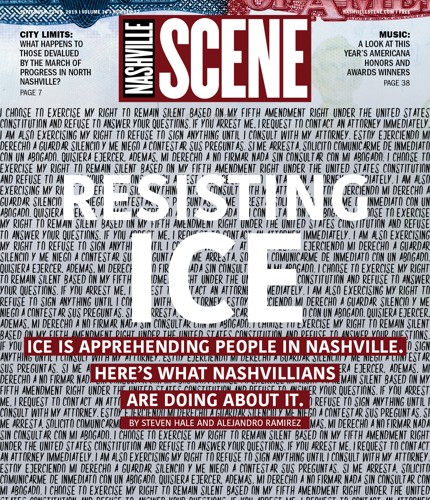

This story is part of our two-piece cover package on ICE. See our second piece here.
The plainclothes agents of Immigration and Customs Enforcement, like sharks appearing in the surf, have sent waves of fear through Nashville’s immigrant communities on more than one occasion in recent months.
Just last week, ICE agents shot an unarmed man as he attempted to drive away from the Food Lion parking lot in Antioch where they were trying to detain him. (He was released from the hospital and was not arrested.)
Since that incident, families have lived under a cloud of uncertainty.
“We were fielding dozens of calls from Antioch residents, terrified that the ICE agents were still in the neighborhood conducting immigration enforcement,” said Camila Herrera, services director at the Tennessee Immigrant and Refugee Rights Coalition, the day after the incident. “Teachers rode the school bus home with their students who lived in the area, uncertain if it was safe for them to return home. ICE is a rogue agency that is enforcing civil immigration law with shocking cruelty. ICE does not make our communities safer or stronger.”
Anxiety about the threat of deportation and family separation is not new, but it has intensified in recent years as President Donald Trump targets immigrants with harsh policy and toxic rhetoric. In Nashville, where more than 10 percent of residents are foreign-born, the effects of that distress show up in a number of ways. A coalition of advocates and organizations is redoubling its efforts to support Nashville’s immigrants, and taking steps to meet the increased threat to their health and safety.
The Tennessee Immigrant and Refugee Rights Coalition has been leading the way. In early 2017, as Trump declared his intent to increase immigration enforcement, the organization began to increase its emphasis on preparing and defending immigrant families. They’ve helped parents get legal documents in order, preparing for the worst-case scenario in which they are deported and separated from their children. The organization also arranges legal screenings to help undocumented immigrants determine whether they can apply for permanent residency, and provides resources on everything from how to report ICE activity to how to appear for a court date safely.
TIRRC has also developed partnerships with community organizations, assisting them in serving the foreign-born Nashvillians who count on them.
Neighborhood Health, a system of 13 community health centers, 11 of which are in Nashville, serves 31,000 patients — 23 percent of them are Hispanic, according to CEO Brian Haile. The organization’s goal is to provide care for any Nashvillian, regardless of their insurance status or immigration status.
“Everyone is welcome to get care at our organization,” Haile says. “There are no barriers. So most of what we communicate to people is: ‘You are welcome here.’ That’s true for Hispanic patients regardless of their citizenship status, it’s true for Somali patients, it’s true for Kurdish patients.”
But in the past two years or so, Haile says, Neighborhood Health has seen changes. Some immigrant patients have “tremendous fear” about traveling by car, he says, which has motivated Neighborhood Health to extend the hours at some of its clinics, creating appointment options at times of day when there are fewer cars on the road. But the changes in the Trump era are also evident in the clinics’ waiting rooms.
“What we’ve seen more recently is the entire family travels together,” Haile says. “There’s a real sensitivity to being separated.”
Neighborhood Health employees have also noted a large number of patients dealing with anxiety issues, forcing the staff to confront the question of how to treat the physical manifestation of political tumult.
“How do you appropriately treat something like high blood pressure in that context?” Haile says. “When you’ve got these exacerbating psychosocial issues and stressors, it definitely changes our approach to primary care.”
Haile’s a lawyer by training, and that has proved useful in this moment too. Asked about the potential of ICE agents appearing at Neighborhood Health locations, he emphasizes the clinics’ status as “sensitive locations” under agency policy.
“One of the things we’re fiercely protective of as an organization is our rights as a sensitive location and how we deal with that,” he says. “So we’ve trained all of our staff four times this year alone how to be prepared for the arrival of any law enforcement official if we did not call 911. Regardless of who it is, this is the protocol we follow. That protocol is pretty simple: We hand them a letter that says you are welcome to remain outside of our facility, but you are not welcome on the premises unless you have a search warrant that’s signed by a judge.”
Haile reiterates the organization’s devotion to its patients.
“They need to understand that we’re going to protect their information. If you don’t have a warrant signed by a judge then, I’m not going to turn over the information. And even if you do, it’s a subpoena, we might file a motion to quash. We will robustly protect that information, because the currency we have with patients is trust.”
Every day, thousands of parents trust Metro Nashville Public Schools with their children. There, too, the impact of an immigration crackdown is evident.
MNPS has nearly 15,000 English learners from more than 130 countries. The district does not track students’ immigration status, and that information is not part of the enrollment process. But it has been taking steps to make sure that immigrant families can access resources like those provided by TIRRC. On the third Saturday of every month, the Office of English Learners hosts legal-counsel sessions where families can get assistance on all noncriminal issues for free.
Molly Stovall Hegwood is the executive director of English Learners for MNPS. At the individual-school level, she says, school leaders are also trying to train and prepare teachers and staff. There’s been an increased effort to be sensitive to the psychological and emotional impact that a constant flow of news about family separation and relentless anxiety about ICE operations can have on young kids.
“Despite a student’s immigration status, or whether you were born here or you’re even a native speaker, what’s happening is traumatic to all students,” Hegwood says. “If you connect to what’s happening in any way, that is going to be hard for you as a student.”
With fear and uncertainty swirling around immigrant families, situations that are already difficult to cope with become only more so.
“One of the cornerstones of healing is safety,” says Alicia Bunch Vargas, a clinical therapist at Nashville’s Sexual Assault Center. “Everyone needs to feel safe in order to heal from trauma. Right now there is so much going on in the news, there’s so much going on with just the rhetoric, that people feel afraid. Kids, adults, both. That can really affect the healing process if there isn’t that sense of safety, that they’re safe at home.”
Vargas has seen the way the threat of deportation further complicates the challenge of responding to crime and, in particular, sexual assault.
“I think one of the things that we’ve observed is whenever people come in for their first appointment, they’ll ask questions about making a report about sexual assault,” she says. “Just a hesitancy to report sexual assault because of fear of potentially being deported.”
If the person in question is a child, the Sexual Assault Center is legally mandated to report the assault. But, Vargas says, in the case of an adult, the center tells clients, “It’s your right to report sexual assault here in Nashville,” but “we’re not really sure what could potentially happen after that.”
The center has victim advocates who will accompany a person to court or interact with law enforcement on their behalf.
As for what could be done to bring relief to the predicament Vargas sees clients navigating, she says she thinks Mayor David Briley’s recent move to challenge the state’s anti-sanctuary-city law is a good one.
“I think that if we can just draw those clear lines about what local law enforcement’s role is, and continue to give the community information about what their rights are in terms of reporting crime and reporting sexual assault, I think we’ll have safer communities,” she says.
TIRRC is also hoping to solidify the distinction between Metro Nashville authorities and ICE in the upcoming Metro Council term, hoping to hold new members to their support of the group’s “Beyond Welcoming” policy agenda.
For TIRRC and the community organizations that serve Nashville’s immigrant community, the goal is straightforward: not just welcoming strangers, but protecting neighbors.




