
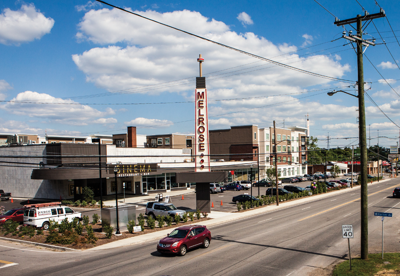

It's a simple thing, really. A 63-foot sign sits on Franklin Pike, beckoning people into The Melrose complex of apartments and retail.
It would have been a lot easier to skip the sign altogether, or to put up one similar to the dozens of dull, two-sided signs across that stretch of Berry Hill. But the developers instead reached back into the history of the area. And in the process, they capped off an example of how development ought to work in Nashville.
As this week's cover story indicates, Nashville is in the middle of a large, sometimes raucous conversation about how it will manage growth and preserve its past. Music Row has been at the center of it, with the fight over preserving RCA Studio A and the outrage generated by the quick demolition of properties for an upcoming Virgin hotel generating headlines for months.
But just a couple of miles south, on Franklin Pike, is an example of development done right.
In the middle of a recession, Mary Fulcher at Fulcher Investment Properties noticed something interesting — there was a waiting list at Gale Lofts just across Franklin Pike. The Melrose property, meanwhile, had been through a couple of hands, with one abortive attempt at development knocking down the Melrose Lanes bowling alley. The property was almost demolished entirely to make way for a grocery store. Fulcher and her father, Ed, approached Joe Parkes to partner with them.
The need for rental housing in the area was apparent. But how to do it? The convenient play would have been to take out the old Melrose Theater. That would let them maximize the property, putting in as many as 300 apartments.
But the group had a different plan.
"We could have torn this building down and built something bigger with more units," Parkes says. "And oddly enough, we never really considered it. And I think part of it is that Ed [Fulcher] and I being a little bit older and being from this community and knowing the significance of this place, that a lot of people had been to the movie theater and been to the bowling alley here. We just like the character of the building. We just thought it was best for Nashville. We might have been able to make a little more money going a different direction, but it's still important to keep some of these kind of places."
The old Loews Melrose theater lobby was turned into Sinema, one of the best new restaurants in town — a gorgeous, Art Deco-inspired reinvention of the space. The main theater, complete with huge bow trusses and a soaring ceiling, became the common area for the 220 apartments on the property.
The beloved old Sutler watering hole was then resurrected, adding live music and a bar. Bob Bernstein of the Bongo Java empire brought in Fenwick's 300, a modern-style diner with breakfast, lunch and dinner service as well as a coffee bar. One national retailer — a hair salon — was added. But the Art Deco Melrose Billiards, a dive-bar staple of the neighborhood for decades, stayed.
Over lunch at Fenwick's, Mary Fulcher says it would have been easy to turn the development into a cookie-cutter strip of ubiquitous brands. Instead, they went local.
"We said no to a lot of national tenants," Fulcher says. "We just didn't want that for this location. We wanted the residents that live here to associate themselves with these places so they could say, 'Hey, I live at The Melrose, you know ... where The Sutler is.'"
Austin Ray, owner of the already successful M.L. Rose pub across the street, was brought in to partner on the restaurant side of things. The results have been pitch perfect: Hiring chef Dale Levitski gave Sinema an instant national profile; resurrecting The Sutler communicated that this was a uniquely Nashville development; bringing in Bernstein ensured the kind of change-up place that the development (and area) needed.
The next step? Fulcher says Berry Hill has received a $150,000 grant to study walkability in the corridor, thanks to the influx of new residents at The Melrose and other new apartment developments on Franklin Pike. The satellite city's population, slightly more than 500 in 2010, will triple or quadruple by the next census.
Think of where that stretch of Franklin Pike was 20 years ago. A neighborhood? It was a speed trap with some fast food and used-car dealerships. Walkability? To what?
Now it's becoming a destination — and The Melrose is at the heart of it all.
"If you take the imaginary other path of 300-plus apartments ... if this gets razed," Ray says, "there's probably a couple of months of people lamenting it, but then it's just gone forever. No one's gonna build this back. Clearly, it took a lot more work, creativity, collaboration and effort to do it this way. But at the end of the day, it's worth it."
That obelisk-looking piece of neon on Franklin Pike does more than just mark a combination of apartments and retail. It's a sign that we don't have to tear everything down to develop something right.



