
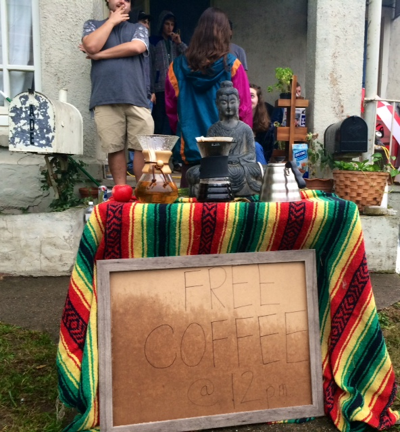


In a front lawn on Belmont Boulevard, there’s a small card table draped in a Rasta-colored blanket with a pour-over coffee station, a Buddha statue on top and a large sign propped up drawing passersby in with two beautiful words: free coffee.
Fiery-haired Logan Hunt, a 21-year-old Belmont senior, lives at that house. He has for the past two years. He set up the pour-over coffee station to collect donations for his homeless friends, including Gary “Pops” Ewing, who, full disclosure, is a vendor for The Contributor, where this reporter used to be the assistant editor.
In less than a week, Hunt and his friends have raised more than $100 to help “Pops,” a thin black man with deep dimples and a wide smile, find housing in the Belmont area. Hunt and his friends hope to achieve that goal by November, as well as organize a potluck dinner and coat giveaway for people experiencing homelessness.
The plan to help “Pops” and others started with friendships with people who are homeless, Hunt said, but was solidified recently by a verbal altercation with Hunt’s neighbor: Bongo Java’s owner Bob Bernstein.
Hunt’s yard is right between Circle K gas station and the Bongo Java on Belmont Boulevard.
Hunt says Bernstein called him to the edge of his yard a couple weeks ago accusing the well-spoken Belmont student of allowing homeless people to hang out at his house and on his porch. Bernstein, whose business has been at that location for 22 years, was unhappy with Hunt’s frequent guests.
“What I said was I didn’t appreciate him allowing people – or that I don’t think it’s a good idea for him to let people sit and drink on the porch all day and pee on the side of his building,” Bernstein told Pith. “I thought that didn’t really fit the neighborhood. Homelessness is a big issue the city is facing. But peeing on the side of the building when there are people next door – when it just happens to be next to my business – isn’t good for my customers.”
But Hunt said Bernstein took a not-in-my-neighborhood tone that defines the essence of gentrification.
“Instead of responding to this incident with anger or hostility, I am instead choosing to take on Bongo Java in the form of an entrepreneurial venture that embraces and welcomes the homeless community of Nashville by giving away free (pour-over) coffee in return for a donation that goes directly to those in our community,” Hunt wrote on his Facebook page the day of the confrontation.
Hunt agreed that he often has guests on his front porch – but said just a few of the many who pass through are homeless. More often than not the people hanging out on his porch are Belmont students playing music or reading poetry, he said. He added he couldn’t be sure who, or if, someone peed on the side of the house.
“There are three homeless people that I know who live in this neighborhood – they were here last winter and the winter before that and they haven’t left – and they hang out at my house almost every day,” Hunt said. “And there are never people here that I don’t know.”
After he’s done serving coffee in his front yard, though, Hunt said he plans to continue his endeavor to help people on the fringe.
And in Nashville – where old and new will continue to collide as the city’s growth explodes – there are plenty on the fringe to worry about. While 24.7 percent of Nashville residents have a household income exceeding $100,000, nearly 24 percent have household incomes below $25,000, according to Metro Social Services. More than 2,200 people like “Pops” live on the streets, according to the city’s last count. One person can’t suffer the load of fixing the city’s poverty and homelessness issues, but Hunt says he is doing one thing that matters:
“The only thing I’m trying to do is treat these people like human beings,” Hunt said.



