


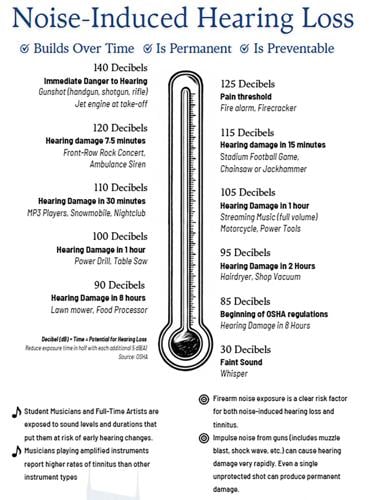


Tinnitus is a condition defined by hearing sounds that aren’t externally present — noises that often sound like buzzing, ringing, crickets or cicadas. The sounds can vary in pitch and volume over time.
Nashville’s many musicians may experience it more than the general population due to their exposure to loud music, a cause and exacerbating factor for tinnitus.
“They’re going to be more susceptible to tinnitus,” says Claire Thomas, doctor of audiology at Ears4U Hearing Services, which has an office in Brentwood and another in music recording haven Berry Hill. “I see not only musicians, but people in sound, engineering, the producers, the lighting people.”
Workers in the music industry may often notice the condition more than the general population — they depend heavily on their ears every day for work.
“I haven’t seen a change in tinnitus rates over time here, but it’s certainly one of those things, especially with all the audio engineers — where they’re very in tune with hearing — and musicians,” says Marc Bennett, quality director of the Department of Otolaryngology at Vanderbilt University Medical Center. “I think they’re more likely to raise those complaints, given their profession.”

Dr. Claire Thomas
Whether patients pronounce tinnitus the more clinically common way (TI-nuh-tuhs) or the more colloquial way (ti-NYE-tuhs), Thomas won’t correct them. They’re all talking about the same thing, she says. Tinnitus also affects more people than one might think, she points out. More than 1 in 10 people experience it.
The ringing, even if temporary, is usually a sign that something in the ears has changed, Thomas explains. However, while tinnitus often accompanies hearing loss, it is not always the chief cause.
The ear’s cochlea can register really high pitches — up to 20,000 hertz — but audiologists measure hearing loss up to 8,000 hertz, the ceiling for the range humans typically use. Tinnitus can be caused by damage that occurs above those levels, like the register required to hear a dog whistle. The brain still picks up on that register, and when the ear and brain are at odds, tinnitus develops.
Bennett says the cause of tinnitus is as often idiopathic as it is related to hearing loss — meaning they often don’t know its cause. That means most patients will have normal-looking ears, visually and in scans.
“I think that’s frustrating to patients to have an exam that’s normal, imaging that’s normal, and have something that’s still bothering you,” Bennett says. “The question is always, ‘Well, what’s causing it?’ We say, ‘We don’t know what’s causing it, here’s our treatments for it.’”
For some, tinnitus is mild enough that they don’t seek treatment. For the rest, it’s trial and error. At its worst, it can affect sleep, concentration and ability to hear people.
“The brain thinks it’s a threat and keeps checking for that threat,” and it depends on how you react to threats overall, Thomas explains.

Click to expand
“My main takeaway that I help my patients understand is that tinnitus is a symptom of hearing changes, but it’s driven by stress,” Thomas says. “Stress in the brain, stress in the body. It’s typically the emotional response that is driving how long your tinnitus is hanging on, or what else you have going on in your life.”
While there are no surgical or pharmaceutical treatments for tinnitus, some things can ease it. Background noise, caffeine reduction, stress reduction and regular sleep don’t necessarily make it better, but they strengthen a person’s ability to cope. In addition, well-tuned hearing aids will help those who have the condition coupled with hearing loss. Maskers — noise produced in the room or fed through hearing aids — can help, as can neuromonics, which mimic tinnitus in an effort to reduce the sound over time.
The latest breakthrough is called Lenire, the only treatment approved by the FDA to treat tinnitus. The device stimulates two sensory pathways to retrain the brain and reduce the effects of tinnitus, coupling sound therapy in headphones and mild electrical pulses to the tongue — a method called bimodal neuromodulation. Thomas has seen patients report lower rates of anger, desperation, frustration and depression after using the device for one hour per day for 12 weeks.
Habituation is one goal — meaning, as Thomas puts it, “I hear it, it doesn’t bother me.” She helps patients go from feeling like they’re hearing a constant police siren to simply living near an airport — habituation means they stop hearing the planes over time.
“The best way to prevent tinnitus is to protect your hearing,” Thomas says. “Then I would say the best way to prevent bothersome tinnitus is to learn about it. Educate yourself on what tinnitus is, so you have all of the tools to understand it and to change your perception of it.”



Post a comment as anonymous
Report
Watch this discussion.
(0) comments
Welcome to the discussion.
Log In
Welcome to the discussion.
Keep it clean. Please avoid obscene, vulgar, lewd, racist or otherwise abusive language. Comments featuring hate speech or threatening or violent content will not be tolerated.
PLEASE TURN OFF YOUR CAPS LOCK.
Be truthful. Don't knowingly lie or mislead.
Be proactive. Use the “report” link on any comment that violates our comment policy.
Share with us. We'd love to hear your feedback.