
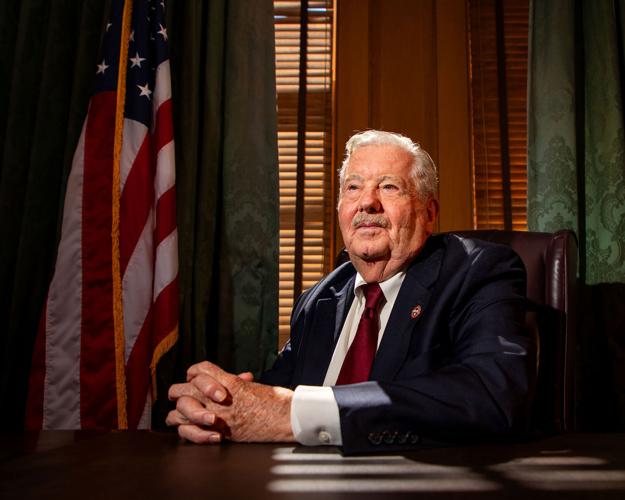

Standing in the empty Senate chambers of the Tennessee State Capitol on a sunny spring day in April, Lt. Gov. Randy McNally greets a visiting family from Louisiana.
“Who are you?” they ask McNally, who’s standing at the Senate podium.
The 82-year-old Republican senator smiles and proceeds to tell them who he is. McNally has come to work in this ornate room for decades. But after 48 years in the gauntlet of Tennessee politics, the speaker of the Tennessee Senate will soon retire from one of the top leadership roles in the state.

After nearly 50 years in office, 82-year-old East Tennessee Republican says physical health pushed him to retire
“It was a gradual decision I made,” he tells the Scene. “I had surgery on my ankle [a year ago], and I was out for a month in January. After that, my wife and I discussed it, and we both realized that we are getting older, and our runways are short. It’s time to get back home and spend more time with family.”
A pharmacist by trade, McNally says he loves history and civics, but didn’t originally plan to be a politician. It wasn’t until a conversation with former Gov. Winfield Dunn, who led the state in the early 1970s, that McNally developed an interest in being in the room where it happens — which is roughly 160 miles from his home in Oak Ridge.
For the past 15 years, Republicans have held a supermajority in the Tennessee General Assembly. But McNally began his tenure in the 1970s and ’80s — first in the House, and later in the Senate — when Tennessee Democrats were the ones holding that level of power.
Something McNally didn’t anticipate when he entered politics: wearing a wire for the FBI, which he did in the mid-1980s as part of Operation Rocky Top. The FBI was keeping a close watch on Tennessee politics following a clemency-for-cash scandal that took place under Democratic Gov. Ray Blanton in the late 1970s. Illegal bingo games in East Tennessee morphed into a gambling scheme, and lobbyists were attempting to bribe McNally. He began wearing a wire in 1986, recording those conversations and taking the bribe money straight to investigators. In 1989, news broke that the FBI was implicating more than 50 people in the criminal enterprise, including state Rep. Ted Ray Miller of Knoxville and Secretary of State Gentry Crowell. Both men died by suicide soon afterward.
“I developed a real support of the FBI, the TBI and attorney general at that time for the state,” McNally says. “I also found out that there were good and honest legislators, and we had some who were the bad apples in the bushel.”
McNally has had successes and failures during his time in the legislature. He notes DUI legislation, tort reform and a bill allowing “good-faith exceptions” to the state’s exclusionary rule among his wins. McNally also recalls losing budgeting battles, and decisions that led to a loss of the state’s AAA bond rating.
“Most of the important issues over time, I eventually won,” McNally says.
But during McNally’s time as lieutenant governor, he has overseen a Senate that has passed controversial legislation, some of it targeting marginalized groups — including bills that have targeted transgender rights. Republicans wrote a bill in 2023 to ban gender-affirming care including puberty blockers and hormone treatments for minors. The Supreme Court of the United States ultimately upheld the law in 2025.

The right-wing-backed 2023 legislation prevails, opening the door for other states
The Senate also stalled on passing significant legislation during a special session of the General Assembly called in the wake of 2023’s Covenant School shooting. Gov. Bill Lee set forth 18 topics for the session, but the Senate passed only three bills: one increasing funding to provide firearms locks to Tennessee residents upon request, one tightening the timeline for court clerks to provide certain criminal-case information to the Tennessee Bureau of Investigation, and one requiring the TBI to report on human trafficking. Covenant families argued at the time that none of the legislation truly hit at the heart of why lawmakers were brought together for that August session.
In 2025, lawmakers targeted DEI initiatives at public institutions. Also that year, Republican leadership voted to enact vouchers with Gov. Bill Lee’s Education Freedom Scholarships — sweeping legislation that allows public tax dollars to pay for private school educations. Republicans and Democrats are still quarreling this session over expanding the program.
Despite a career spent rising through the ranks, McNally says he didn’t initially imagine himself in a higher role — but he’s nevertheless served as the lieutenant governor since 2017.
“At one time, I thought I might run for governor,” he says. “I gave that idea up rather quickly. Being a governor, it has much greater management responsibility than the speaker of the Senate. Though Speaker [Cameron] Sexton and I have a lot of responsibility, it’s nothing compared to that.
“I thought that in the House, wanting more was being on the House Finance, Ways and Means Committee,” he continues. “Then it was the Senate, and when an opportunity rose, it was the Senate Finance, Ways and Means Committee. Then it was being the chairman of the committee. I thought that was the pinnacle, but your expectations change sometimes.”
In the past decade, McNally has faced personal strife. His health concerns started in 2023 with heart issues, and that same year he received criticism from Republicans and Democrats alike — and ridicule on Saturday Night Live — for leaving comments on a young gay man’s revealing Instagram posts. He ultimately survived a no-confidence vote from his colleagues following the scandal.

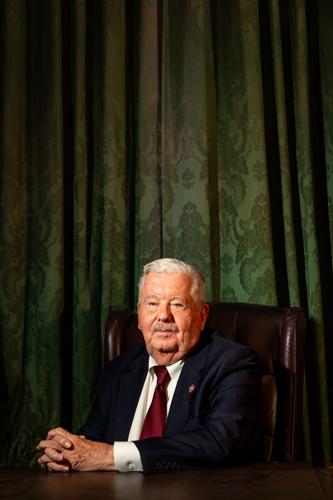
Lt. Gov. Randy McNally in his office, April 2026
Reflecting on his nearly five-decade tenure, McNally says he considers himself a centrist Republican. In a time when politics is often a game of extremes, he says he thinks people like himself can still exist inside the Tennessee General Assembly.
“It’s just a feeling that I have,” he says. “I think things tend to try to balance themselves out, and even though there are swings sometimes — just like things like the economy — it rebalances.”
McNally won’t say who he’d like to see take his place as leader of the Senate. He says all three men who have expressed interest in the position — Sens. Paul Bailey (R-Sparta), Ferrell Haile (R-Gallatin) and Jack Johnson (R-Franklin) — could do the job. But he does list the qualities he believes his replacement must have, and notes that he has maintained strong relationships with former Speaker of the House Beth Harwell and former Govs. Phil Bredesen — a Democrat — and Bill Haslam.
“I think one of the most important things is the ability to listen to others and respect people with their point of view that might be different from yours,” McNally says. “Government can’t do everything and shouldn’t try to do everything. There still has to be a lot of individual freedom. At the same time, you need strong leaders who are fiscally responsible. Who the public can trust and lead the public in the proper way.”
Correction: A previous version of this article listed Sen. Bo Watson (R-Hixson) among those interested in succeeding McNally as the state's lieutenant governor. This is incorrect. We apologize for the error.



Post a comment as anonymous
Report
Watch this discussion.
(0) comments
Welcome to the discussion.
Log In
Welcome to the discussion.
Keep it clean. Please avoid obscene, vulgar, lewd, racist or otherwise abusive language. Comments featuring hate speech or threatening or violent content will not be tolerated.
PLEASE TURN OFF YOUR CAPS LOCK.
Be truthful. Don't knowingly lie or mislead.
Be proactive. Use the “report” link on any comment that violates our comment policy.
Share with us. We'd love to hear your feedback.