

Ralph and Rosie Graham were ecstatic to hear that the United States is planning to return to the moon for the first time in more than 50 years through NASA’s Artemis program. That’s because the two Middle Tennesseans were among those who helped put people on the moon the first time.
Ralph, as an engineer for NASA, and Rosie, as a computer programmer for IBM, were among the thousands of experts who worked on the Apollo missions in the 1960s.
On July 20, 1969, Rosie was fresh out of college with a master’s degree in mathematics and education when she was recruited to be one of 30 women to work for IBM (alongside 600 men). Junior programmers drew times when they could watch the action from mission control during the Apollo 11 mission. Rosie, just six months into her tenure, happened to draw the hour during which Neil Armstrong stepped onto the moon’s surface and uttered his famous “one small step” line.
The Grahams see putting a man on the moon as one of the country’s greatest accomplishments — a reflection that’s especially fitting as the nation celebrates its 250th anniversary. The moon missions also get the credit for how the pair met. “The moon brought us together,” says Ralph.
When Rosie first started in the field, computers were capable of holding just a single megabyte of data and were big enough to fill an entire room. (Modern iPhones can hold tens of thousands of megabytes.) A computer programming degree didn’t even exist at the time, and coding was done on paper.

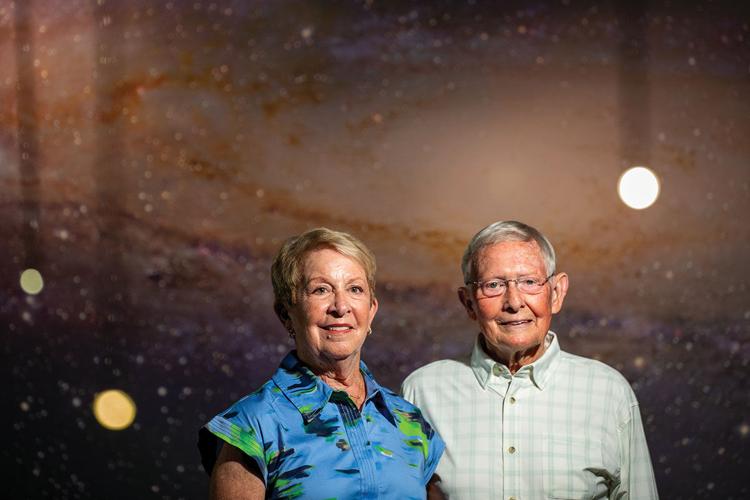
Ralph and Rosie Graham, photographed at the Adventure Science Center
“I always used to tell my son, my students, if the car industry had moved as fast as the computer industry had, today six cars would fit on the head of a pin and they’d get a million miles to the gallon,” says Rosie, who pivoted to a career as a teacher in 1975. She has since taught at several colleges including Motlow State Community College in Tullahoma.
Ralph was appointed to the Space Task Group in 1961. There he helped design the Apollo launch escape system and led wind-tunnel studies to ensure the spacecraft could safely reenter the Earth’s atmosphere. Later the pair moved to Tullahoma and worked at aerospace testing facility Arnold Engineering Development Complex.
Ralph notes that NASA’s moon-landing missions brought various disciplines of science and math together for new advancements — and that’s one side effect of the plan to take people to Mars by way of the moon through Artemis in the coming years. Apollo and Artemis are twins in Greek mythology, after all.
“Nobody can predict the future, but with a focus on going to Mars and back safely, you’ll end up learning something — advancing technology, advancing human disciplines, learning more about how teams work together,” Ralph says. “Look at your smart watches and phones and PCs and all the things that you’re benefiting from that had [their] birth in the space program. You’re fortunate to live in these times, and now it’s in AI times, where it could be frightening — but it’s also an exciting time too.”
The pair is hopeful to travel to see the Artemis III launch in 2027; Artemis IV in 2028 is planned for a lunar landing. They also hope another moon landing will bring the country — and the world — together, as they experienced in 1969. We all share the same moon, Ralph points out.
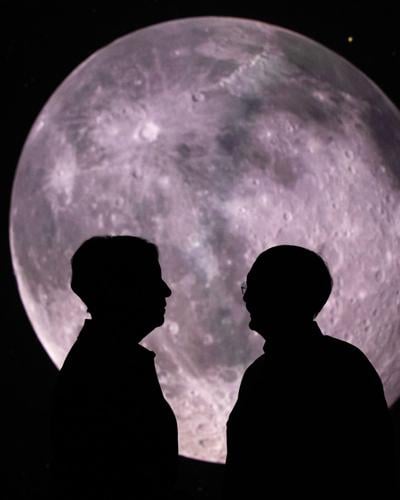
“It’s that blue marble in the sky there,” Ralph says of the view of Earth from the moon. “You don’t see the continents, you don’t see the walls, and you don’t see people of different nationalities. You see we’re together in this thing.”

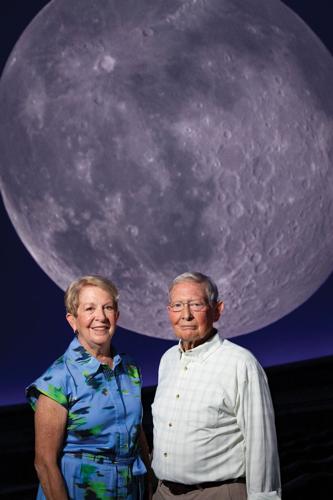
Ralph and Rosie Graham, photographed at the Adventure Science Center
The Artemis missions also mark the first occasions of women traveling to the moon. Artemis II astronaut Christina Koch became the first woman to orbit the moon in April, and while next year’s Artemis III crew is set to be all-male, women may be included in future Artemis missions. Rosie followed closely behind the Black female mathematicians and engineers who worked for NASA in the 1950s and ’60s (whose exploits were featured in the 2016 film Hidden Figures). She says she was grateful for the opportunity, even temporarily, to step outside of women’s typical roles in the workforce at the time — teacher, nurse and administrative assistant.
“It is a thrill to watch other young people learn and go off and do bigger and better things than I ever did,” she says.
As they were with the Apollo missions, Ralph and Rosie are comfortable being a small part of a larger cause.
“It’s a humbling thing to think how Rosie, me — how we could make a contribution, but all of these contributions together made it happen,” Ralph says. “That’s a humbling thing, and also I’m grateful I was part of it, because I was part of something that really was important.”
“Everybody needs to know that you don’t always have to be up here being the big shots,” Rosie adds. “You can be a part of something that makes the whole great.”



Post a comment as anonymous
Report
Watch this discussion.
(0) comments
Welcome to the discussion.
Log In
Welcome to the discussion.
Keep it clean. Please avoid obscene, vulgar, lewd, racist or otherwise abusive language. Comments featuring hate speech or threatening or violent content will not be tolerated.
PLEASE TURN OFF YOUR CAPS LOCK.
Be truthful. Don't knowingly lie or mislead.
Be proactive. Use the “report” link on any comment that violates our comment policy.
Share with us. We'd love to hear your feedback.