

Promise Land
In Dickson County, a 150-year-old African American settlement still stands. The unincorporated community of Promise Land, Tenn., is a piece of living history, carrying on a powerful story of freedom through the descendants of its founders, its educational programs and its ongoing volunteer efforts.
And recently, it has also become the site of collaboration between Nashville activists and Dickson County natives.
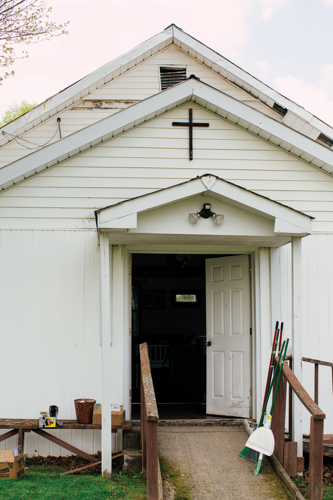
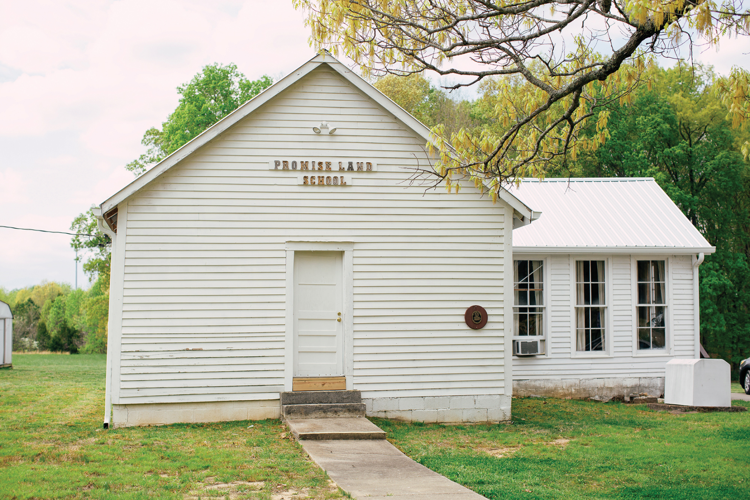
Promise Land was settled shortly after the Civil War by a group of freedmen, including at least six United States Colored Troops veterans, and it quickly became a self-sustaining community. In the early 1880s, brothers Arch and John Nesbitt used their war pensions to build a school and church. In the following decades, Promise Land thrived despite segregation and Jim Crow laws, and is reported to have included 1,000 acres, 50 homes, several stores, three churches and an elementary school. There was also the community’s renowned musical group, the Promise Land Singers. While most of the original land now belongs to new families, Promise Land’s original church and school remain intact.
Serina Gilbert, executive director of the Promise Land Heritage Association, is a direct descendant of Promise Land founders through both of her parents — her mother was Essie Vanleer Gilbert, a celebrated local figure who died in 2017 at 101 years old.
“Growing up we had separate schools, and we would not be able to go to the stores downtown,” says Gilbert of living through segregation. “But at the same time, we were also buffered from racism. We had our own restaurants that we went to. ... We had our own teenage hangouts. And you didn’t feel a loss with that.”
The Great Migration, integrated schools and new industries pulled Black residents away from Promise Land in the 20th century. Still, some community elders — many of them descendants of original residents — maintained the site. Other Promise Land descendants moved to different states and even countries, and the community began holding annual reunions.
Gilbert attended Tennessee State University, then moved to New York City for a few years before returning to an integrated Dickson County. In Charlotte, Tenn., she began her historical research, befriending a local archivist who made her feel at home again.
“I never felt like a stranger,” Gilbert says. “I never felt any discomfort, and was not mistreated in any way. In fact, I felt embraced.”

April 17 cleanup in Promise Land
Over the years, Promise Land became more difficult to maintain. The school needed repairs, and the church had a wasp infestation. But amid the challenges, the Promise Land Heritage Association began a series of educational projects and preservation efforts. The site gained national recognition: It now has its own Civil War Trails marker and a sign from the Tennessee Historical Commission; the school and church are also on the National Register of Historic Places.
Over the past 20 years, Gilbert says she has witnessed newfound interest in Promise Land’s history, and not from “just those who had just a blood connection.”
“We were attracting a diverse group of people that were interested in saving this place,” she says.
The interest couldn’t come soon enough. The Heritage Association is currently trying to raise at least $75,000 for necessary renovations, and the group needs volunteers to help clean and maintain the property. Luckily, Promise Land recently gained the attention of members of People’s Plaza, the Nashville advocacy group formed during last year’s protests at Legislative Plaza. In March, a small group of Nashville-based activists visited Gilbert and explored the site. Aaron Worley, one of these activists, felt “instantly captivated” by Gilbert’s stories of growing up in the area.
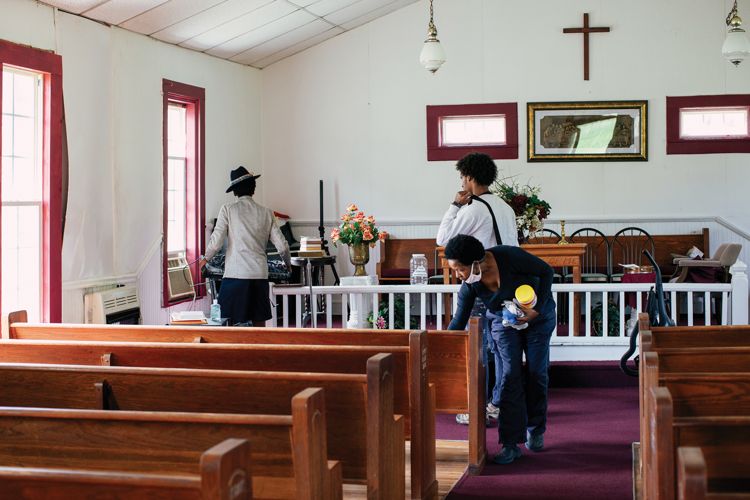
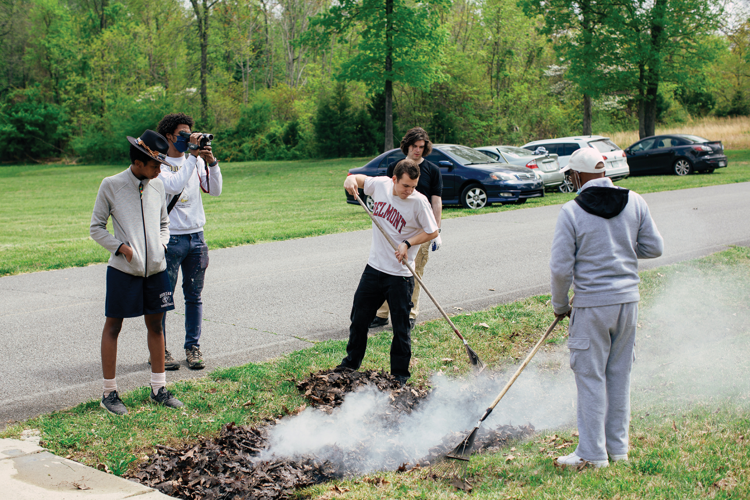
When the Promise Land Heritage Association organized a Big Spring Clean for April 17, Worley and others spread the word. Volunteers from Nashville gathered amid community elders — raking leaves, painting steps, cleaning windows and removing wasps from the sanctuary.
“We came out here to learn about it, and then when we learned that there was gonna be this event, everybody was excited,” said volunteer Ruth Reeves during the event. “We’re excited to know that it even existed.”

April 17 cleanup in Promise Land
On the afternoon of the 17th, Gilbert took a moment away from the busy scene outside. The Promise Land School was quiet and organized, and it felt like a time capsule. The original sign still hangs on one wall, opposite the original “chalkboard” — wooden slats with a coat of black paint. Students attended Promise Land School from 1880 to 1957; in later years, teachers were sometimes bused from Nashville, and they lodged with local families. Gilbert herself attended until the fifth grade.
Looking around the room, Gilbert considered the future of Promise Land. “My hope is that it will continue to be preserved,” she says. “That there will be more people standing up and wanting to take part, and to keep the history alive and work toward preserving it.”
While some historians call Promise Land’s founders “freed slaves,” Gilbert points out that the term is not accurate.
“I always correct people when they say ‘freed slaves,’ because it’s an oxymoron,” she says. “You can’t be free and enslaved. They became free people. And I always want to put people first.”
This shift in terminology points to Promise Land’s power — it was, and is, a space built by and dedicated to true self-determination.
“They didn’t start out being slaves,” she explains. “That’s not a name that they called themselves. They were people. They were husbands, wives, mothers and fathers. So when they were freed, they were still people. The one thing that they had shaken was that connotation of being enslaved.”
To learn more about Promise Land and donate to its preservation effort, visit promiselandtn.com/support.




