
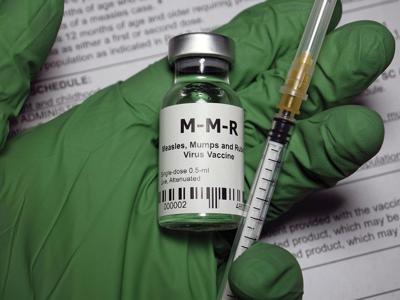

For the past five years, fewer and fewer kindergarteners have begun the school year fully vaccinated in Tennessee, according to the latest kindergarten immunization report from the Tennessee Department of Health. While vaccination rates have seemingly leveled out, they still lie below the public health goal of 95 percent immunization.
During the 2025-26 school year, just 17 percent of counties reached at least 95 percent immunization. That number has steadily declined from 76 percent in 2019, but is slightly higher than the 15 percent rate for the 2024-25 school year, according to the Department of Health report.
Overall, 92.5 percent of kindergarteners in Tennessee were fully immunized with all six required vaccines heading into the 2025-26 school year, which was on par with the 2024-25 vaccination rate of 92.3 percent.
“Kindergarten-aged children are more susceptible to infections due to a variety of factors, including their still-developing immune systems, frequent hand-to-face contact, and close physical interactions commonly found in classroom settings,” the report reads. “Vaccination builds lasting immunity, provides protection against infectious disease morbidity and mortality, and helps prevent outbreaks in schools and the broader community.”

The Vanderbilt immunologist is seeking funding for 100 antibody treatments
In Davidson County public and charter schools, 92.9 percent of students were fully immunized starting the 2025-26 school year, representing a slight increase from the previous year’s rate of 92.2 percent. However, 3.7 percent of students presented a religious exemption from vaccination, representing an increase from 3.3 percent the year prior.
In nearby Williamson County, just 87.7 percent of students were fully immunized, with 11.1 percent of students presenting religious exemptions, for the 2025-26 school year. This represents a substantial drop from the year prior, with 90.5 students fully vaccinated in Williamson County in the 2024-25 school year, and 8.4 percent utilizing a religious exemption.
More families are getting exemptions for their children — whether religious or medical exemptions — than ever before. The 2025-26 school year had the all-time-highest percentage of documented exemptions statewide at 7.5 percent — higher than the previous year’s rate of 6.6 percent. This was largely driven by an increase in religious exemptions, including a jump from 3.5 to 4.6 percent year over year.
In order to receive a religious exemption, the parents or guardians of a child must submit a signed statement expressing that the vaccination conflicts with the tenets of their religion. A medical exemption requires a note from a physician or public health nurse listing risk of harm for specific vaccines. The child is required to get any remaining vaccines that they are not at risk of harm for.
Dr. Joseph Gigante, professor of pediatrics at Monroe Carell Jr. Children’s Hospital at Vanderbilt, says some medical professionals are willing to sign an exemption for students who aren’t necessarily at risk of harm. But, he says, you won’t find any of them at Vanderbilt.
Gigante tells the Scene he’s concerned about a measles outbreak in the Nashville area. In fact, Monroe Carell Jr. Children’s Hospital at Vanderbilt confirmed they treated a child with measles last week. There have been at least nine cases of measles statewide this year, according to the Tennessee Department of Health, with five of those cases confirmed unvaccinated.
“I think, unfortunately, this is predictable,” Gigante says. “As more and more parents opt to not vaccinate their kids against measles with the MMR vaccine, we’re going to see more and more of these outbreaks.”
Measles may get the most press, but it’s not the only concern. Gigante is starting to see children in his clinic with meningitis, haemophilus influenzae and pneumococcus, which are all preventable by vaccine.
Kindergarten immunization requirements have not changed in recent history, but the government’s stance on them has. After the Centers for Disease Control and Prevention cut childhood vaccination recommendations down to 11 vaccines from 18 earlier this year, Gigante and his colleagues continued following the American Academy of Pediatrics vaccine recommendations, which remained at 18 childhood vaccinations.
The only addition to the childhood vaccination slate is an optional respiratory syncytial virus (RSV) shot, which was rolled out in 2023 and significantly decreased the rate of hospital admissions for babies and toddlers, Gigante says. However, vaccine hesitancy is at an all-time high.
“I’ve been doing this for over 30 years,” he says. “This is the worst it’s ever been by far, and I’m afraid it’s only going to get worse.
“I don’t know how many more measles outbreaks it will take, and to be quite honest, how many more children have to die from measles and other vaccine-preventable diseases before folks decide, ‘Hey, maybe not vaccinating our children is is not the right choice.’”


Post a comment as anonymous
Report
Watch this discussion.
(0) comments
Welcome to the discussion.
Log In
Welcome to the discussion.
Keep it clean. Please avoid obscene, vulgar, lewd, racist or otherwise abusive language. Comments featuring hate speech or threatening or violent content will not be tolerated.
PLEASE TURN OFF YOUR CAPS LOCK.
Be truthful. Don't knowingly lie or mislead.
Be proactive. Use the “report” link on any comment that violates our comment policy.
Share with us. We'd love to hear your feedback.