
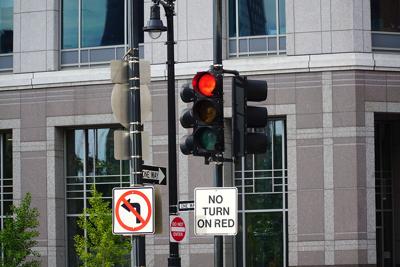

Street View is a monthly column taking a close look at development-related issues affecting different neighborhoods throughout the city.
Dr. Ezra Howard is a close follower of Metro politics and an advocate for accessible data. He has also been hit by cars multiple times, while traveling to work downtown and near his previous residences in Germantown and East Nashville. In October, these backgrounds came together in his independent project to crunch the numbers on a current roadway safety discussion: city efforts to prohibit right turns on red at certain intersections across Nashville.
In an article for Nashville People’s Journal, Howard used publicly available data on Metro Nashville’s Open Data Portal to see whether the places the Nashville Department of Transportation and Multimodal Infrastructure had planned to ban right on red would make a difference. His prediction? The proposals were a good idea.
Howard measured incidents involving pedestrians, cyclists and non-motor vehicles within 1,000 feet of a crosswalk across the whole city — about 48 percent of the accidents in the past five years. Consistent with NDOT’s proposed right-on-red bans, many of these incidents were significantly clustered in Nashville’s downtown core.
Then Howard looked at the data within 50 feet of the proposed bans. He found that 73 percent of intersections had incidents occur within the past five years. Many of the proposed locations for signs restricting right turns on red had experienced multiple accidents.
In recent months, a right-on-red bill sponsored by Councilmember Sandra Sepulveda has been the subject of lively debate at the Metro Council, with concerns over traffic volume and increased commuting time in the proposed areas of implementation. Originally planned for Nashville’s entire Urban Services District, the legislation was subsequently whittled down to 59 intersections, with plans to study 700 others. On Oct. 21, Sepulveda withdrew the legislation, explaining that NDOT had plans for a no-turn-on-red trial at 14 intersections alongside studies of other intersections for potential implementation.

Following 'productive conversation' with transportation department, councilmember rescinds legislation to prohibit vehicle turns
NDOT does not require legislation to implement no-turn-on-red across the city, and department representative Brendan Scully tells the Scene that NDOT will place right-on-red restrictions or leading pedestrian interval additions (a type of traffic signal that gives crossing pedestrians a head start before cars can move) at 14 intersections this month. The actual right-on-red restrictions will apply to just seven new intersections: Smith Springs Road and Old Murfreesboro Road, 12th Avenue and Broadway, Third Avenue and Commerce Street, Fourth Avenue and Korean Veterans Boulevard, Rosa Parks Boulevard and Church Street, 25th Avenue and Children’s Way, and Nolensville Pike and Welshwood Drive.
NDOT had previously worked with Sepulveda to find the right streets for the program. They primarily considered intersections where large numbers of pedestrians (particularly children, older pedestrians or people with disabilities) used crosswalks that were in the path of many cars turning right on red. To help more vulnerable pedestrians, they also looked at intersections that were within 500 feet of schools, hospitals and parks.
“NDOT determined that all these 59 signals necessitate a safety intervention of either leading pedestrian intervals, no-right-on-red-turn restrictions or exclusive pedestrian phase,” says Scully. However, he tells the Scene that many of the intersections already had pedestrian safety measures installed in spring 2025. These interventions have seen “notable safety improvements,” he says. The others went on a list of intersections planned for upgrades.
Right turns on red signals were introduced as a nationwide standard in response to a 1970s oil crisis, when members of the Organization of Arab Petroleum Exporting Countries threatened an embargo to the U.S. as an ally of Israel during the Arab-Israel War. The initial idea was that allowing right turns on red would reduce idling, saving on gas. In 1975, the U.S. government passed a law that any state not permitting right on red would not receive federal energy assistance. But in recent years, some areas — like Atlanta and Washington, D.C. — have enacted bans in certain areas.
In downtown Nashville, Councilmember Jacob Kupin says some of the new signals have already caused inconvenience. At one development, some residents have reached out to Kupin about longer times spent trying to make a right turn into their property. Kupin says he supports right-on-red restrictions as part of NDOT’s larger menu of safety tools, but he didn’t like the initial focus on so many intersections downtown, where residents already face significant traffic.
Downtown is a challenge for implementation. Its traffic density means that banning right on red could cause the biggest delays. However, that same density means the bans could also make the biggest safety improvements.
For Howard, and for NDOT, the right-on-red discussion is just the beginning. “It’s a piece, for sure, but not the sole solution,” Howard says. “The bigger picture is robust, multimodal safety infrastructure.”
In an email to the Scene, Howard talks about living in the Czech Republic and Portugal while completing his Ph.D., where he experienced safe and efficient transport options. Now, living in Bellevue with a young toddler, he says he wants these options for his own city.
“Nashville isn’t Europe, and Bellevue is not the urban core or the ideal candidate for a walkable neighborhood, but I know there are so many things possible even out here with some basic infrastructure,” he says. “We just need the will to build it.”
NDOT will continue to look at more intersections for pedestrian improvements in the coming months. Scully says that, in line with national guidance, they will consider right-on-red bans in areas with more than three right-turn-on-red crashes in a 12-month period, challenging angles or conditions for drivers’ sight lines, high numbers of vehicle and pedestrian movements, and other operational features that might make turning right on red difficult or dangerous.



Post a comment as anonymous
Report
Watch this discussion.
(0) comments
Welcome to the discussion.
Log In
Welcome to the discussion.
Keep it clean. Please avoid obscene, vulgar, lewd, racist or otherwise abusive language. Comments featuring hate speech or threatening or violent content will not be tolerated.
PLEASE TURN OFF YOUR CAPS LOCK.
Be truthful. Don't knowingly lie or mislead.
Be proactive. Use the “report” link on any comment that violates our comment policy.
Share with us. We'd love to hear your feedback.