
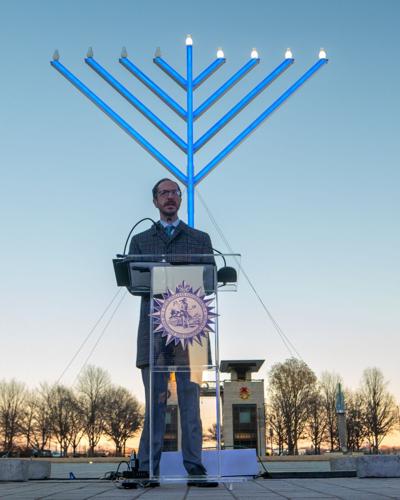


Mayor Freddie O'Connell speaks at Public Square Park during a Dec. 11, 2023, Hanukkah celebration
Children sang and music played in Public Square Park at sundown on Dec. 11. A small crowd had gathered on the fifth night of Hanukkah for the city’s 20th annual menorah lighting. A few speakers took turns at the microphone — Rabbi Laurie Rice of Congregation Micah, Erin Coleman of the Jewish Federation of Greater Nashville, Nathan Appelbaum of Vanderbilt University’s Hillel chapter. All remarks focused directly on Hanukkah, a 2,000-year-old story of light triumphing over darkness, which speakers used to allude just barely to the tense backdrop of that night’s event.
“It is fitting that we’re here in these challenging times to celebrate the light that has sustained the Jewish community over the centuries,” said Mayor Freddie O’Connell, who spoke about his own Jewish heritage at the event. While he spoke, a Metro police detail waited on horseback in the background. “We are a place that welcomes the differences between us and draws strength from inclusivity.”
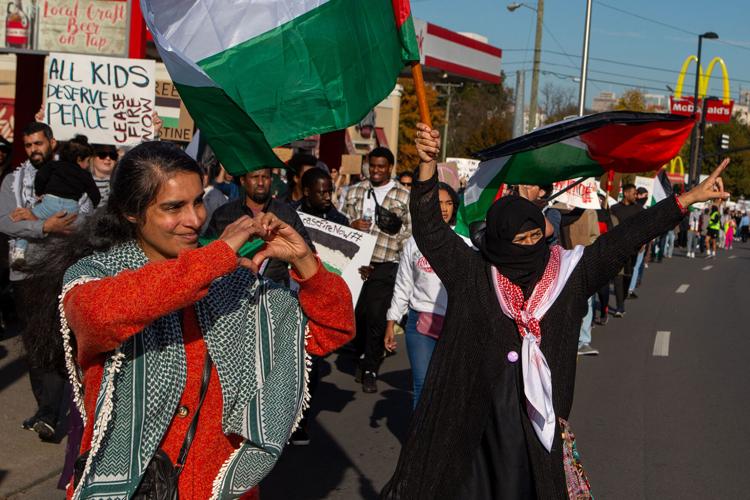
The week before, activists calling for a cease-fire assembled on Lower Broadway, turning the city’s heart into a stage for speakers and protesters. The message of the action, organized by the newly formed Palestine Hurra Collective, was that the killing in Gaza is not a war but a brutal acceleration of Israel’s decades-long project of eliminating Palestinians from the area. The day after the menorah lighting, educators and teachers met downtown to remember those killed in Gaza. Across Nashville, hostages taken from Israel by Hamas stare back from flyers tacked on telephone poles.
Vigils, dinners, memorials, protests and demonstrations have marked Nashville’s response to the Oct. 7 attack on Israel by Hamas — which killed more than 1,200 Israelis — and Israel’s subsequent invasion of Gaza. Close to 20,000 Palestinians, mostly women and children, have died in the tiny strip of land since Israel launched its assault in October, supported and armed by the U.S. government.
O’Connell met with representatives of Nashville’s Jewish community in the days following Oct. 7. It took a few more weeks for O’Connell to meet with Palestinian, Arab and Muslim leaders, who sat with the mayor in late October. O’Connell has shied away from strong rhetoric on either side of the issue, casting himself as a listener and supporter. In late October, his office shared links related to emotional and physical safety in a “Resource Guide for Nashvillians Impacted by Middle East Conflict.”
“My role is to take care of Nashvillians,” O’Connell tells the Scene. “We continue to talk to leaders and all of our Jewish, Israeli, Muslim, Palestinian and Arab populations. To me, it is far more important to be involved in conversation than to make statements.”
Reeling from the Oct. 7 attack on Israel and the recent uptick of public antisemitism in Nashville neighborhoods, Jewish leaders cite heightened sensitivity among their peers since the attacks by Hamas. As recently as Sunday, Jewish organizations including the Gordon Jewish Community Center have received emailed threats.
“We’re all feeling a bubbling to the surface of antisemitism that we knew existed,” says Barbara Dab, a spokesperson for the Jewish Federation of Greater Nashville. “Our Jewish world and the world in general is in a very dark place right now. We stand with Israel no matter what, and don’t want to see violence or killing on either side. But a cease-fire is not going to accomplish that.”
For months, a clear majority of countries and U.S. voters have supported a cease-fire. The U.S. government has continued to deliver aid and public support to Israel, though warnings from the White House to avoid civilian deaths have gotten sharper in recent weeks. For two months, airstrikes have reduced much of Northern Gaza to rubble, while humanitarian aid trickles in through borders controlled by Israel and Egypt. Dehydration, starvation, death, disease and mass displacement have compounded the international crisis, which has simultaneously become a graveyard for journalists reporting on the situation.

All Out for Palestine Peace Rally, Nov. 11
“We can’t understand this,” says Sabina Mohyuddin, executive director of Nashville’s American Muslim Advisory Council. “We can’t comprehend why this is being justified and why people aren’t saying more or demanding a cease-fire. The only explanation is that our humanity doesn’t matter. There is no justification for what happened on Oct. 7, and I haven’t heard anyone in our Muslim community even come close to justifying that, but the lack of support for a cease-fire is hard to deal with emotionally. I know the mental health of our community has really suffered, and it has set back our interfaith work with the Jewish community. It just feels like there’s not a real recognition of Palestinians’ humanity.”
Mohyuddin estimates that the Muslim community of Middle Tennessee is between 50,000 and 60,000 people, a few thousand of whom are Palestinian. Muslims’ views should not be painted with a single brush, but, says Mohyuddin, many share a view of Israel and Palestine that differs dramatically from the mainstream. She tells the Scene that refusal to condemn or even recognize “genocide” — a term Mohyuddin uses unflinchingly — has eroded the relationship between Arab and Muslim Nashvillians and local leaders, including O’Connell.
“There’s always been this solidarity with Palestinians in the Muslim community, and it’s not just religious,” says Mohyuddin. “Many Palestinians are Muslim, but there’s a Christian population of Palestinians. It’s based in a shared understanding of oppression. Many Muslims experience oppression themselves or come from countries where they were oppressed. We see the establishment of the state of Israel as a colonial project, but nobody really talks about that here. Americans get a different sense of the news from the rest of the world — they are watching a different news.”



