
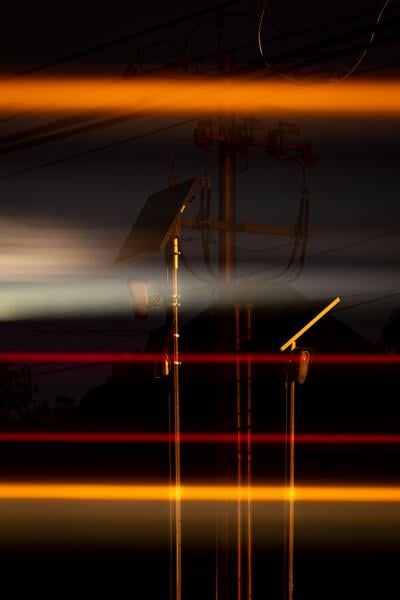

The Murfreesboro City Council voted in June to renew the city’s contract with Flock Safety for the company’s gunshot detection system. The Atlanta-based surveillance company’s gunshot-detection sensors and license plate readers have become among the most contested pieces of policing technology in the country. While police surveillance tech has been hotly debated in Nashville, the contract renewal in Murfreesboro was approved with relatively little controversy.
The only vote tied to Flock-related surveillance technology at the June 18 Murfreesboro City Council meeting was approval of a two-year, $243,898 renewal of the city’s contract with Flock Safety for the “Raven” gunshot detection system. Murfreesboro Police Department Chief Michael Bowen confirmed that gunshot detection is a separate system from license plate readers, and that the detection system covers roughly five of Murfreesboro’s 64 square miles, based on violent crime data. The system was originally purchased in January 2024, making this a service extension rather than a new acquisition. The renewal passed the City Council unanimously by roll-call vote.
Murfreesboro officials addressed its use of Flock’s license plate readers separately in an informational presentation — not a funding or contract vote. Bowen and the police department’s Real-Time Crime Center supervisor Ryan Lawrence explained how license plate readers, gunshot detection and public safety cameras work. They cited 30-day data retention, restricted access to eight of the city’s 361 sworn officers, a requirement for search justification, and no collection of facial recognition or personally identifiable information. Bowen noted that he and Lawrence are “personally available” to address residents’ concerns directly.
“So anybody watching this council meeting that has questions and wants to call either of us directly, we’re willing to talk and discuss any concerns,” Bowen said at the June 18 meeting. “We’re not hiding anything.”

Citing Trump administration’s willingness to defy courts, mayor says ‘guardrails’ may not be enough to implement a contract with Fusus
Murfreesboro officials say license plate readers and gunshot detection are critical to solving violent crime. Lawrence offered numerous examples, including the use of gunshot detection sensors in apprehending three suspects in a Rushwood Drive drive-by shooting and attempted homicide in June, where no 911 call was made. Officials say gunshot detection sensors alerted officers, leading to the arrests, and two of the suspects are facing attempted first-degree murder charges.
“We hear that argument all the time,” says Matthew Guariglia, a senior policy analyst at the Electronic Frontier Foundation, a nonprofit organization focused on defending civil liberties in the digital world. “They can show cases where the technology contributed to solving a crime, but they usually can’t show that there was no other way to solve it.”
Guariglia adds that police already have many investigative tools available that don’t require the surveillance of everyone in a jurisdiction. He says the core problem with police tech like gunshot detection is that the systems are designed to replace “individualized suspicion.”
“In our legal system, if police suspect someone committed a crime, they go to a judge, obtain a warrant, and then investigate that person,” Guariglia tells the Scene. “These technologies invert that process. Instead of collecting information about a specific suspect, they’re collecting information about everyone and then searching through that massive data set later.”
The result, Guariglia says, is that “everyone is effectively under suspicion all the time.”
During the council meeting, Murfreesboro officials said the Raven gunshot detection units do not provide continuous audio recording. The units provide only a five-second audio snippet with each alert, which narrows officer response from a “multi-block area” to a precise zone.
“It cannot be tapped for any type of live audio surveillance,” Lawrence said. “So if you have one that’s deployed next to a bus stop, we in the crime center can’t tap into that and listen to conversations or anything like that.”
Yet while police departments often emphasize transparency in how they deploy gunshot detection technology, Guariglia says much less is known about how the systems actually function on the back end.
“Many of these systems rely on probabilities rather than certainty,” he says. “For example, instead of telling officers, ‘This was definitely a gunshot,’ the system might indicate a 60 percent or 80 percent likelihood that it was a gunshot.”
The stakes of those errors can be significant. Gunshot detection systems have been known to mistake fireworks, car backfires and other loud noises for gunfire. In 2024, Chicago police responding to an alert from ShotSpotter fired at an unarmed teenager after the system incorrectly flagged fireworks as gunshots. Chicago later canceled its contract with ShotSpotter amid criticism over the technology’s inaccuracy, racial bias and misuse. ShotSpotter is a gunshot detection technology similar to Flock’s Raven product.
Guariglia says incidents like the one in Chicago raise a fundamental question about the presumption of innocence.
“If a sensor is triggered and officers rush to the area, what happens to everyone nearby?” he says. “Do police suddenly believe they have probable cause to stop or search everyone in the vicinity? They shouldn’t. But in practice, police sometimes act as though simply being near a sensor alert justifies additional scrutiny.”



Post a comment as anonymous
Report
Watch this discussion.
(0) comments
Welcome to the discussion.
Log In
Welcome to the discussion.
Keep it clean. Please avoid obscene, vulgar, lewd, racist or otherwise abusive language. Comments featuring hate speech or threatening or violent content will not be tolerated.
PLEASE TURN OFF YOUR CAPS LOCK.
Be truthful. Don't knowingly lie or mislead.
Be proactive. Use the “report” link on any comment that violates our comment policy.
Share with us. We'd love to hear your feedback.