

Many residents will have to wait for the small, printed passes that have become a new Nashville currency as more cars crowd residential streets. Neighborhoods have increasingly petitioned Metro to lock down street-by-street parking rights via residential parking permits (RPPs). The issue bubbled over in 12South this summer as cross streets became parking lots for the popular shopping district, prompting the Metro Traffic and Parking Commission to pause the permit process altogether at its July meeting.
Increased overlap between residential and commercial properties has brought patrons into neighborhoods like Lockeland Springs, North Nashville, McFerrin Park, Midtown and Sylvan Park. Weekend crowds flock to 12South, where residential streets branch off the main commercial strip. Commissioners want to study these patterns — particularly with an eye on increasing parking-spot turnover throughout the day — to help address a debate that’s spreading beyond just a few hotspots. Paid parking has expanded too, with 2.41 million hours purchased in fiscal year 2026 (up from 1.86 million in FY25) for $6.7 million (up from $4.7 million); the city issued more than 76,000 parking citations during the same period, a 53.5 percent annual increase, about half for expired parking. Tighter parking regulations are a Big City Issue straining residents and businesses as Nashville tries to re-urbanize itself.
“It’s a geometry problem and a cultural thing — Nashvillians are accustomed to being able to park close to where they’re going and leave without much fuss,” says District 5 Councilmember Sean Parker, who also sits on the Traffic and Parking Commission. “More people want to be here. They bring the largest thing they own with them and need to store it, and there’s not enough space. The best solution is getting around without personal vehicles — carpooling, taking transit, taking a bicycle.”
Parker defends the city’s paid parking spots, which have taken over the urban core in recent years. When popular Tex-Mex restaurant Redheaded Stranger drew crowds and cars to McFerrin Park in his East Nashville district, annoyed neighbors protected their curbs with traffic cones. When restaurant employees began moving the cones, Parker saw tension escalating, and used RPPs to help broker peace between the business and neighborhood. Two streets in the neighborhood — Arrington and Hancock — are now among the city’s small but growing network of reserved curb parking. So far, such accommodations have been granted for about 50 city blocks concentrated around Music Row, Five Points, Belmont, Edgehill and 12th Avenue South.
Pittsburghers use the “parcha” — short for “parking chair” — to unofficially reserve space on Pennsylvania streets. Handmade signs, creative punishments, word of mouth and embossed permits help enforce order across America when it comes to street parking, a daily hazard in cities where population density has crossed an invisible threshold. It’s the expected cost of living for car owners in Chicago, San Francisco, Seattle, D.C. and Boston, all breezy compared to Manhattan — where elaborate machinery stacks and sorts cars in compact lots for commuters who pay handsomely for private commutes downtown.
Nashville is quickly catching up. Paid lots, city meters and space-searching headaches have become regular obstacles for drivers here. Free, easy parking has gone extinct in hot spots like 12South and Five Points as residents struggle for a new equilibrium.

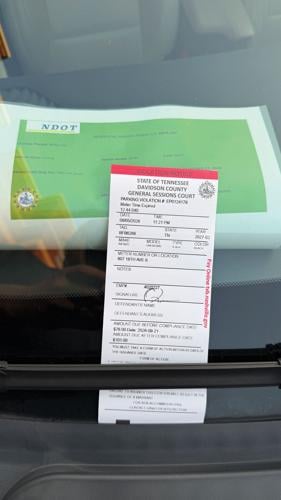
Printed permit and parking ticket
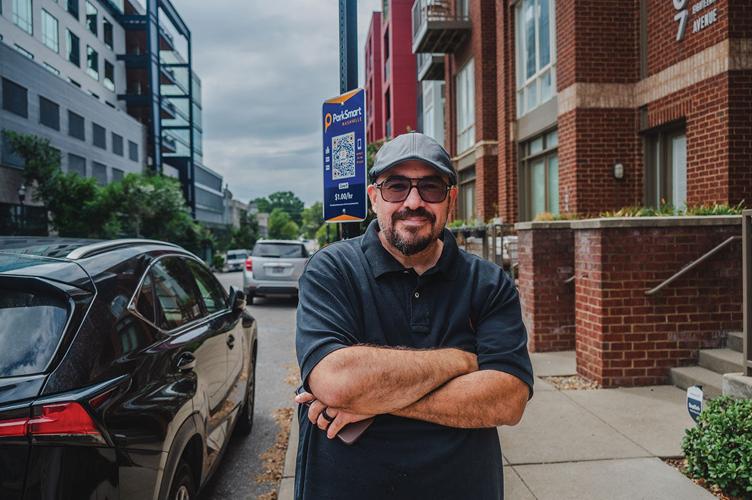
A mix of office, residential and commercial buildings brings cycles of traffic to Midtown throughout the day. But since the city put in paid parking two years ago, 18th Avenue South stays mostly empty overnight, says Bo Gutierrez, who leads a homeowners’ association of about 70 residents on the block near Division Street. Rather than overcrowded free parking, his street is dealing with charges imposed by the Nashville Department of Transportation and Multimodal Infrastructure that have cleared out parking altogether, often pushing cars to other blocks.
“ NDOT is predatory with their ticketing — they sit out here at 5:45 in the morning and wait for 6 a.m. to hit,” Gutierrez tells the Scene from a stoop outside of his condo. “ So our streets are bare, and it’s a ghost town. My wife does not feel safe walking the dog outside with nobody on the streets. We want life and activity, and we want nothing for free — we just want to pay so we can park in front of our houses.”
Gutierrez says he’s battling through a yearslong application process with NDOT for residential parking permits on behalf of his neighbors. (Gutierrez, who has one vehicle, uses his condo’s single private spot.) The city approved his first petition, which required signatures from 70 percent of residents supporting the change. But he says no one came to his street to put up new signs. After he resubmitted, Metro bounced his second petition as a duplicate in March 2026. He says the city’s temporary moratorium has frozen his third try.
For its part, NDOT wants to offer the forthcoming 12South parking study as an example for a whole-city strategy. Initial findings are expected in December, and final study recommendations will take until April. They back the study as a potential reset button for standards that can be applied across Nashville.
“Generally speaking, the study will look at curb use in both the commercial and residential portions of the study area to determine how to best accommodate the various right-of-way needs,” says NDOT spokesperson Cortnye Stone. “The planning process will include robust data collection and engagement to inform a sound final plan. We definitely won’t be starting from scratch on this, and have a pretty significant amount of community feedback from prior periods of engagement.”
In a cruel twist of fate, Gutierrez spotted a permit behind a neighbor’s windshield last month. He printed his own, a lime-green rectangle with his vehicle’s information and an identification number, from NDOT’s online portal. Gutierrez thought it was a miraculous breakthrough, only to get a $75 ticket when he tried to use it on the street. The piece of paper was legally powerless, NDOT explained, obtained through an online administrative error. Gutierrez documents the ongoing drama to get permits for his block on Do Better Nashville, a website listing his grievances with city bureaucracy and his councilmember, Terry Vo, whom he criticizes as unresponsive and inconsistent in explaining the complicated application process.
Vo says she’s helped answer Gutierrez’s questions and supported his petition. She also backs the city’s current moratorium.
“ Free parking is not sustainable — in any large city, where do you get free parking?” says Vo, who represents District 17, just before starting a town hall with constituents. “ It’s not on the city to subsidize your second or third vehicle, and when people tell me, ‘There’s a parking problem,’ often it’s actually that there’s not enough free parking. Part of that is they are getting gouged by private parking lots too. The issue needs a complete overhaul to be reviewed fully so we can make fair decisions across the whole county.”
Vo says the current residential parking permit cost — $10 per year, $25 downtown — should be at least $365, with exceptions for those on fixed incomes. She represents both Midtown and Wedgewood-Houston, where parking woes have become central to neighborhood politics, especially tied to WeHo’s overhaul by AJ Capital and Geodis Park. Soccer games flood surrounding streets with cars and pedestrians, even with the team and city collaborating on a fare-free bus option.
For shows, which rarely start before 7 p.m, music venue 3rd and Lindsley now directs patrons to $2 hourly parking at the city’s nearby office complex, which clears out after 5 p.m. Parker suggests a similar “blended” approach for 12South, where side streets clear out during the day and fill up when residents return at night. As an example, he floats paid parking with a heavily discounted annual cost for residents to maximize public space while balancing multiple uses. A similar approach could solve Gutierrez’s block. A densifying city has lots to celebrate, like new restaurants and businesses. But it doesn’t take another study for Nashvillians to see that the golden age of abundant, free and convenient parking is over.



Post a comment as anonymous
Report
Watch this discussion.
(0) comments
Welcome to the discussion.
Log In
Welcome to the discussion.
Keep it clean. Please avoid obscene, vulgar, lewd, racist or otherwise abusive language. Comments featuring hate speech or threatening or violent content will not be tolerated.
PLEASE TURN OFF YOUR CAPS LOCK.
Be truthful. Don't knowingly lie or mislead.
Be proactive. Use the “report” link on any comment that violates our comment policy.
Share with us. We'd love to hear your feedback.