
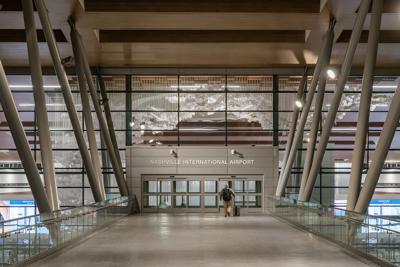

Passengers hit Nashville International Airport’s growing pains well before checking bags or fumbling for a driver’s license in the security line. During peak hours on either side of the weekend, airport traffic clogs Exit 216A hundreds of yards up I-40 East. In a pinch, you might even see a desperate traveler saddled with luggage walking the highway ramp.
Airport planning documents refer to I-40 as an “incompatible object” that is outside the airport’s control — one of many stumbling blocks the airport contends with as it scrambles to update, upgrade and scale facilities to meet explosive demand. In December, Metro sold $600 million in bonds to support the airport’s breakneck expansion plans. (The Metro Nashville Airport Authority issues its own bonds, which it backs with airport revenue.) A revamped main terminal, massive new garages, an on-site Hilton hotel and the new Concourse D are Nashville’s latest offerings, the culmination of “BNA Vision 1.0,” the $1.3 billion overhaul laid out in 2017 to keep BNA on pace as a modern metropolitan airport. A new six-gate international terminal pairs well with Nashville’s ambition to land more nonstop flights around the world, specifically direct flights to Asia, a goal that’s eluded BNA because its runways aren’t quite long enough.
Other renovations included a light rail station on top of Terminal Garage 1, a key hookup that could introduce the city to rail transit and relieve the I-40 traffic crisis that’s getting worse by the year. “The status of a future light rail is currently unknown,” BNA documents read, a polite way of saying that there is a need and an opportunity but no plan.
Knee-deep in a generational moment, BNA’s board has lost two veteran board members, Bobby Joslin and Jimmy Granbery, amid an ongoing governing battle for airport control. After state lawmakers moved to create their own MNAA Board of Commissioners in the spring, Joslin and Granbery — both prominent conservative businessmen in Nashville — jumped ship, betting on state lawmakers’ dubiously legal takeover attempt.
“I don’t want to say anything that might add more fuel to this fire,” Joslin tells the Scene, referring to the ongoing court battle. “Let’s wait and let the big guys handle it.”
Granbery did not return a request for comment left with his PR firm.

New state laws aren’t passing constitutional muster
A three-judge panel sided with the city in a 36-page decision handed down on Halloween. Nashville’s airport board is a domain of the city government, judges decided, and enjoys Home Rule protections from targeted legislation passed by the state. It was another win for Metro Legal’s Wally Dietz and a valuable precedent as the city fights an extremely similar case to keep control of its sports authority. The dual-board crisis also got the city crossways with the Federal Aviation Administration, which alluded to BNA’s operating certificate in a letter sent to the city and state in the spring.
“Director Dietz clearly believes that those two members, in joining the other board, vacated their seats and has conveyed such to those individuals,” Mayor Freddie O’Connell told reporters in early November. “At this time, we would expect there are two vacant seats, and that is how this administration is assessing the situation.”
O’Connell’s office has not yet offered any names to the Metro Council to replace Joslin or Granbery. Both are still listed as board members on the airport’s website.
Meanwhile, BNA is busier than at any point in its 86-year history. The airport fully bounced back from a COVID-era decrease in air travel, serving nearly 22 million passengers in 2022, up from 18.5 million in 2019. Nashville does it all with relatively few gates — just 43 compared to Salt Lake City’s 71 or Baltimore’s 72, the country’s next two busiest airports. Nashville is firmly the territory of Southwest Airlines, which announced Nashville as a crew hub earlier this year and controls 53 percent of market share at BNA. Additional upgrades (including a second terminal) plan for 31 million annual passengers, the airport’s next big target.
“Are you going to start the next ‘Fortune 500’ company in a city with no air service, or one flight a day, to Orlando?” says Ganesh Sitaraman, a law professor at Vanderbilt University who has spent the past year writing a book explaining the importance of air travel to American cities. “People need to get to you. Employees need to be able to go home for Thanksgiving. Your suppliers need to get to you. Places need basic transportation services in order to grow and flourish.”
Sitaraman’s new book, Why Flying Is Miserable: And How to Fix It, explains how deregulation in the 1980s turned a stable airline industry into today’s much-hated oligopoly marked by spotty service and unpredictable fares. Air travel, he argues, can define the success of a city in today’s national and global economy. A bustling international airport goes hand in hand with a thriving metropolis.
Airlines run six nonstop flights from Nashville to New York City and five to LAX on a given day, as well as regular direct flights to Cancun, London and, seasonally, Yampa Valley, a regional airport in Colorado ski country. BNA has also signaled its intention to expand nonstop air service to Europe, Asia, Latin America and beyond. Connections to national and international centers of business and wealth reflect a city’s clientele. Seen through its airport, Nashville is punching above its weight.
To stay on course, city leaders have to steer BNA through a little bit of turbulence.



Post a comment as anonymous
Report
Watch this discussion.
(0) comments
Welcome to the discussion.
Log In
Welcome to the discussion.
Keep it clean. Please avoid obscene, vulgar, lewd, racist or otherwise abusive language. Comments featuring hate speech or threatening or violent content will not be tolerated.
PLEASE TURN OFF YOUR CAPS LOCK.
Be truthful. Don't knowingly lie or mislead.
Be proactive. Use the “report” link on any comment that violates our comment policy.
Share with us. We'd love to hear your feedback.