
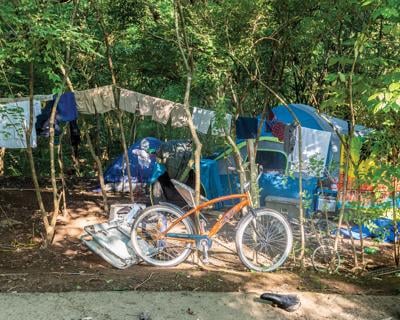

A bill that would further penalize unauthorized camping on public property is on its way to passage at the state Capitol, and opponents say it will criminalize homelessness in Tennessee. The legislation also aims to expand a current law that makes camping on state property a felony to include all forms of public property.
Service providers who work with unhoused communities say the bill won’t help reduce homelessness and simply puts people who need housing out of sight and out of mind.
“These folks are not going to disappear through some magic trick of a bill that says they aren’t wanted,” said the Rev. Jay Voorhees at the Senate Judiciary Committee meeting on April 6. Voorhees, who represents the congregation City Road Chapel United Methodist Church, called for city and state solutions that would help people find housing instead.
Lindsey Krinks is a co-founder of Open Table Nashville, a nonprofit that works with people experiencing homelessness. She noted that such laws can be expensive to enforce and that similar laws have in some cases been deemed unconstitutional.
Judith Tackett, the former director of Nashville’s Metro Homeless Impact Division, said rural leaders she spoke to were concerned about the consequences of the bill, and that energy would be better spent creating state programs to incentivize landlords to rent to unhoused Tennesseans and work with service providers.
Opponents of the bill also noted laws and ordinances exist that already prohibit camping.
The bill, SB 1610, positions itself as primarily concerned with camps near highway entrances and exits, making the creation of such camps a class C misdemeanor. Law enforcement officers would give a written warning on first offense, and later a $50 fine. The legislation also expands the Equal Access to Public Property Law of 2012 — which in response to racial justice protests of 2020 was revised to make camping on state property a felony. SB 1610 originally included language that would also penalize soliciting, but that was removed in an amendment.
It’s unclear how many citations or arrests will be made, but the bill’s sponsor, Sen. Paul Bailey (R-Cookeville), said that there were zero convictions under current laws over the past five years. The amendment predicts little change in conviction rate.
Sheriff Eddie Farris of Putnam County spoke in support of the bill, saying it would allow the Putnam County Sheriff’s Office to access county property they couldn’t otherwise enter to “confront” people camping there. However, Farris said the ultimate goal was to move people on the property to a service provider rather than cite or arrest them.
The bill passed the committee with a 7-2 vote, and as of this writing, it’s set for a vote on the Senate floor Wednesday, April 13.
Speaking with the Scene, India Pungarcher of Open Table Nashville says she is concerned about how the law will affect people in rural communities.
“This bill does not create any sort of a solution,” she says. Pungarcher adds that “even if charges or tickets are not written or carried out, it will still be an intimidation tactic” to coerce people to leave certain areas.
While there isn’t much research on the topic of camp closures, a 2019 study from the U.S. Department of Housing and Urban Development suggests that clearing encampments without providing any resources to displaced residents may reduce the likelihood that they seek shelter or other services. If the law does deter people from camping in parks and other public spaces, there are concerns that unhoused people may seek refuge in even more remote areas. Pungarcher says enforcement of camps in Nashville contributed to the growth of camps on the outskirts of town.
“If people can’t stay on public property, and they also can’t stay on state property, and they obviously can’t stay on private property, and there aren’t enough shelter beds … where will people go?” asks Pungarcher. “No one has that answer.”
She also notes that being charged with a felony makes finding work more difficult and creates barriers to both public and private housing.
The topic of homeless encampments has been spotlighted over the past year in part due to the growing camp at Brookmeade Park in West Nashville, which inspired a vocal group of residents to pressure the city into taking action at the greenway. Calling itself Reclaim Brookmeade Park, the group has gotten the attention of Mayor John Cooper and the Metro Homeless Impact Division. While the organization has received criticism for heated online rhetoric as well as surveillance of the camp, several members insist they want humane housing options for those staying at the park and not just arrests and enforcement.
Rebecca Lowe, the group’s founder, spoke at the judiciary committee hearing in support of the bill, saying it could deter camps like the one at Brookmeade Park.
Housing-first models, which prioritize getting people into homes as quickly as possible, have become widely accepted as the best solution to ending homelessness, and see more success than policing. Tackett reiterates this point in a statement to the Scene.
“If arresting people with no places to go would end homelessness, there would be no street homelessness in this country,” she writes. “Housing ends homelessness. Period.”



