
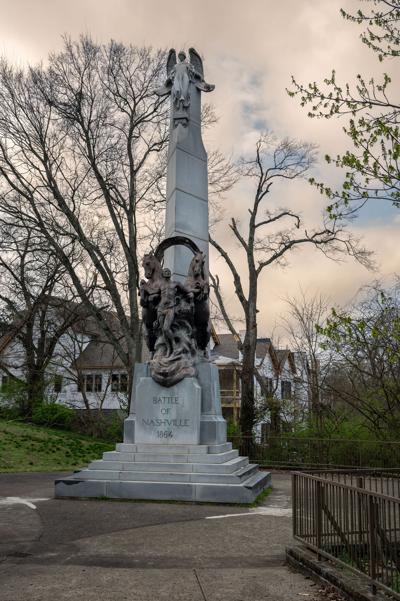


Battle of Nashville Monument in the Battlemont neighborhood
On a recent Wednesday evening, about 30 people sat facing a PowerPoint slideshow in a basement classroom on Granny White Pike. The Battlemont Neighborhood Association had called this meeting to brief neighbors on its top order of business: securing a conservation overlay from the Metro Planning Department.
“ Some of you might live in a house that looks like that or that,” said Brian Nock, a steering committee member, pointing to two side-by-side houses — a tall and boxy modern duplex on the left, towering over a stout brick ranch home on the right. “We’re not making a statement about whether that’s a good thing or a bad thing. I think the observation that we’re pursuing is that these two things are very different, and are we OK with replacing the right with more of the left? Again, not to pick on anybody that lives in the neighborhood.”
Battlemont, a quiet contained neighborhood tucked between I-440 and Woodmont Boulevard, has slowly been remade with large new homes over the past decade. Proximity to 12South, Lipscomb, Green Hills and Eighth Avenue, balanced with large lots safe from through traffic, made the land here a perfect candidate for lucrative house-flipping. It also tightly bonded neighbors fiercely protective of this corner of Nashville — in 2022, a few Sutton Hill Road residents banded together to take builders to task over a legal but out-of-step setback for a new home.

A neighborhood legal battle has created the land-use equivalent of a constitutional crisis
After reviving a Battlemont neighborhood association during COVID-era reflection, many now want to break the cycle of teardown development. Historic landmarks still dot the area. Former buffalo trail Granny White Pike dates back more than 150 years as a usable road to Franklin. Union and Confederate armies clashed here during the Battle of Nashville, and a few 19th-century structures — including the Mulberry House on Clifton Lane — still stand nearby.
The group will host a public meeting once more on April 8 alongside the Metro Planning Department in pursuit of a coveted conservation overlay. If approved, the planning tool would apply specific building restrictions to new construction based on design guidelines. The Metropolitan Historic Zoning Commission, a mayor-appointed panel moved to the Planning Department last year, would then extricate architectural elements based on “contributing” homes to formally establish what does and doesn’t fit. These design guidelines help translate abstract terms like new homes’ “feel” and “character” into legal standards for future construction.
“ People would come to our neighborhood meetings and say that they felt nearby development was out of context for our neighborhood,” Kira Hilley, treasurer of the Battlemont Neighborhood Association, tells the Scene. “ Everyone was concerned about the character of the homes and the sizes. Too much mass, too much change, too drastic of a change. So we looked up what the options were and asked if we would be eligible for a conservation zoning overlay.”

Following an audit, new legislation from Councilmember Benedict aims to move MHZC into the Planning Department
If successful, Battlemont would join a growing registry of acreage governed by additional building restrictions. Conservation neighborhoods are elite company, often overlapping with the city’s most expensive enclaves like Whitland, Richland and Lockeland Springs. These residential areas often share key qualities: single-family dominant blocks conveniently located near urban amenities but not overrun with tourism or commercial real estate. Most overlays came online in the late 2000s and 2010s as Nashville’s boom began, though neighborhoods like Salemtown (2023), Lathan-Youngs (2023) and the Rock Block (2024) secured overlays in recent years.
Green Hills Councilmember Jeff Preptit, whose District 25 contains Battlemont, is simultaneously guiding another neighborhood through the city’s conservation overlay process for a few hundred homes near Lipscomb University. That legislation was deferred in January and is listed as “in the works” by the MHZC.
“These have both been efforts that originated with community groups that approached me with interest in historic preservation,” Preptit tells the Scene. “These measures have previously been identified as being appropriate for these areas and are narrowly tailored for those purposes and are in line with [Nashville’s] Community Character Manual. Given the current character of these neighborhoods, I am confident that these areas will be able to facilitate future growth in line with the needs of Nashville in a manner that respects the history of these areas.”
Prime neighborhoods have been ideal candidates for real estate development seeking to capitalize on Nashville’s popularity and population boom. Still, new residents have outpaced housing units, leading to skyrocketing home prices within Davidson County and concentrating development in city suburbs, like Mt. Juliet and Nolensville. Some Metro councilmembers, led by Rollin Horton of The Nations, have tried to reform Nashville’s outdated and restrictive zoning code to help induce density-rich homebuilding closer to the city. For years, market dynamics and zoning rules have led developers to tear down smaller, older homes and build structures maxing out the allowable building envelope, increasing the new home’s square footage and price.
Such is the case in Battlemont. Hilley says the potential overlay would not prevent density, but that its main priority is to slow down change on her neighborhood streets.
“It would make development more measured and gradual, and it would keep the character of the neighborhood, is what it would do,” Hilley says. “It wouldn’t be so sudden and so drastic.”



