
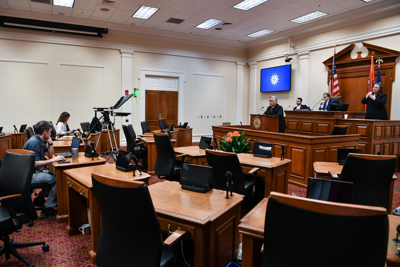


Mayor Cooper delivering last month’s State of Metro address
Nashville Mayor John Cooper, finance director Kevin Krumbo and Metro Council budget chair Bob Mendes were prepared for a tough budget cycle.
Mendes has for the past few years been pushing for a property tax increase to boost recurring city revenues. Cooper was at least open to the idea, despite his opposition in the past. The group was working with state overseers concerned about the city’s finances. Cooper secured promises of additional money from the Music City Center and sought other avenues of plugging a budget gap in the tens of millions of dollars.
But all that was before a tornado hit the county last month — and before the city’s economic engines ground to a halt in an effort to curb the spread of COVID-19.
Cooper was originally scheduled to deliver his budget proposal for the next fiscal year alongside his first State of Metro address late last month. He went ahead with the address, delivered to a nearly empty Metro Council chamber, but the budget won’t be delivered until later in April.
The mayor and his budget team are using the additional time to try to nail down better estimates of what the economic impact of the virus will be on Nashville. But early projections are grim: Mendes cited projections that the state could miss out on between $300 and $600 million in revenue in the coming months, but those estimates are constantly changing.
Hotel occupancy has plummeted (along with corresponding occupancy taxes), so the tourists who typically fill the hotels are not spending money that could be collected as sales taxes.
With a drastic drop in revenue staring the city down, Cooper decided to freeze all Metro salaries and leave unfilled positions empty, except those needed for public safety. Even so, it won’t be nearly enough, as he noted during his State of Metro address.
That’s why Cooper will be proposing a spending plan in which property taxes — the city’s most reliable revenue source — will “sharply increase.” (He also encouraged more vulnerable Nashvillians to apply for various tax-freeze programs.)
“Metro’s finances are in a place where there is no option,” Cooper said. “We can’t print money or borrow to cover our operating expenses. We must raise property taxes.”
Cooper is also waiting to see how much federal relief money the city can secure before deciding on spending for next year. After Congress passed three packages comprising trillions of dollars in funding for nationwide relief, Nashville leaders do not yet know how much will come to the city. Gov. Bill Lee estimated that the state could receive between $2 billion and $3 billion.
“We don’t have enough information right now,” Cooper said Friday.
When the Brookings Institute studied when and how cities around the country will feel the economic impact of coronavirus, researchers pointed out that cities like Nashville that rely on property tax revenue face a more favorable situation in the short term than those that rely more on income or sales taxes — meaning the local impact could hit a little further down the line. But that analysis does not consider the tourism- and conference-related downtown spending that has nearly evaporated in a few weeks, which could send a jolt through Metro’s short-term situation.
Mendes, like Cooper, is worried that the city’s relatively low cash reserves leave Nashville in a worse position than its peers facing similar revenue drop-offs.
“It’s the worst-case scenario to stroll into a dramatic, fast, deep revenue cut with no savings,” Mendes said last month. “Any city who would ever be faced with this, you would either start selling off everything that’s not nailed down, start firing people or raise revenue.”


Post a comment as anonymous
Report
Watch this discussion.
(0) comments
Welcome to the discussion.
Log In
Welcome to the discussion.
Keep it clean. Please avoid obscene, vulgar, lewd, racist or otherwise abusive language. Comments featuring hate speech or threatening or violent content will not be tolerated.
PLEASE TURN OFF YOUR CAPS LOCK.
Be truthful. Don't knowingly lie or mislead.
Be proactive. Use the “report” link on any comment that violates our comment policy.
Share with us. We'd love to hear your feedback.