



Big news at The Belcourt tops an autumn feast in the Scene's annual Fall Guide. Read on for this season's best in film, classical and dance, theater, food, music, books and art.
The last time the Scene featured the Belcourt Theatre on the cover, in January 1999, the occasion couldn't have been sadder. A heroic effort to operate the historic Hillsboro Village cinema as an independent arthouse had failed. After steady losses, the theater was closing its doors. And while its owners at the time, led by the late real estate mogul Charles Hawkins, hoped to preserve it, the odds of its becoming a parking lot or drugstore were strong. Its future looked bleak.
Sixteen years later, The Belcourt is again on the Scene's cover. And once again, the theater is closing — sort of.
This time, though, the occasion is triumphant.
In the years since a grassroots community effort banded together in 1999 to save The Belcourt, the weekend after that long-ago article, the theater has undergone a transformation. Once-empty auditoriums are often full on weekends; distributors now clamor to get films into a venue they once shunned; and the theater has emerged as a key player in a nationwide support network for other indies. In the process, it's become a source of civic pride — the hub of the city's film culture, and an enticement for others wanting to move here.
One thing hasn't kept pace, however: the building itself. Ironically, the theater's success has pushed the 90-year-old facility to the breaking point. Patrons have complained for years about the two tiny, cramped bathrooms, which result in lines even when theaters are half full. They're even worse when the ancient plumbing gives out. The narrow lobby becomes hot and uncomfortably crowded before and after packed screenings; that in turn puts extra strain on an air-conditioning system that predates 1967's Bonnie and Clyde.
That patrons love and support the theater anyway — last year was the best in Belcourt history, with 160,000 visitors and 116,964 film tickets sold — is not something Belcourt executive director Stephanie Silverman takes for granted. Silverman says audiences were sympathetic this summer when the groaning AC system conked out altogether at the height of July heat — just hours before a sold-out Rifftrax screening of Sharknado 2 was to broadcast live to a nationwide audience. Even in that "perfect storm of horrible," she says, as staff handed out paper-plate fans and water, audiences were forgiving.
"But at a certain point," Silverman says, "people will stop forgiving you."
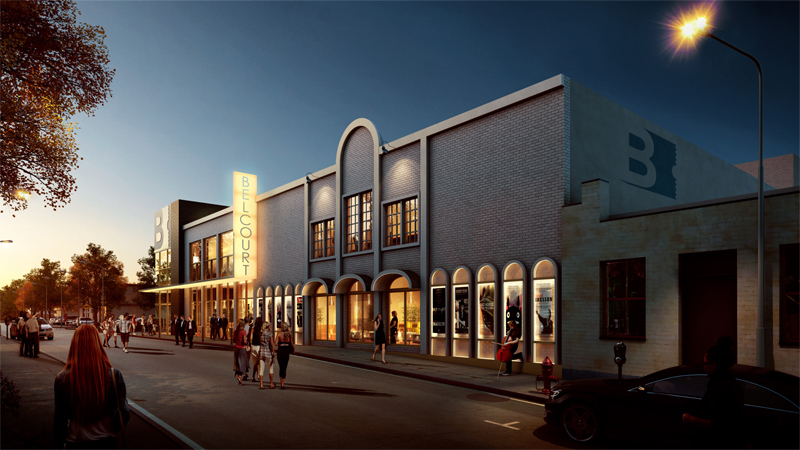
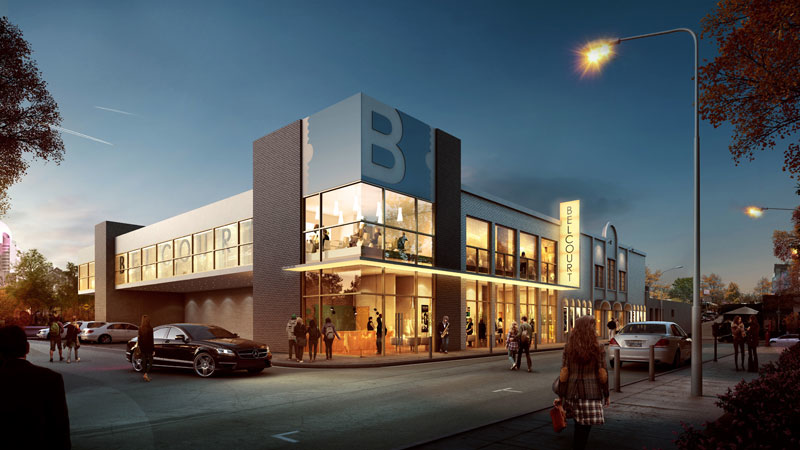
By next summer, there won't be any need. In January, The Belcourt will close for an estimated six months of remodeling — a $4.5 million upgrade that will reconfigure the lobby and box office, replace and expand the bathrooms, restore the old theatrical fly loft, and renovate the decrepit second story to include space for its continuing education and outreach efforts. Perhaps the most momentous change, though, will be a longtime wish-list item for Belcourt patrons.
That's right: The Belcourt is getting a third screen.
These changes have been in the works for years, following surveys of samplings of regular patrons, planning sessions with historical commissions and architects, and quiet meetings with big-ticket donors. What finally convinced the theater to go ahead was the steady financial drip of repairs, which The Belcourt estimates add up to roughly $60,000 a year.
With the theater in its best fiscal health this century — debt is low, and some $2.2 million has already been raised even before The Belcourt goes public this week with its $4.5 million capital campaign — staffers say the timing was now or never. Shortly after the theater hosts its annual sellout holiday run of It's a Wonderful Life, The Belcourt will close, and R.C. Mathews Contractor will begin a furious push toward a grand unveiling in June 2016.
The trick, Silverman says, has been adding elements that patrons say they want — a bigger lobby, better bathrooms, the third screen — without disrupting parking or harming the historic elements.
For all the love that regulars have for the theater, and as attached as they've grown to the hodgepodge facade — a nondescript pink wall outside the 1966 addition, then a brick front broken up by arched poster sconces, raised arches over the box office and a mostly vestigial second-story balcony — The Belcourt was relatively no-frills compared to grander movie palaces. In the 1920s, one such theater operated just down the block from its initial entrance facing 21st Avenue: the Belmont, a lavish Moorish temple to the movies where Cornerstone Financial Credit Union stands today.
In a distant echo of The Belcourt's late-'90s woes, competition put its founders, the Lightman family of Memphis-based Malco Theatres, up against one of the region's most successful and tenacious exhibitors: Belmont owner Tony Sudekum, whose Crescent Amusement Company ran the Belle Meade Theatre and other grand cinemas across the mid-South. The Belcourt, then known as the Hillsboro Theater, began to rely more on its stage for attractions. By the 1930s, these included the Grand Ole Opry, what would become the Nashville Children's Theater, and the Nashville Community Playhouse.
In 1927, the Lightmans sold off the 21st Avenue entrance — it became the White Eagle Tavern, known these days as The Villager — and opened the box office onto what is now Belcourt Avenue. A renovation in the 1950s decreased seating while adding French Quarter flourishes to the building. The next dramatic change came in 1966, when the next owner, Fred Massey of the Masco chain, built a second auditorium next door and turned the renamed Belcourt Cinema into the city's first two-screen theater.
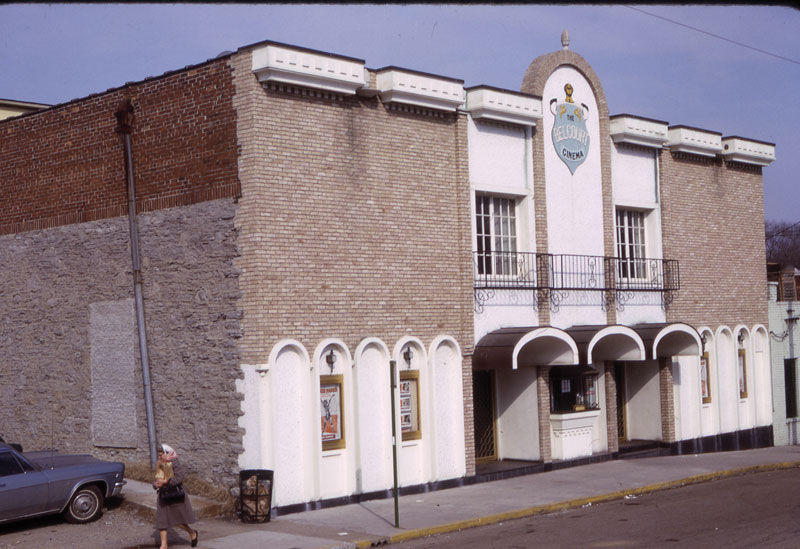
The Belcourt, circa 1963
But apart from a push started in 2008 to replace the theater's seats and carpet, and the introduction of a supplementary 4K digital projection system in 2013, the facility has stayed largely the same for a half-century.
"Imagine if that was your house," Silverman says.
Three years ago, after years of rising attendance and fiscal solidity showed that the theater's future was secure, The Belcourt began a feasibility study to see what that future might look like. The theater brought in Willard White, an arts-organization consultant with Chicago-based Marts & Lundy, to ask a targeted group of 30 people — Belcourt regulars as well as civic and neighborhood leaders and philanthropists — what they thought about potential improvements.
Three key pieces of information came back. First, Silverman says, those interviewed were unanimously supportive of upgrades to the building. Second, though, they introduced a note of caution: Nobody wanted to see the theater attempt something beyond its means — which might threaten its stability — or change its current mission. Third was a nuts-and-bolts concern: Don't lose the adjacent parking lot.
Simple as those guidelines were, they proved vital. The theater had considered a $9 million effort, an enormous overhaul that would have turned the rooftop into an additional screening and event space and expanded the 1966 hall into the parking lot for conversion into two screens. After getting the community feedback, the theater scaled down its thinking by half.
The theater shared the same concerns as patrons about bathrooms, which are not handicap-accessible yet grandfathered in under city codes. That mortifies the staff every time they have to direct patrons in wheelchairs to facilities elsewhere. Another concern was making the theater more visible. The Belcourt's only signage consists of banners and a hand-lettered sandwich board. From 21st Avenue, the Village's main artery, it's hard to make out that it's a theater.
Belcourt staffers put their heads together in 2013 with Chuck Miller and Seab Tuck of Tuck-Hinton Architects, the Nashville firm behind the Bicentennial Mall and the Frist Center for the Visual Arts. The result, tweaked and reworked over the past two years, is an ambitious but workable plan that makes the most of The Belcourt's space, expands the lobby and bathrooms, leaves the 1925 hall and most of the 1966 hall intact, shores up the aging facility, brings air and light into the monolithic expanse along Belcourt Avenue, and catches attention from 21st Avenue.
If all goes as planned, supporters hope it will transform The Belcourt into a gleaming but recognizably historic movie theater and arts center — a magnet for Hillsboro Village at a time the district needs it most, after losing anchor tenants such as Sunset Grill, Boscos and Sam's Sports Grill.
The most immediately noticeable change will be the outside, with the biggest differences coming to the more modern 1966 section. The entrance to the theater will now face the parking lot, creating a roomier lobby and making wheelchair access vastly easier. Instead of a marquee, which Silverman says would have taken up too much room, the large letter "B" from the theater's logo will rest like a building block atop the corner above the parking lot, with a vertical "blade" sign marking the division between the historic facade and the add-on.
An early mock-up replaced the current box office and its arched "eyebrow" entrance doors with a flat two-story glass panel that exposed both the lobby and upstairs. This drawing was posted earlier this summer on the Urban Planet website. To make sure the plan passed muster with preservationists, Belcourt staffers showed the drawing earlier this year to the Metro Historical Commission and the nonprofit Historic Nashville.
Silverman says both groups strongly approved of "90 percent" of the plan. But they had the same criticism: Lose the glass panel and keep the eyebrows, which Metro Historical Commission executive director Tim Walker calls "its most iconic feature."
"That's the identity that people know," Walker explains, adding that other additions such as windows in the façade "looked great." While he notes "it was nice they even asked for our opinion," he's pleased to hear the theater ultimately took the suggestion: In the plan that has final approval, the more historic section of the facade is largely unchanged and the eyebrows remain. Perhaps a Joan Crawford retrospective is in order.
Inside, the lobby will extend from the parking lot all the way to the current concession-counter location, with an adjacent space called "the alcove" for people to sit and talk after movies. The concessions stand will move to the middle between the auditoriums; its current space will be given over to an elevator. Light locks added to the auditorium entrances will fix another common Belcourt complaint: the light and lobby noise that disrupt movies whenever someone opens the doors.
Upstairs will be the second item of most interest to patrons: a graded 45-seat auditorium with digital projection and a screen size to be determined. The theater has long needed a third, smaller screening room, for several reasons. One is logistical: The Belcourt is currently wedging as many as 10 movies each weekend onto two screens. That's the only way programming director Toby Leonard can keep up with the volume of new releases and repertory titles, if for only a single show or two a day for some films. Even then, there are notable films the theater simply can't wedge in, such as the gripping Ukrainian delinquent drama The Tribe, shot entirely in unsubtitled sign language.
Another is that some of the less familiar but worthy titles booked at The Belcourt — Canadian auteur Xavier Dolan's Tom at the Farm is a recent example — can't fill a 300-seat auditorium but would do just fine in a smaller hall. On the flip side, when The Belcourt snags a title like the Brian Wilson biopic Love & Mercy that can draw respectable crowds for months, it could play indefinitely in the smaller room without logjamming the bookings.
That goes also for less promoted films with outstanding word of mouth. After the raves patrons were giving Christian Petzold's Hitchcockian melodrama Phoenix last weekend, its audiences will almost certainly be bigger in coming weeks. That's no small consideration, as theaters get to keep a larger percentage of the box office the longer a movie stays.
In addition to the third screen, the upstairs will house a classroom space for educational outreach efforts as well as new office spaces. On the day Silverman unveiled the plans, she and three other staffers were crammed into a single office, in quarters so close they could reach across each other's desks and carry on conversations through the walls. Most of the new second-story space will extend above the parking lot; in the end, the theater sacrificed only three parking spaces.
"I hate to use the cliché, but I guess you could say it's almost a dream come true," says H.G. Webb, the longtime financial adviser and Belcourt board member who's one of the theater's most familiar patrons. (He not only attends most every film that has multiple screenings, he knows all the theater's 30 or so part-time employees by name.) When he was shown the plans a year ago, he and his wife Nina became the first to contribute to the theater's capital campaign — a $350,000 gift.
"I believe in this project 100 percent, and I wanted everybody to know," Webb says. "I wanted it to be a dollar amount that was emphatic." Other faithful Belcourt philanthropists have joined the effort, among them Mimi and Scott Manzler and F. Clark Williams. In addition, The Frist Foundation kicked in $300,000 in April, and the Cal Turner Family Foundation has pledged $1 million.
As cautious as The Belcourt has been about the plan — and about keeping it under wraps — the risk is still significant. While the response from those who've seen the mock-ups has been "incredible," Silverman says, she expects resistance from some patrons who don't want anything about the theater to change. When the Scene posted the early mock-up on its Facebook page — the drawing made before the iconic eyebrows were restored — response was largely negative. (That may prove the historic commission's point.) The most controversial aspect will likely be the loss of the small section of rocking seats in the back of the 1966 hall, even though most typically sit empty; the new lobby will claim the space.
Staffers also worry what effect six months of downtime will have on The Belcourt's relationships with distributors as well as patrons. Even though Silverman says the spring months are routinely the quietest for programming, the theater will be forced to pass on the year-end Oscar contenders that often play The Belcourt well into February. The next Birdman will roost elsewhere. Leonard will be delivering the news in person to distributors at this week's Toronto International Film Festival, while trying to secure films for next summer's reopening.
To hardcore Belcourt regulars, who reliably turn out for the most obscure documentary, vintage title or foreign film, no doubt the immediate reaction is, "Who's going to show these movies?" Silverman has quietly met with arts leaders such as Lauren Snelling at OZ Arts Nashville and Ben Swank at Third Man Records about stopgap programming that will maintain The Belcourt's presence while the facility is under renovation. News on those fronts is expected soon.
But the main reaction she's received as word has spread, Silverman says, is excitement. One person who got a poignant early look at the design is Julia Sutherland, who led the initial Belcourt YES! campaign that reopened the theater in June 2000. Those early years taxed friendships, shredded nerves and strained finances as the theater struggled to survive against all odds. When Silverman lifted the page to reveal the mock-up, Sutherland burst into tears.
"It's just that they took the torch and ran with it, in ways I never could," recalls Sutherland, getting choked up again at the memory. "It looks like a mini-Lincoln Center. I was not expecting what I saw."




Post a comment as anonymous
Report
Watch this discussion.
(0) comments
Welcome to the discussion.
Log In
Welcome to the discussion.
Keep it clean. Please avoid obscene, vulgar, lewd, racist or otherwise abusive language. Comments featuring hate speech or threatening or violent content will not be tolerated.
PLEASE TURN OFF YOUR CAPS LOCK.
Be truthful. Don't knowingly lie or mislead.
Be proactive. Use the “report” link on any comment that violates our comment policy.
Share with us. We'd love to hear your feedback.