
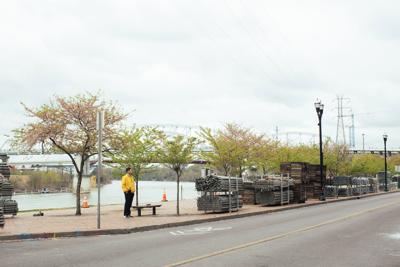


Some cherry trees remain as crews set up for the NFL Draft
On the last Saturday in March — just two weeks ahead of the annual Cherry Blossom Festival — Nashvillians woke up to news that 21 mature cherry blossom trees would be chopped down in Riverfront Park to accommodate a 450-foot-long stage. The stage would be used for three days during the upcoming NFL Draft, an event spearheaded by the Nashville Convention and Visitors’ Corp. and the Mayor’s Office of Special Events.
Jim Gregory and Will Worrall of the citizens’ group Nashville Tree Task Force pounced on the news, drafting a Change.org petition opposing the trees’ removal. The petition read in part: “The city needs to stop allowing private interests to supersede the public’s interest.” More than 66,000 people signed the petition, and Mayor Briley modified the plan, instructing the NCVC and the NFL to remove some trees for transplant elsewhere in the city while chopping down others that were diseased or near death. Arborists, however, generally advise against moving flowering trees in the springtime (when transplantation could be potentially lethal), and Briley’s statement left many unsatisfied.
The Tennessee Division of Forestry estimates that over the past eight years, Nashville has lost 72,000 trees. Since Metro owns only 5 percent of the land in Davidson County, activists who want to improve tree density are setting their sights on private land.
Councilmember Angie Henderson has worked closely with the Nashville Tree Task Force and the nonprofit Nashville Tree Foundation to craft a bill that would amend Metro’s tree ordinance. The amended ordinance would require newly developed commercial and multifamily residential properties to increase new and preserved tree density by 36 percent. Significantly, developers would no longer be allowed to subtract the building’s footprint from the tree density requirement. Gregory notes that even with this increase, Nashville will fall below average compared to peer cities like Atlanta and Charlotte, N.C.
The bill passed its first reading in November 2018, and now the Metro Planning Department is meeting with stakeholders — including tree advocates, nonprofit leaders and developers — to fill in the details. Henderson says the bill is meeting opposition from developers, who say it shouldn’t fall on them to increase tree density, adding that people building single- and two-family homes should also chip in.
This is just the first of a series of bills aimed at increasing tree density. Henderson and other Metro Council members plan to roll out amendments to the tree ordinance incrementally. The second reading and public hearing about the current bill, 2018-1416, is scheduled for May 7.
The cherry blossom controversy isn’t the first time Metro has faced criticism over its treatment of trees. In 2016, Metro clear-cut the forest surrounding Fort Negley, triggering public outcry.
Untangling what went wrong in both situations requires a few degrees of patience. Trees touch upon many parts of our infrastructure, so multiple Metro departments oversee their planting, removal and maintenance, such as planning, codes, water services and public works — and of course, the Department of Parks and Recreation, which is the most important body when it comes to trees growing in public spaces like Riverfront Park and Fort Negley Park.
In the case of the cherry blossom trees, as many as five separate bodies may have reviewed plans for their removal. The Metro Board of Parks and Recreation supervises, controls and operates the city parks system, but according to board member Susannah Scott-Barnes, the plans to remove the cherry trees from Riverfront Park did not cross the desks of those board members. Members of the Metro Council’s Parks, Library and Arts committee say they were also surprised. Then there’s the Metro Tree Advisory Committee, which is made up of Metro staffers and people in the nonprofit and for-profit sectors. Its role is to “assist in educating the community and agencies of the Metropolitan Government regarding the value of trees and proper techniques for the planting, maintenance, and removal of trees.” Despite its very specific description, the advisory committee wasn’t consulted about the cherry tree removal either. After Fort Negley was clear-cut, a new board was formed in late 2016: the Parks Natural Resources Committee, to which tree-policy activist Gregory was appointed. He says the committee met only once in 2016.
Which brings us back to Parks and Rec, which has an ad hoc review board of Metro employees from various departments who can review tree removal on public land. This body, which includes urban forester Stephan Kivett of Metro Codes and urban forestry manager Naomi Rotramel of Metro Water, gave the cherry tree removal the green light.
Nashville Tree Foundation president Noni Nielsen sees the cherry blossom outcry as a step toward all of Nashville seeing that trees have environmental, health and economic value. She cites Washington, D.C.’s Cherry Blossom Festival — a three-week cultural event that draws 1.5 million tourists annually and generates about $150 million worth of economic impact.
“I would love to see our visitors’ bureau invest in something ... that is going to have that economic impact over and over and over again,” says Nielsen. “Not one time.”
But D.C. didn’t always see that potential. According to The Washington Post, the government of Japan gave the nation’s capital 3,000 cherry trees in 1912. When President Franklin D. Roosevelt wanted to build the Jefferson Monument in their path, a group of women organized a pro-tree movement that saved the trees (and the annual cherry blossom celebration).
Nashville may have a long fight ahead of itself for greater tree protections and awareness, both in government and in our own backyards. But tree advocates Gregory and Worrall are ready.
“We’re taking the oak-root strategy,” says Gregory. “Oak roots don’t break through concrete and bend steel in one swift movement. They apply gradual, consistent pressure, and over time, the cracks begin to form, and eventually something crumbles.”



