
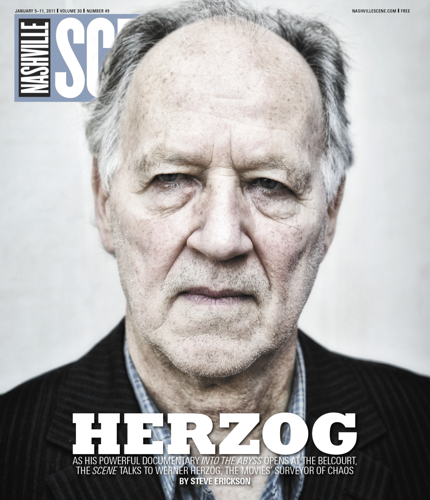
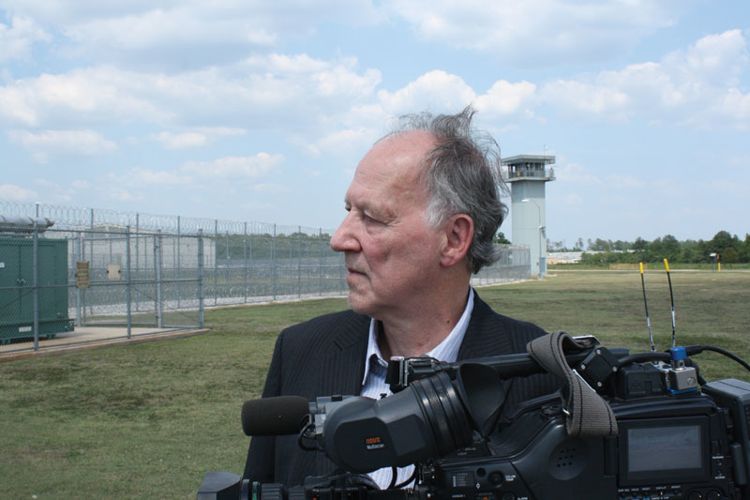


Judging from his films, German director Werner Herzog might seem an intimidating figure to interview. His work is full of mystical ponderings on the indifference of nature and the unreasonable impulses in the hearts of men. His movies seldom examine obsession from a safe distance.
Take 1982's Fitzcarraldo, his most notorious film. For it Herzog staged a foolhardy episode in which his 19th century hero commanded natives to drag a steamboat over a mountain in the Peruvian rain forest — part of his scheme to build an opera house. It was a quixotic and hazardous undertaking, captured in all its awe-inspiring folly in Les Blank's unforgettable making-of documentary Burden of Dreams. And yet, because its maker jumped into the void alongside his protagonist, Fitzcarraldo captures the sense of being held in thrall to an all-consuming vision as few other films do.
As a result, it's sometimes difficult to draw a fine line between Herzog's tormented characters and the director himself, who has a keen eye for self-promotion. The subject of countless Internet parodies that apply his pitiless narration style to everything from children's books to nursery rhymes — though it's hard to top his actual reading of the bestseller Go the Fuck to Sleep — he seems to enjoy playing to stereotypes about German romanticism and his country's national character, acting like the "crazy German guy."
Yet when the Scene met Herzog in October to talk about his latest documentary, Into the Abyss — a true-crime study opening Friday at The Belcourt — the crazy German guy was nowhere in sight. While the discussion was animated at times — unfortunately, his parting dis of Steve Earle as a self-promoting vulture wasn't caught on tape — the somber, pensive director never seemed to be acting out a persona.
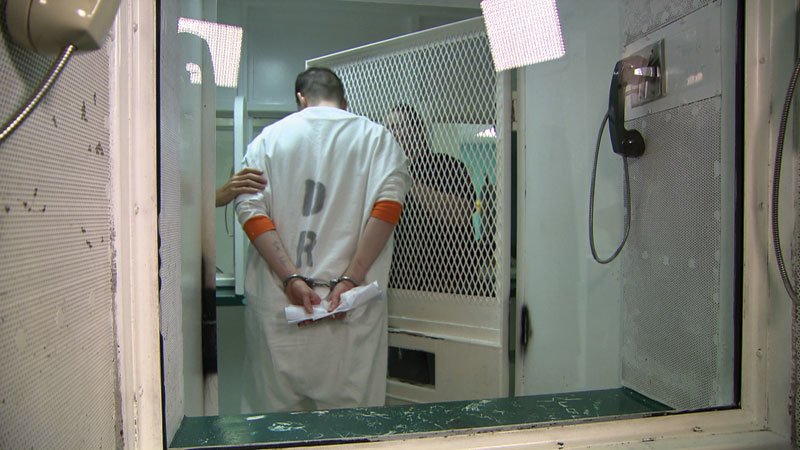
This is fitting, as Into the Abyss is one of Herzog's most straightforward, journalistically inclined films. Where his Gulf War documentary Lessons of Darkness found horrific beauty in the devastation left by Kuwait's oil well fires, Into the Abyss investigates a murder in Texas and uses it to explore America's death penalty and culture of poverty. Relying almost entirely on interview footage, Herzog reconstructs a senseless crime in which several people were killed just to get access to a car.
Since making his feature debut with 1968's Signs of Life, Herzog has gone back and forth between documentaries and narrative films. At first, films as inimitable and distinctive as 1972's Aguirre, the Wrath of God and 1977's Stroszek overshadowed his documentary work. But over the past 30 years, the tide has turned, and Herzog now looks primarily like a documentary filmmaker. While he's made some worthwhile narrative films recently — such as Bad Lieutenant: Port of Call New Orleans, his entertaining reworking of Abel Ferrara's Bad Lieutenant — they can't compare to the string of consistently powerful documentaries he's made in the past 20 years, including last year's surprise 3-D arthouse hit Cave of Forgotten Dreams.
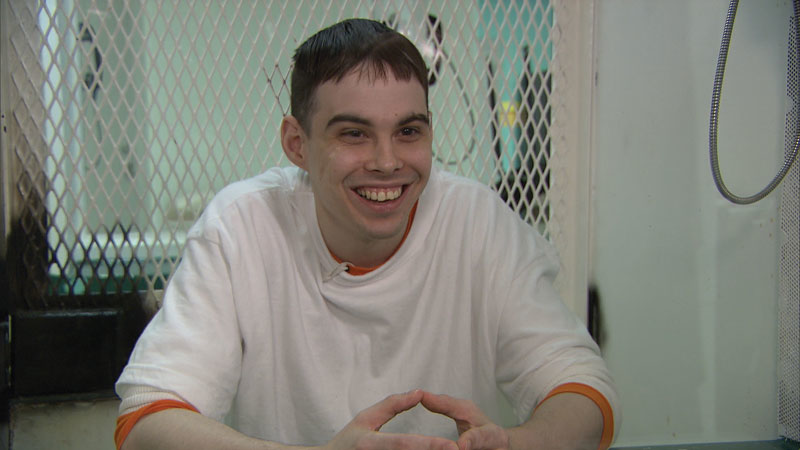
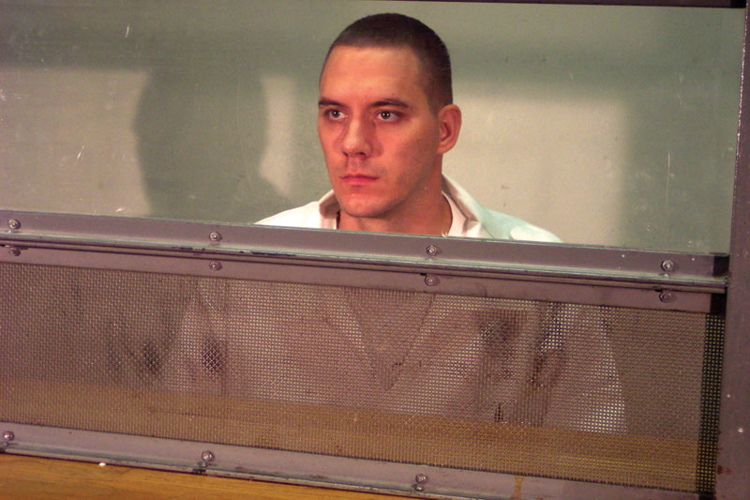
Add to this list Into the Abyss, his best film since 2005's Grizzly Man. The movie is light on mysticism, yet it concerns itself with the differing fates of the two killers convicted in the Texas case — one of whom, Michael Perry, was interviewed by the director just eight days before his scheduled execution. His partner in crime, Jason Burkett, received a life sentence. Uncharacteristically for Herzog, he declares his opposition to the death penalty in the movie's first 10 minutes — explaining in the film's press kit that his stance is rooted in his childhood experiences in Nazi Germany.
But those expecting (or wanting) an attack on capital punishment will be frustrated. Into the Abyss is more a study of the spiral of chaos that the crime sets in motion, of which killing one of the killers is the ultimate extension of the unfolding illogic. Herzog has never made overtly political films, even when he's taken on political subjects, and the results have often been conservative by default.
He seems attracted to the theme of colonialism, for example, but his take on it is ambivalent. While theoretically sympathetic to indigenous people, he tends to portray them as noble savages, reserving charisma for the type of Aryan brutes played by his "best fiend" leading man Klaus Kinski in films such as Aguirre and Fitzcarraldo. Critics have argued equally passionately whether Lessons of Darkness is actually pro- or anti-war; Jonathan Rosenbaum compared it to the morally untroubled image-making of Nazi propagandist Leni Riefenstahl.
But Herzog says that he searches mainly for moments of "ecstatic truth." He's been willing to resort to elements of fiction in order to find them: In Lessons of Darkness, a firefighter suddenly reignites a powerful blaze, a gesture which seems meaningless, while some of the interviews in Grizzly Man appear blatantly rehearsed. With Herzog, however, even in the fictional films, the least likely incidents are often true. The one moment in Into the Abyss that seems dubious — a chaplain's odd story about an encounter with a squirrel on a golf course — is according to the director a product of real chance.
If the crazy German persona is missing from Into the Abyss, it's sure to be present in Herzog's next project: playing a supervillain in the thriller One Shot opposite Tom Cruise. The Scene spoke to Herzog in October at a Park Avenue hotel in New York.
When did you start production on this film?
Cave of Forgotten Dreams was filmed in March and April 2010. I was in the middle of editing, in June, when I jumped into filming Into the Abyss, when I knew that one man whose crime interested me was going to be executed in eight days. I left editing behind to start shooting, so it overlapped. There's a separate television miniseries version of Into the Abyss [Death Row: A Miniseries in Four Parts], which isn't finished yet. In December, I have to act, and in January, I'm teaching my Rogue Film School.
What made you want to make a film about the death penalty?
It's not about the death penalty! It's about a senseless crime and as a secondary title, it's a tale of death and life. It's about the urgency of life. It's not an issue film. Coincidentally, one of the perpetrators was executed, whereas his co-defendant, found guilty of the same crimes, got away with life in prison. It's equally about victims of violent crimes. I tried to avoid narrowing it down because people will think, "Do I want to be part of a film which is an argument about the death penalty?"
But the central issue is about the fact that he takes a life and then the state takes his life.
Yes, but what makes this crime so interesting for me is the staggering amount of senselessness. Let's assume that if both perpetrators had gotten away with life in prison, it would have been equally fascinating. I would have made the same film.
How did you get involved with the Investigation Discovery channel, which backed the film? I find some of their programming interesting, but it's usually marred by sensationalism and bad re-enactments. When I saw your film, I thought, "This is finally how it should be done."
Because of the Internet, television is in a slight decline. But Investigation Discovery has grown by 95 percent [over] the past year. They figured they need to add some real quality to what they're doing. It's a very fine target to work with. They were almost instantly on board. They liked the idea and my previous films. It was not me who contacted them. My company co-produced the film because I wanted to control the foreign rights.
At the end, there's a dedication to victims of violent crimes. What interested me about it is that it starts out with a chaplain talking about his experience of the death penalty. The major justification for the death penalty in the U.S. tends to be closure for the victims' families. By the end here, though, you're swayed from one position to the other.
Closure can be life without the possibility of parole. Even Lisa Stotler, whose brother and mother were killed, admits that it would be an eternity. [The death penalty] is more archaic, like a criminal justice system with the possibility of retribution. Statistics tell us it doesn't play any role in the prevention of crime. It's a very ancient concept, anchored in thousands of years of almost every civilization on the planet.
America has no exceptional status. China practices capital punishment. Almost the same population size in Pakistan practices it. Russia just gave it up recently. I'm not in the business of America-bashing, or Texas-bashing either. [Texas Gov.] Rick Perry represents a vast majority who are pro-capital punishment. It's not going to go away easily or quickly.
I'm interested in the way you conduct interviews.
I never do interviews. They're conversations. I don't have a list of questions, like you have. I have no idea what's next. You have to find the right tone, and the conversation can go in another direction. I'm trying to find out about things that trouble and fascinate me. Talking to people is my profession. I wouldn't be a filmmaker if I couldn't do it.
In a way, it's a public profession. You have to take charge of things. If I didn't have it in me, I never would have made a decent film. You can't learn how to ask a question in film school. When I asked the death row chaplain about the squirrel, I asked him because he seemed like a television preacher and I had the feeling I had to look into his heart. Fifteen seconds after that, he was unraveling. I don't even know myself why I asked him about the squirrel. You have to have the right instincts.
What surprised me about the film is whether the killers really did it for the sake of a red Camaro. You had enormous time constraints, but you didn't seem to answer that question.
I have read 800 pages of court testimony. Every single crime photo and video, every single statement of a detective. So it's public record, and it's accessible to the general public. If you want to know all about the case, read these transcripts.
But I want to see you interrogate that notion of senselessness.
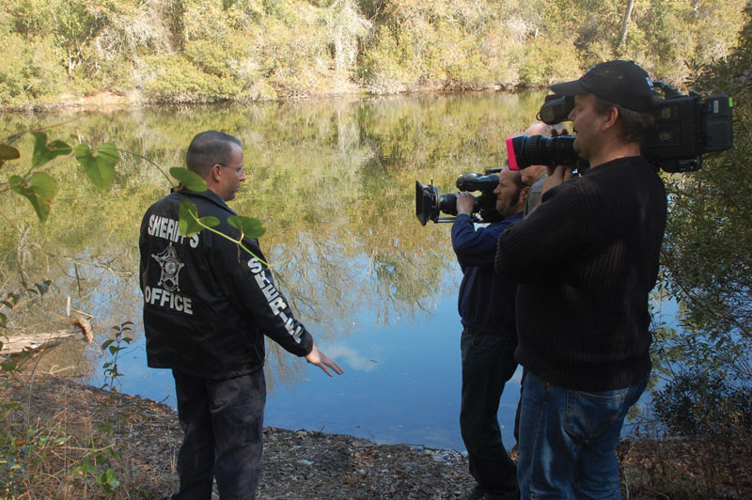
Both perpetrators had asked to spend that night in this house because they knew the son who lived there. They were acquaintances. There was a vague plan that they would steal the car keys and maybe a year later make it to California. When they approached the home they saw a woman alone, making cookies. The son was not home. They spontaneously decided it would be so much easier to just kill her and take the car. Then they dumped the body in a pond.
When they returned, they found the gate closed and didn't have a clicker. They waited for the son, who had a friend with him, and they killed those two teenagers just to have access to the gate. I can assure you that's what we know from the case file, witnesses and two confessions from Perry. As mind-boggling as it may sound, they wanted to have a car, and they were in possession of it for less than 72 hours.
One thing I love about your work is your diversity of interests. What connects with you to your subjects?
I don't know. Some of my films try to look into the human condition. Into the Abyss could have been the title of quite a few of my films. Initially, there were suggestions like, "Let's call it The Red Camaro." That's fine, but it shouldn't be the title. Into the Abyss stems from Cave of Forgotten Dreams. It's looking deeper into prehistory. All of a sudden, we manifest ourselves as modern human beings. It's not that I'm searching for these projects.
Since your theme is the senselessness of the crime, did you deliberately leave Michael Perry's backstory ambiguous? You say that he lived out of the back of a car, and then you seem to contradict yourself immediately, saying that he had supportive parents.
His parents told him, "Go to work, and you can live with us." But he didn't want to work. You're right that there's a gap. The gap can be explained. His father died 13 days before I met him, and 8 days later he was executed. His mother declined to appear on camera. Months later, I cautiously approached her again. I said, "I hope the worst of times are over," but she said no. There are no other family members. I would like to know about his family and upbringing, but the film doesn't have a chance to give it to the audience.
I was struck by the movie's lack of judgment toward these people.
You don't necessarily have to like them, just respect them. I'm not trying to be chummy or portray them as outlaw heroes. I had no idea what they would be like. What I find was something essential about ourselves, and the human condition. When the death row inmate talks about seeing the world from a van, he says, "It all looked like the Holy Land." I took the same trip with my camera, and it looked like average, gray Americana. But an average gas station could all of a sudden become magnificent. The shittiest suburb could change perspective. It brought about a new perspective.
Email editor@nashvillescene.com.



