


Beyond the personal grief of those who knew him and the memories of those who observed him over his decades as a singular figure in Tennessee politics, the death of John Jay Hooker over the weekend raises a political and legal question: What now for legalized doctor-assisted suicide or 'death with dignity,' the cause to which he dedicated the final year of his life?
That was the point, in a way. By making his dying self the central piece of his argument — by making his crusade personal and not just hypothetical — Hooker guaranteed that his effort would attract attention while he was alive and that his death too would mean the words 'death with dignity' appeared in newspapers around the state.
The effort he started will go on, albeit as a long shot. Shortly after Hooker's cancer diagnosis, House Minority Leader Craig Fitzhugh agreed to sponsor a bill for him that would have essentially legalized doctor-assisted suicide patients meeting certain criteria, including being over 18, mentally competent and having a terminal diagnosis from two physicians. That bill was sent to a Summer Study where it was taken up by a committee, allowing Hooker to testify on the issue. The bill could come up again if Fitzhugh or Senate sponsor Reginald Tate decide to move on it, but it's practically a non-starter in the Tennessee legislature.
As for Hooker's fight in the courts, which began when he filed a lawsuit essentially asking for aid in dying in May, his attorney and long-time friend Hal Hardin tells Pith the legal case goes on. Three medical doctors are also plaintiffs in the case, Hardin explains, so the case does not die with Hooker. Those doctors want the court to rule on what their rights are as it relates to treating patients in Hooker's position. Davidson County Chancellor Carol McCoy had dismissed the suit in September, claiming Hooker didn't have legal standing. In October, Hooker asked the Tennessee Supreme Court to hear his case without waiting for an appellate court to rule on it, given what he expected was his imminent death. In November, the high court declined to hear his case before it went through the regular appeals process.
As it stands now, it could be heard by a court of appeals, though no date has been scheduled.
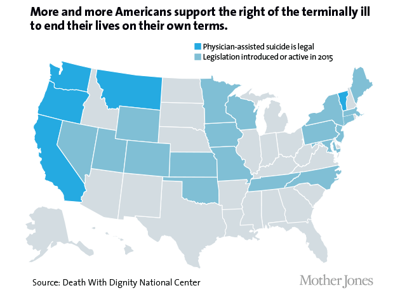
Four states have legalized physician-assisted suicide, but some form of such legislation has been introduced in many more and the issue has been the subject of some national media attention in the past year. Earlier this month, Kevin Drum of Mother Jones wrote a lengthy piece on the issue motivated by his own terminal illness and stating that, since California is among the states that has legalized assisted suicide, "when the end is near, I want to take my own life." Opponents have written just as forcefully on the issue, as when The Week's Michael B. Dougherty picked over a New Yorker piece that reported on the practice in Belgium, where Dougherty argues the many dangers of the policy are being exposed.
With Hooker's passing, the issue seems likely to fade from Tennessee's agenda. But his case, anyway, is still on the docket.



