
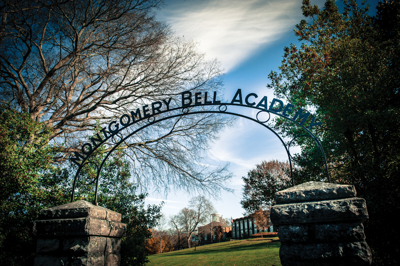

In the aftermath of the document handover, MBA headmaster Bradford Gioia spoke briefly to the Scene's Steve Cavendish about the financial-aid investigation, the TSSAA's framework and enforcement of financial-aid issues, and his impression of the coverage to date.
What do you think the school learned over the course of the investigation? Do you think the school had a lack of institutional control in regards to financial aid and athletes?
I think we learned that we always want to do things appropriately. And I think that, as you said, we made some mistakes of omission and not commission, in that we never actually tried to recruit people. And we could have a done a much better job in understanding how payments should be made. So, yes, we've certainly learned some things, and we value doing things the right way. We've admitted that.
One of the outgrowths of the investigation was that you had said MBA would like to share with other Division 2 schools what you had learned from this process and that you would lead an education process.
We went to the state meetings with the TSSAA, and I've made some talks at events and said that anyone who wants clarified for them the things we have learned and how we can all make sure to do things appropriately, we'd be glad to talk about that.
Has anybody taken you up on that offer?
Well, they did that day and we've had several calls afterwards.
One of the things that's striking about this case and indeed most of the financial aid cases is that it seems like the rules that are in place for Division 2 schools are nearly impossible to enforce. Is that fair? It appears to be a completely voluntary set of enforcements.
I think it's like a lot of laws and rules, like perhaps our speeding laws. You know what the rules are. You're supposed to do things a certain way. All of our schools that are independents that you're pointing out, the TSSAA has tried to do their best in communicating the policies. As you well know, we self-reported everything, and we did our own investigation as well as opened up our records to the TSSAA. Because we knew something was wrong in what had occurred in the process of financial aid. And I think that's a hard thing for anybody to do. And it's a hard thing for us. We think we did the right thing in opening ourselves up and being open about it all.
Do you think Division 2 schools that offer financial aid are compatible with the TSSAA framework? Several other states have seen a split where those schools form their own association. Is that more viable?
I think my hope is that it will not split the two, although it is certainly hard to marry independents and all of the desires of independent schools, as you would know. There are problems in the public arena just as there are problems in the independent arena. And so I don't think it's fair to paint it the way you're painting it. I think it's a very one-sided perspective. We will have a better city and state if people know each other on playing fields and they know each other as individuals who do not play separately.
Holistically, how that works out, I cannot predict. And I would be dishonest if I didn't tell you that I'm frustrated sometimes about the issues. And that's separate from the financial aid issues: the practicality where we play state championships, whether that makes the most sense for the independent schools; where the lines are drawn; why we're required to play on certain test days like the SATs. There are a lot of compromises in any sort of membership in an organization.
But I hope you hear my comment that the city and the state are ultimately better off. I think it's very unfair the way you're arguing it, to be honest. It's not just about financial aid. That's one of many, many topics. I think you're being much too limiting in bringing that up as the major issue.
What is the major issue?
I articulated it. And I think you can look at transfer issues; why certain public and independent schools have certain advantages. It's a huge topic. If you look at the financial aid issue, MBA was founded on financial aid — that is to say, the request for the school was originally for boys who could not afford to come here. And you have thoroughly vetted this as I've read your writings. I think you should see that what we did was not so intentionally trying to find students. We were a little sloppy about how we did things.
I think that's a fair reading of the issue.
Your articles have been very slanted, so you're not talking to a friendly.
Anybody who reads these records walks away with the impression that MBA, in most cases, was trying to help kids whose situations had changed and couldn't be at MBA without help.
It wasn't as though there was institutional lack of control, which you said; it's that we weren't paying attention to every "T" and "I," and I agree with that. This stuff is pretty complicated, and it's just like any story: You can't quite get to the bottom of it so easily. But I appreciate you calling about it. It's very old news, as you know.
Well, the courts move a little slowly.
This would have never come to the attention of the TSSAA unless they look through every school's records.
Is Joe Davis still a member of the coaching staff?
Yes. He's a volunteer coach, yeah. And I understand from what I've been told, that you're going to attack him a little bit.
I'm just pointing out what the records say.
What do you think the records say?
It says that he helped one kid who couldn't afford to be at MBA and had another situation where, as terms of his employment, his father got his son's tuition paid.
I suspect if you did your journalism more carefully, you'd see that at a number of independent and private schools in this state. Which is only to point out your general question, that it's hard to track a lot of these financial aid issues. And I'm not excusing any of this, given I know what the rules are. We didn't hide that particular issue, incidentally. We looked at it like a business.
But I can see ... I've been through all of this with TSSAA, and I know these problems. I mention that because Joe's not a vicious offender and somebody who went out to buy people. I'm just telling you my own personal opinion. He's not somebody that I'm particularly close to, so I'm not trying to protect anybody. He doesn't work here in the sense that he's an employee of the school.



