
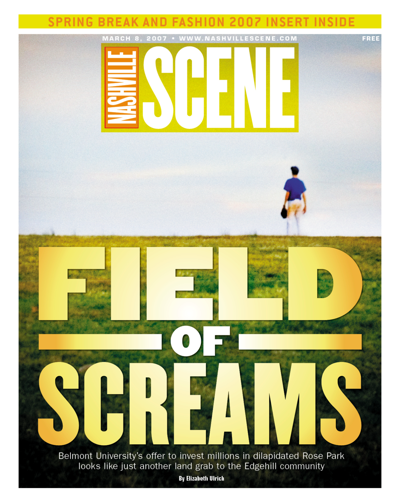

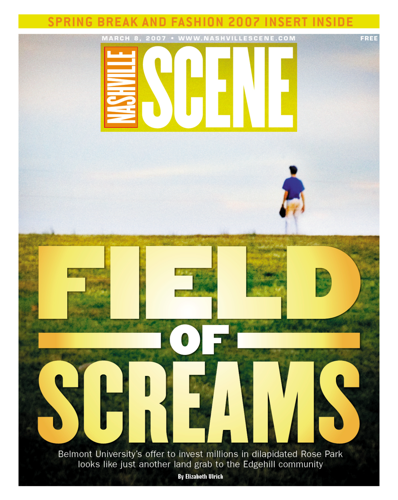
From his office on the second floor of Belmont University’s Freeman Hall, Robert Fisher peers out the window, past the building’s classic columns, and points to a park pavilion sitting atop a hill of browning grass. From here, a mass of spindly trees obscures what rests just below that hill—a nearly 25-acre park that isn’t much to look at. With no bathrooms, no landscaping, rusty chain-link fences, cracked concrete stadium seating and unkempt outfields, the conditions at Edgehill’s E.S. Rose Park are poor at best.
Yet when Fisher, Belmont’s president, looked at that same patch of grass atop that very hill nearly one year ago, he saw the perfect solution to the university’s limited athletic facilities: a seemingly underused community park that could house a multimillion-dollar, state-of-the-art sportsplex.
In his office, Fisher holds oversized renderings of Belmont’s dreamy sports park above his shoulders and smiles. Complete with fountain-laden walking paths, pristine landscaping and brick-lined stadiums worthy of NCAA Division I play, the picture-book renderings show a glisteningly flawless Rose Park.
He wants Belmont to invest $6.8 million to upgrade the park’s existing baseball and softball fields and to construct a new soccer field, track, rest rooms, locker rooms and concessions. In return, he has asked the Metropolitan Board of Parks and Recreation to allow Belmont’s sports teams to use the park’s facilities. In January 2006, the board agreed to explore the partnership with Belmont and in February asked Belmont to develop a contract for usage. “I’ve believed from the beginning this is a win-win deal,” Fisher says.
But not so fast. Many Edgehill residents would rather see the park rust and rot away than share it with Fisher and his Belmont crew. While they’ve raised concerns about everything from increased traffic and parking difficulties to noise, it’s the fear of a complete Belmont takeover of the park—and the community—that’s got residents riled. Given the neighborhood’s historic struggles with big universities (with even bigger plans to buy up homes and build on top of them), the neighborhood’s anxiety is not entirely unfounded.
Still, the overwhelming—and at times, vehemently emotional—opposition has caught Belmont officials off guard. A bit dumbfounded and admittedly reeling in his own naïveté, Fisher says he’s surprised that he hasn’t been able to convey his grand vision for the park more effectively. “I’m not sure why it’s bad for the community,” he says. But as he stands smiling in front of the technicolor park renderings, now poised in a pile against the wall, he returns to talk about artificial turf, stadium seating and such. And you sense he has no idea that many of his Edgehill neighbors think the perfect park is one without him in it.
Edgehill is a predominantly black neighborhood where more than one-third of residents are living in poverty, according to one neighborhood association. Over the years, the neighborhood has endured white flight, an ever-encroaching Music Row and Belmont University’s buyout and demolition of Edgehill homes for its expansion in the ’50s. The burns inflicted by gentrification and urban renewal are still exposed and oozing. To many, any word that Belmont could be moving into the neighborhood park is just another strike of the match.
In the densely populated neighborhood, a smattering of homes, along with Rose Park Magnet Middle School and Carter-Lawrence Elementary Magnet, couch the community park so closely on all sides that you could stand on the park’s perimeter and hit them with a rock, or for that matter, a wayward foul ball. Residents such as Arlene Lane, who has worked with the Organized Neighbors of Edgehill (ONE) since 1969, describe the park as one of the neighborhood’s few amenities.
Lane is frail and has the demeanor of a patient schoolteacher. But when she talks about her fight to keep Belmont out of Rose Park, she’s flustered to the point of shrill. “Can you imagine being in the position where every single thing that you have—no matter what it is—you have to fight for…whether it’s grocery stores, whether it’s parks, whether it’s schools,” she says, her cheeks and neck flushing. “Every single day is a fight, and it’s a fight for the people who have the least amount of resources to be able to fight against it and win.” She exhales, drops her shoulders and sighs. “It’s frustrating.”
For almost a year, Lane has toted around a hefty tupperware box filled with various documents, ONE letters addressed to Metro parks officials and folders bearing homemade stickers that read “Edgehill Community OPPOSES Belmont Proposal to Revamp Rose Park.”
In the park’s potholed parking lot, she climbs into the backseat of her beat-up car, pulls out a few papers from among the tupperware trappings regarding ONE’s latest fight, and starts in with a well-rehearsed list of problems with Belmont’s plan. “It’s just another example of how more and more things are being taken away from the indigenous population of Edgehill,” she says. “There are many, many parks across the system—many much bigger parks than Rose Park. Belmont University doesn’t have to come to Rose Park.”
Sure, Belmont doesn’t have to refurbish Rose Park, but it does have to go somewhere. Years of ambitious expansion have exhausted the university’s available space. With only a soccer field on campus, Belmont’s athletic facilities are minimal. Its baseball team plays at Greer Stadium and Shelby Park. Its softball team leases a field at Aquinas College. And the track team uses the Vanderbilt track for practice and home meets.
All the while, Rose Park, located at 1000 Edgehill Ave., sits about one mile away from Belmont’s main campus. Couple that with the park’s ready-made ballparks ripe for an upgrade—all amid a stellar skyline view of downtown—and Belmont is faced with a deal too attractive to pass up.
But when ONE held a community meeting about the university’s proposal in January 2006, Lane says Edgehill residents unanimously voted against it. They’re quick to cite parking problems and increased traffic in a long line of grievances against the proposal—and against Belmont, whose growing pains have already left Edgehill streets more congested, Lane says.
Fisher says Belmont’s proposal calls for cars to filter into the park through the heavily trafficked Wedgewood Avenue and 12th Avenue South. The plan also outlines that the improved baseball field alone could seat 500. Those spectators would be parking in a proposed 244 spaces throughout the whole park. “That’s standard,” Fisher says.
But residents say those parking allocations don’t take into account all of the other spectators—softball and soccer fans just to name a few—who will join the coaches, players and general park goers who will also require parking. They also fear that parking spillover can’t hit neighborhood streets without an increase in traffic.
Then there are the scheduling conflicts. Fisher estimates that the park would be available to schools and the community at least 85 percent of the time. Metro parks board member James Lawson says it’s a pretty close approximation. But Metro parks’ own estimates show scheduling conflicts between Belmont and neighborhood schools in at least seven months out of the partnership’s first year.
When those conflicts do occur, Fisher says neighborhood schools will take priority. “We’re not the ones who will say who does what,” Fisher says. “Belmont will have to schedule through Metro like we do at Shelby Park. We don’t have first dibs on anything—and we’re accustomed to that.”
Lawson says the parks department will, indeed, have the final say. Schools, community organizations and Belmont would submit their schedules and usage requests to the parks department, who would then mediate conflicts and devise schedules for the fields. Fisher says Belmont’s willingness to be “flexible” should ease scheduling woes.
Judging from president Fisher’s usage analysis, the very residents fighting against Belmont’s plan rarely even use the park. “I have been in that park more than 100 times in the last two years—probably a lot more than that. It’s maybe 3 to 5 percent of time that there’s anything going on at those fields.”
Perhaps Fisher hasn’t visited the park during school hours. In a June 2006 letter to Roy Wilson, director of Metro parks, Rose Park Magnet Middle School principal Wade Jones writes that the school’s physical education teacher uses Rose Park’s fields for classes from 8 a.m. to 2:30 p.m. at least 60 percent of the days during the school year. He also says one-third of the school’s students walk through the park to and from school.
Carter-Lawrence Elementary Magnet and Hume-Fogg Academic Magnet High School also use the park, but Jones says they’re able to do so with few scheduling conflicts. To determine if the park is available now, he says the school’s P.E. coach can just look out of a window. “It’s not a great facility now, but it’s one the schools can use,” Jones says.
After studying Belmont’s renderings, Jones worries that the revamped baseball field would be a mere 30 feet from the school. “I’m just thinking about home runs and long fly balls that end up in the library,” he says. Add that to the noise and hoopla that comes along with construction—and the potential for students to watch an NCAA ballgame from their desk any given spring afternoon—and the proposal might not be such a good deal for schools.
As for Fisher’s promise of scheduling flexibility, ONE’s not convinced. “When someone or some business is investing $6 million in a project, the question as to how many times they are willing to go somewhere else for their practices is highly questionable,” Lane says. “The community definitely believes we will be on the losing end when it comes to scheduling.”
When those NCAA-quality facilities open to the public, Belmont may not be Edgehill’s only scheduling headache. ONE worries that people from all over Nashville will flock to their little community park. Some Metro officials hope they’re right.
“It is their community park, but it’s part of Metro’s park system,” Lawson says. “So in the grand scheme of things, if an opportunity at one of our parks opens up that benefits the entire city of Nashville, we had to weigh that against the issues that exist in the immediate community…. I think most organizations think there’s an intrinsic right to making the final policy decision about that area, and that’s not their responsibility.”
That’s what ONE has feared all along, that the larger need would overtake the community’s needs—and their park. It doesn’t help that several ONE members claim that Belmont’s president said at the very beginning that “Belmont only wants to pursue the proposal if the community is in support of it.” Fisher says he doesn’t recall making such a statement.
It also doesn’t help that members of ONE feel that Belmont and the parks board haven’t truly addressed their concerns about the proposal’s potential impact on the neighborhood. The only formal impact study Belmont has conducted was an October environmental assessment to determine if there were any hazardous substances or petroleum products under the park’s surface before construction. They didn’t find anything.
A January 2007 parks staff analysis of Belmont’s plan refers to a “photometric light study of the baseball and softball field,” which found that the proposed field lighting would direct light downward with little “spillage” outside of the fields. But Belmont didn’t produce a written report of the light study.
That still leaves traffic, parking, noise concerns and, of course, scheduling conflicts unresolved. And Lawson says the parks board still doesn’t know who would handle park maintenance (especially in the off-seasons), who would be held legally responsible if someone is injured at the park or how many years the partnership would last. But Lawson is certain about two things: he wants the parks board to give Belmont’s proposal final approval in the next three to four months, and he wants the partnership to be a multiple-year agreement “in fairness to Belmont.”
It seems the only thing everyone can agree on is that Rose Park needs help. In fact, the park board’s 2002 Metropolitan Parks and Greenways Master Plan called for anywhere from $600,000 to $800,000 to enhance the park’s athletic fields, Lawson says. The master plan improvements are still a possibility, he says, but the board didn’t include the capital dollars in its budget for the next several years. Translation: Lawson says Belmont’s proposal will “get us to a place where we can’t afford to get faster.”
Despite assurances that a partnership with Belmont will truly help their community, despite Belmont’s attempts to garner community input through neighborhood meetings and advisory groups it assembled on its own, many longtime Edgehill residents just don’t want Belmont around. Indeed, some are downright hostile.
Janice Davis, a 55-year-old substitute teacher who has lived in Edgehill most of her life, now lives in a home about 100 feet from Rose Park. She is one of the founders of the South Nashville Neighborhood Assistance Group, aptly acronymed SNNAG.
As Davis speculates about president Fisher’s Confederate roots, about how Edgehill was rattled to the core by blasting on Belmont’s campus—construction that she says cracked the foundation of many Edgehill homes—you sense that this park deal is no longer just a Belmont-Edgehill conflict but rather a cultural chasm too deep for Belmont to cross.
There’s a soft sagging to Davis’ face and a gentle, husky breathiness to her voice, which is mostly free from inflection, even when she sets off on a Belmont rant. As she accuses Fisher of coming to Belmont from “South Carolina wearing his Rebel flag,” the deep furrowing of her forehead hints to how deeply she believes it. Fisher says he has never lived in South Carolina—he is from Arkansas—but has visited a few times. Moreover, his long list of community service work, including his work with the Arkansas Enterprise Group to integrate the small town of Helena, Ark., proves he’s no racist.
No matter how outlandish her claims may be, Davis says she typifies the anti-Belmont sentiment that’s been brewing in her neighborhood for decades. “When I was growing up, Belmont was sitting up there like some big antebellum slave house,” Davis says. She also says her neighbors still talk about childhood run-ins with Belmont bigwigs. “If you were black and you were riding a bicycle on Belmont property, Belmont board members would tell you never to come on their land again,” she says.
Even Belmont’s promises of increased community service, outreach and scholarship programs for the neighborhood’s students—regardless of whether the parks board gives them the go-ahead at Rose Park—breed discord. “It’s just a Band-Aid over cancer to let them get a foothold in the community,” Davis says. “They had all those same kids at their doorstep all these years and they didn’t invite them across the street.”
That tendency to demonize Belmont has much more to do with Edgehill’s history than it does with a little community park. Now shaken awake from his grand Rose Park dream but still a little groggy, Fisher’s starting to face Belmont’s bad wrap. “I really look back at Belmont’s history, and I’m not sure we’ve earned [the hostility],” Fisher says. “But I accept that it’s there, and I know that it’s there. We are going to do our best to earn [trust]. Trust has to be earned.”
Rev. Bill Barnes, a member of ONE’s board and a founding pastor of Edgehill Methodist Church, is a small part of the Belmont history that university officials say is often exaggerated in community lore. Barnes says he was forced out of his rental home on East Belmont Circle in the late ’60s, when Belmont bought the home and replaced it with a parking lot.
But the thing is, the university bought the home outright. Belmont didn’t snatch it up with government help through eminent domain or the like. In fact, Belmont officials say they haven’t acquired any Edgehill homes through eminent domain—ever—which is confirmed by the Metro Planning Commission.
Yet Barnes talks about home after home lost to urban renewal and university expansion, and he’s still surprisingly tender about it. He doesn’t list the houses by street name or address. He refers to them, one after another, by the first and last names of the people who once occupied those homes. Considering his experience in Edgehill, he can’t help but be a little tender.
Barnes, now 75, lived in Edgehill for more than 40 years. Even before ONE formed in 1967, he led his neighbors to fight off the construction of more public housing—and subsequently the concentration of poverty—in Edgehill. About a year ago, he helped thwart zoning changes that would’ve eased Music Row’s push into the neighborhood. And he’s still perturbed to see more Vanderbilt students moving into northwest Edgehill.
He characterizes Edgehill as low-hanging fruit for developers, urban renewers and Music Row alike. “The neighborhood is being radically and rapidly gentrified,” he says. “So there are two kinds of suspicion: one is that people are disgruntled—and maybe rightly so—about parking on the streets immediately close to Belmont. But the much longer-term thing…the more important thing, is that we’re not mad at Belmont, but that Belmont represents another kind of grabbing—grabbing a piece of this community.”
Even though Fisher’s intentions seem good, even though he says Belmont won’t use the park to gain a foothold in Edgehill, won’t buy up and raze the neighborhood’s homes for more space and won’t hog Rose Park, Barnes says Belmont’s plan still triggers the historic Edgehill response: “You’re doing us in.”
It’s a sentiment that could very well make the grand vision Fisher had in his office more than one year ago a moot point to his Edgehill neighbors. Fisher admits that he finds that “somewhat painful,” but he can’t help but still hope it will all work out in the end. “I don’t know how to soothe it other than just to continue to be who we are and who I am and that’s it,” he says. “I haven’t seen much good happen in my life—really meaningful good—unless it hurt a little, too.”
And he’s going to press on with the hope that a neighborhood teeming with Belmont distrust will someday embrace—dare he say it, even enjoy—the new park. In the meantime, he says he’ll keep “spending money on this development as though it’s going to happen.”



