




Marcus Whitney
In some ways, Marcus Whitney has the perfect Nashville tech founder story. It starts in a Mexican restaurant.
The day he arrived, Labor Day 2000, he was still wearing his uniform from Atlanta's Rio Bravo Cantina. He was visiting the Nashville location, and as it happened, the Music City outpost was slammed. The manager pulled up Whitney's information in the corporate system — checked out, looked good — and told him to get out on the floor.
He went home with $140 that day. Soon he was splitting his time between Nashville's Rio Bravo and Le Peep, where his attitude impressed the well-heeled Belle Meade clientele. "You seem like a smart guy," Whitney remembers a customer saying to him. "Why are you waiting tables?"
"See that over there?" he replied, pointing to a book about the Web language HTML. "I'm studying to become a programmer."
As fate would have it, the customer's last name was Frist.
Whitney started attending user group meetings, networking, and sharpening his programming skills. Eventually following a lead from one of his best tables, he applied for a job as a developer at HealthStream — a company run by Bobby Frist. He got the job in April 2001, a day after his son was born.
He worked there for a year — it was "a confusing time in the company," Whitney says — before leaving for an agency called Anode where he would meet formative challenges.
"The guy I replaced, I think, literally would choose another technology set for every single project," Whitney remembers. "So I walked in and inherited ColdFusion technology, this weird database called 4th Dimension, Microsoft ASP, PHP, Java — like, if there was a technology you could build a Web app on, he had done it. The server room had Windows, and it also had Linux, and it had — I mean, it was unbelievably exotic. ...
"I spent a lot of late nights when everyone else was gone, with the lights dim, trying to read all these books and understand all this technology that I did not understand. But I ended up learning it."
Flash forward to Oct. 23, 2012, a gala event at the downtown Schermerhorn Symphony Center. The occasion is the Nashville Technology Awards, and one of the night's biggest honors is Chief Technology Officer of the Year. Standing at the podium, facing the concert hall's grand tiers and sonically exacting fixtures, is this year's winner, Marcus Whitney. Within months, he'll have an even bigger prize — $5 million in Series B financing for his Nashville-based company, Moontoast.
As remarkable as Whitney's rise, though, is the number of peers now present to applaud him. Among the night's other winners will be Kate O'Neill. Her company [meta]marketer works with clients ranging from the Grand Ole Opry to Ingram Book Co. to optimize the way customers interact with their websites. Even the dazzling 20-foot video display that frames Whitney was created just blocks away, near the Entrepreneur Center on Broadway, in the offices of LMG Design Studio. Months before, LMG's Ken Gay had worked there perfecting Madonna's Super Bowl halftime show.
There too is Clint Smith, CEO of online email marketing company Emma. Maybe the most dramatic local tech success of recent years, Emma has gone national, with satellite offices in Portland, Ore., Denver, Austin and New York City. And yet Smith describes being at a neighborhood supper party a few years ago and having to explain what he does for a living.
"Oh, you mean like a Constant Contact or an Emma?" his neighbor asked — assuming Smith's office must be some lesser local version.
"It's funny," Smith says, "the assumption that [we] were in San Francisco or somewhere like that."
But he's not. He's in Nashville, where a close-knit — some might say incestuous — community of local tech pioneers has risen through the ranks. A new generation of small, nimble companies is bubbling up across the city, staffed by skeleton crews of obsessive coders and CEOs crazy enough to believe they can build the next big thing. They talk in a patois of acronymic geek-speak, venture capitalist jargon and affirmational sloganeering. The names may be unfamiliar to many Nashvillians — Cardagin, Evermind, Kiwi, Waffle, Zeumo — but their ethos is not.
They believe Nashville has what it takes to be a great technology city — and moreover, it's a point of pride. Scroll to the bottom of Populr.me, and you'll find a tagline more likely to be inlaid on a guitar or stitched on a bespoke tie than displayed on a website specializing in HTML5-based micropublishing: "Proudly made in Nashville, Tennessee USA." And as more break through to a national stage, they want to see others join them, and extend what they've done.
For that to happen, though, the city will have to figure out how to keep and attract tech talents who, at the moment, are more eagerly courted (and more richly compensated) in established development hubs. And as Nashville shows an aggressive new focus on tech cultivation and recruitment, its tech community must decide whether it's worth trading some of the city's sense of mutual supportiveness for a sharper competitive edge.
The rise of Moontoast says much about the tortuous development of Nashville's tech culture. In the early Aughts, once he'd signed on with Anode, Whitney found himself on a small team that was basically a startup operating within the company. They developed a digital signage platform called FireSign, and made their first installation at the Frist Center.
"I didn't realize it, but it really kind of determined what my professional path was going to be," Whitney says, "into products and startup." After leaving Anode to start what he calls an "ill-fated" consulting firm, Whitney landed as one of the first employees at Emma. The company, whose name is a portmanteau of "email" and "marketing," had been successfully launched by dot-com-crash survivors Clint Smith and Will Weaver, and it was ready to grow.
"But the platform they had was built by an intern at Vanderbilt," Whitney says, "who, the legend says, they paid in beer." After Whitney helped completely rewrite Emma's system, Smith and Weaver offered better than a few cases of Natty Light: They made him a partner. He went on to help hire out the remaining technical team, and stayed on for three years.
Then came the tweets heard 'round the world.
Whitney was at South by Southwest in 2007 when Twitter debuted. "It was unbelievable," he says. "It was the first time that I got to experience mobile devices literally determining where dollars were going to go locally." That got him thinking in new ways.
"I believed that social was going to change the way that marketers worked completely," Whitney says. At the time, though, Emma was not in a position to capitalize. "The right thing for them to do was to solidify the business," he explains, and they did — only without their new partner. Over a tumultuous 60-day period in 2007, Whitney left Emma, which was now serving 10,000 clients; started his own technology company, Remarkable Wit; and separated from his wife.
"A very, very intense period in my life," he deadpans.
As Remarkable Wit was developing its client base, Whitney met two key figures, Joe Glaser and Bucky Baxter. Though known mostly for music — Glaser for his world-class guitar shop, Baxter as a first-call pedal steel player and former Bob Dylan sideman — they had an idea for a company that aligned exactly with Whitney's innovation thesis, which was: Social media would continue to grow; e-commerce would continue to grow; online marketing would continue to grow; and "somewhere in there, in that intersection, there was a great technology opportunity."
Glaser and Baxter collected angel funding, and Whitney began operating what was basically a startup within his own startup. In March 2009, Baxter and Whitney launched Moontoast at South by Southwest, the event that had, in a sense, inspired its invention. By summer 2010, the company would have $6 million in Series A financing secured.
What Moontoast does for a client roster that includes Big Machine Records and Lexus is create direct-to-consumer campaigns and in-newsfeed apps. That second part seems obvious enough — everything, including email signups and purchases, happens seamlessly inside the Facebook newsfeed, without requiring consumers to jump to an external site.
"It's very 'duh,' " Whitney says, "but still nobody's doing it but us." In fact, the "duh" aspect is the secret to a killer app, and the hardest to accomplish. The goal is something easy to use that masks its true complexity, thus making it difficult to copy or steal.
Later in 2010, Moontoast would open an office in Boston, with Whitney spending an average of 175 days a year traveling back and forth. The expansion led to speculation that Whitney was moving the company, a rumor he has worked hard to dispel.
"I've always been working for Nashville," he says adamantly. He has never forgotten that he landed a job his first day here, or that user groups at Cummins Station helped him learn and grow.
"I have a debt of gratitude to this city," he says. "My life is here. I moved my parents here. I've got two children here. I've got a fiancée here. My best friends are here.
"The other thing," he adds, "is that in order for me to have a great professional career, Nashville has to evolve as a startup city."
In a city notoriously resistant to change, that will be no small feat. But at least Whitney and his fellow Music City tech pioneers know what obstacles they face — and maybe how to overcome them.
By the time he sold it in 2007, Mark Montgomery's Echo Music had offices in Nashville, London, New York and Los Angeles, with clients ranging from Kanye West to Keith Urban. But in the Aughts, when he was pitching the monied classes of Nashville his fairly novel idea — targeted online music sales — he got mostly cold stares, or blank ones. He laughs remembering one incredulous response from a potential investor: "You wanna sell what on the where?"

Mark Montgomery
To be sure, Nashville has come a long way since Montgomery started selling "what" on the "where" more than a decade ago. Even so, three key problems persist in the wider startup ecosystem.
First, there is not enough technical talent in Nashville, especially at the senior level — the level of experience needed to produce the simplicity Marcus Whitney cites as the grail.
"So you're better off trying to do something that's pretty damn difficult to pull off, but you make it feel simple," Whitney explains. "Well, guess what? That doesn't require junior and midlevel developers. That requires software architects and great, experienced engineers who've been there and done that and been through fires."
The Nashville Technology Council publishes a quarterly Tech Jobs Report, which typically lists anywhere from 800 to 1,200 unfilled positions in Middle Tennessee. "It's huge, and it's a challenge right now," says Liza Massey, the council's president and CEO. "What we have got to get really good at now is not just creating our own tech graduates and employees, but bringing them in."
Montgomery is more blunt: "I think we lack the technical co-founder and pure tech talent to really bring the market into a sort of nationally competitive realm." And as Nashville's profile has risen, senior talent has been recruited away.
"Corey Watson, who used to be head engineer at Magazines.com, works for Twitter," Whitney says. "Rick Bradley, he works for GitHub. ... I know that Facebook has approached developers in this market."
Second, not enough investment capital is going to small, risk-taking startups in Nashville.
"The deals are way better than they were, but they're still not there," Montgomery says. Part of that has to do with an old-money mindset. At meetings for Partnership 2010 — the Chamber of Commerce's economic development initiative, now Partnership 2020 — Montgomery says he told the "85 old white guys in suits" this: "Look, Nashville doesn't fund what it doesn't understand, and all it understands is health care services. And if you really want to be a national player, you've really got to start thinking outside of what your comfort zone is."
There's a reason that comfort zone is the shape and size it is. Landon Gibbs of the venture capital firm Clayton Associates explains it simply: "Historically, Nashville has been a health care community — people have seen a lot of success." And investors are in the business of succeeding. Part of the hesitance has to do with the kind of in-between area tech startups represent. Venture capitalists typically don't want to invest below $1 million because the math doesn't make sense for them: It's too much risk for too little reward.
Third, Nashville isn't generating enough big ideas.
Relative to other markets, Montgomery writes in a recent Tumblr post, Nashville is still producing "C-plus/B-minus ideas." And as the story of Clint Smith's neighbor demonstrates, even the really good, really successful ideas that originate here don't necessarily get associated with Nashville.
Whitney acknowledges all these challenges. But he says quality of ideas is not his biggest concern.
"The ecosystem is more important than the idea," he says. "When you launch a venture, you're starting with 5 percent true, true awareness of the reality of what this business could be, and 95 percent is uncertain. And over time, as you go to market, and you create, and you get the proprietary knowledge from sales interactions, you close in on something close to, I would say, 80 percent, at a max. ... In a strong ecosystem, you close that gap faster. You can adjust, and you're not so dependent on the strength of that initial idea."
Michael Burcham, president and CEO of the Entrepreneur Center, phrases it more tersely: "Good ideas are worth about 20 bucks. It's all about execution." Taken together, the obstacles are daunting, Montgomery believes, but not insurmountable.
"I think those things are all being worked on," he says, "and quite frankly, I think we're on year three of a 20-year continuum."
Or is that year six? Many, like Kate O'Neill, believe the spark really ignited over the course of 12 hours in August 2007, when Nashville's isolated tech community first saw the strength of its numbers. The setting was a crowded, bustling, "miserably hot" Exit/In; the occasion, the very first BarCamp Nashville.

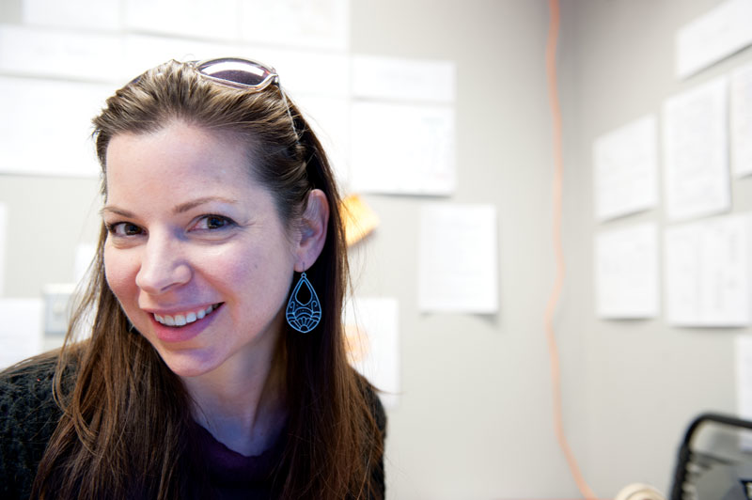
Kate O’Neill
The BarCamp concept of bringing tech-minded people together for an "unconference" was born in the Bay Area. While the first Nashville iteration didn't follow the rules exactly — against form, the event featured scheduled speakers, including serial entrepreneur and Brazen Careerist founder Penelope Trunk — it laid an important section of the tech scene foundation.
"The whole idea was to bring the community together," says Dave Delaney, a social media marketer who helped organize the first BarCamp Nashville along with Whitney (his recruiter to work at Emma) and O'Neill. "Many of them met for the first time in person."
That physical connection proved crucial. In that pre-Facebook, pre-LinkedIn version of Nashville, the bloggers, coders, entrepreneurs and marketers in attendance mostly knew each other only digitally through a network of blogs. Many were aggregated by the WKRN-hosted hub Nashville Is Talking, spearheaded by Brittney Gilbert and later run by Christian Grantham, who now works in the aboveground moonshine business. But meeting in person, at BarCamp Nashville, brought needed new levels of networking.
"That was a pretty key moment," O'Neill says. "It was such a great connecting point for the Web and digital thinkers in town who didn't have a physical venue." At the time, she worked as a Web developer at Magazines.com, sharpening the analytics skills she would use to start her own company, [meta]marketer. (O'Neill took the award for Social Media Strategist of the Year at the 2012 Nashville Technology Awards Gala.)
"Within a few years," O'Neill says, "there's a slew of geek-related opportunities — Firefly Logic Geek Social, the Nashville Geek Calendar." Add to that mix Podcamp (a content-side version of the BarCamp concept) and well-attended meet-ups around Ruby on Rails and other programming languages, and serious momentum began to build.
Opportunities for meat-space networking spread. Delaney's Geek Breakfast template — coffee and computers, basically — has been exported as far away as London and Johannesburg, and he continues to host the events in Nashville monthly. That a schism would develop, albeit briefly, in 2010 between social media- and marketing-focused BarCampers and those more interested in hard coding only showed how much the community had grown.
But if any company proved what benefit real-life social networking could bring to the city's nascent tech scene, it was CentreSource. An early (and ongoing) BarCamp sponsor, CentreSource helped modernize Nashville's technology infrastructure and vocabulary.
As founder Nicholas Holland puts it, "The open-source movement had not found a home yet in Nashville; on the flipside, it was roaring in tech centers like Silicon Valley, New York, Boston, Austin. We had early on decided to use the open-source stack." CentreSource was one of the first companies in Nashville to provide digital strategy for companies that, in many cases, didn't think they needed it.
"Our competitors laughed and said no one would pay for strategy," Holland recalls. "I don't know a single firm in town that doesn't charge for strategy now."
In 2010, .net magazine named CentreSource one of the top three design agencies in the world at a London ceremony. Here, it is just as well known for hosting Yazoo-fueled monthly events that draw upwards of 250 tech-minded Nashvillians — a forum where peers can blow off steam and toss around ideas. Yet even when beer isn't flowing, CentreSource has served as an important connecting point, thanks to Holland's allowing anyone to rent a desk in the company's collaborative workspace.
When relocated New Yorker Brian Daily, Jason Moore and former Nashville Technology Council president Tod Fetherling all started working on separate projects at the CentreSource offices, something interesting happened: They got to talking and realized their interests overlapped in important ways. With CentreSource as essentially their creative lab, they decided to start a company together. Stratasan, a cloud-based health care analytics company, launched in September 2010.
But if BarCamp provided what O'Neill calls a "gelling of sorts," the gel only spread so far. For Nashville's tech scene to take off, it needed more institutional backbone. That need ushered in the next major development on the city's tech front.
[page]
Just as Montgomery had found himself frustrated with the investment community, Holland encountered a similar disconnect at the enterprise business level. He remembers going to a Nashville Technology Council board meeting and asking how many were going to BarCamp. "Crickets," he says. "They had zero idea about this occurring right under their nose. And it highlights the maturity process that Nashville has had to go through to understand this kind of entrepreneurial stuff."
Around 2008, when Holland was developing one of the first location-based iPhone games — GPS Assassins, which eventually sold to Seattle-based WorldBlender with around 24,000 active players — he pitched Vic Gatto of the venture capital firm Solidus Co. on the idea of investing. That's when Holland learned about the $1 million threshold for traditional venture capitalists. (Full disclosure: Solidus is an investor in SouthComm, parent company of the Nashville Scene, and Gatto serves on its board of directors.)
Gatto knew Solidus couldn't get in the tech startup game playing by the old rulebook. But he was also sympathetic to the plight of Holland and other tech startup founders. "Vic was really the only VC that was going to BarCamp, showing up on panels and like, really starting to venture out into the space and connect the dots with us," Whitney says.
So Gatto led the way in establishing a microfund called JumpStart Foundry, which launched in March 2010 to help back new technology-based companies early in their development.
"It was such a ragtag group of people — ridiculously wealthy guys next to guys with three failed startups," Holland says. "We had no idea what we were doing." But for taking that chance with JumpStart, Holland calls Gatto "one of the unsung heroes of Nashville."
JumpStart Foundry was built on a fairly simple, if unconventional, premise: A group of companies still in concept (or "seed") stage would pitch their ideas to the Foundry members. Then they'd leave the team while the Foundry debated.
"We'd argue, and we'd yell, and somebody would have to say, 'I'm going to be the champion for X company,' " Whitney explains. "And then they'd walk back into the room and we'd say, 'OK, here's $15,000, here's your team from the Foundry, go make something great."
JumpStart was testing uncharted waters — uncharted in Nashville, at least. (It was modeled partly on programs like TechStars, started in Boulder, Colo., and Y Combinator, started in Silicon Valley.) "None of the state regulators understood it," Holland says. "Hell, half the startups in town were suspicious of it." But it was mixing things up, and the tech-funding gears, frozen for so long, slowly began to turn.
Meanwhile, a new venue and connecting point was finally taking shape. In August, the Entrepreneur Center, a project more than three years in the making, opened its doors on Lower Broad.
"I don't think the public really saw it happening, but if you were in the know, it was really starting to come together," Whitney says. If 2007 was pivotal for the grassroots Nashville tech community, 2010 marked a similar turning point for the city's larger tech-hub aspirations.
"You're starting to realize who has money, and you're starting to see angel deals getting done," Whitney says. "And you're starting to kind of understand what this EC thing was really going to be about."
Sitting above street level at 105 Broadway, next door to Joey and Gavin DeGraw's bar/nightclub The National Underground, the Entrepreneur Center doesn't look like much from the outside. But every day, people are fighting for their professional lives inside.
President and CEO Michael Burcham is happy to rattle off the vital stats: more than 5,000 visitors in its first 24 months; 1,500 business concepts screened; 50 companies incubated and launched through the EC; total seed and angel money raised by EC startups approaching $20 million. He delivered these to a meeting of StartupAmerica leaders in Washington, D.C., on Feb. 5, where he says the name Nashville was on everyone's lips. (Perhaps Burcham couldn't help but "break into the goofy grin of the newly popular," as The New York Times put "it.")
Of the 50 businesses that have come through the EC, "well over half of them have already reached a break-even point and are now self-sustaining," Burcham reports. Jamplify, a social media platform that rewards users with tickets or other merchandise for creating buzz around bands, took home top honors at Midem, one of the world's largest music industry conferences, after going through JumpStart last summer.
Later this year, the Entrepreneur Center will reopen in Rolling Mill Hill, where it will join Emma, Hands On Nashville and the Center for Nonprofit Management. The new EC will be three times the size of the Lower Broad location, and include dedicated space for corporate employees to work away from their offices on new ideas.
"There's a lot of cross-pollination we'll be doing on that hill," Burcham says, "and our goal is to make Rolling Mill Hill, when we all get there together, sort of the creative campus of Nashville."
If there is broad agreement about the three main obstacles facing the tech community, there has certainly been internal disagreement about how best to address them. Montgomery says the Nashville Chamber of Commerce approached him looking for a recommendation on the workforce front. "So we put together a pretty substantial thought process for them," he says with a shrug, "and they're building a fucking website."
That website, WorkITNashville.com, launched officially on Feb. 5 with an event at the Frist, and packages Nashville as a vibrant hub bubbling over with music, arts, great neighborhoods and, most importantly, good tech jobs. Smith, Whitney and O'Neill are among the smiling faces beckoning prospective tech workers to town, along with a searchable database of open jobs.
Thinking he could help "home-grow some talent," John Wark, a longtime programmer and part-time Belmont instructor, took matters into his own hands: He founded the Nashville Software School in January 2012 after talking with local entrepreneurs about the talent shortage. He runs an intensive vocational program specifically tailored to the specific needs of Nashville tech companies.
"John's a doer," Montgomery says. "Everyone else sat around and whined about it, and he figured it out."
The NSS focuses on practical skills. "We're training people to get entry-level software developer or Web developer jobs," he says. "There are no gen-ed requirements. We're teaching people how to program."
The first class started in June and consisted of 15 people. Most had never done any programming or even taken a Web design class. Several were musicians. Of the 14 students who graduated in November, however, eight had full-time jobs before Christmas. Two more have landed positions since the New Year, and all the remaining graduates are either doing contract work or actively interviewing.
A point of pride for Wark is that the NSS is, as far as he knows, the only program of its kind in the country operated as a nonprofit. That helps keep the cost relatively low for students. Partnering with local companies also helps offset those costs, though Holland says he'd like to "cast a cone of shame on the large companies" for not taking the lead.
On the financial side, JumpStart has helped, as has a similar microfund called Bullpen Ventures, which Holland used to incubate his new business, Populr — a platform that allows users to create drag-and-drop single-page websites called POPs, short for "Published One-Pagers."
Wark admits the NSS is only "one piece of the solution." Even if they bear a decent number of successes, a few well-run microfunds can only close the gap so much. But Burcham says there's another force that's already applying noticeable pressure on local investors: outside investors. He cites Jamplify as an example of a Nashville startup that quickly drew interest in New York — which in turn sparked interest in Nashville.
"And while it takes a little time," Burcham says, "nothing begins to move a market [like] seeing this sort of traction of things coming in and out of the market — other eyes looking in, saying 'We want that.' "
That's a lesson Mike Butera is learning, as he introduces a product that's already turning heads across the country.

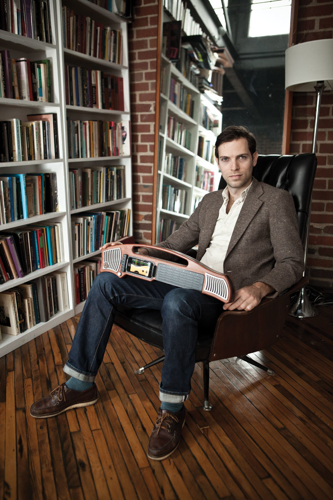
Mike Butera and the Artiphon Instrument 1
"So this is made in Nashville," Butera says, running his hands along the sleek mahogany-stained body of the Artiphon Instrument 1. "The wood's cut right across the river. Cumberland Architectural Millwork is one of our partners and investors. And it's all designed here, by people who've worked for and designed some of the top audio consoles and consumer electronics."
The Instrument 1 is about the size of a ukulele, but instead of a sound hole it has a dock for an iPhone 5. Instead of strings, it has two touch- and velocity-sensitive pads: a narrow one for strumming, finger-picking or bowing; the other, about the width of a fretboard, for forming chords or playing individual notes on raised ridges that mimic strings but don't move.
The iPhone provides the sound processing, through two speakers that can handle up to 30 watts, but not the playing surface. A player can hold it like a guitar or under the chin like a violin, and through an almost endless variety of apps can make it sound like anything from an acoustic guitar to a squelchy, arpeggiated synthesizer. As evidenced by numerous videos posted to sites like TechCrunch — which brought Butera onstage during the Consumer Electronics Show in Las Vegas — the Instrument 1 largely elicits wide-eyed, slack-jawed delight. A gaggle of Scene staffers reacted much the same way, giggling in amazement.
Butera says he continues to be amazed by the response wherever he shows off the Instrument 1, which will sell for $800 and precede a less expensive consumer-grade version. Artiphon attracted so much attention at CES that the annual National Association of Music Merchants invited them to its Los Angeles trade show.
"We think that you're ahead of the curve," Butera says NAMM organizers told him, "and it's likely that you are pushing us out into a new category that in the next couple years is gonna be so obvious."
Still, despite all the glowing press, Butera says, "it has been really difficult to figure out where to go for money in town. And part of that is, we have certain values about how we want to do it. We want to maintain ... our principles of environmental sustainability, domestic production, things like that." He likens Artiphon's position to that of local clothiers like Imogene + Willie or Otis James — companies whose signature is handcrafted quality, and who must reconcile rising demand with their principles.
"We have the same struggle," Butera says. "We can make these by hand. They're very expensive. ... If we could make it in Nashville, and it [only] cost $5 more, would we do it? Yes. But is anyone stepping up to provide those services to us? Would the investors support that? Do people care about that enough? It's just an ongoing question."
Pre-orders for the Instrument 1 begin later this quarter, and while bringing the project to life has brought its share of frustrations, Butera remains committed to Nashville even with the lure of outside money.
"I have not yet gone to Silicon Valley with this for a reason," he says. "I think it's better done here."
Here is the last American city dedicated to music, trying to become the next American city dedicated to technology. An unlikely progression? Perhaps not.
"Musicians and coders are the same animal." Mark Montgomery says. "When you look at it, they're both math equations. They have a very similar mind. And they have very similar quirks. Coders are wacky as hell, right? Musicians are wacky as hell."
If not wackiness, then maybe it's some combination of creativity, attention to detail and mastery of patterns that draws similar minds to music and programming. Which makes sense. After all, "three chords and the truth" just might be the purest line of code ever written in Nashville.
Singer-songwriter Matt Urmy started his own tech startup after becoming frustrated with the many apps he was using to manage his music career. The all-in-one solution he helped develop, Artist Growth, just launched its second version, which includes a deeper set of tools for management companies to also access and organize data for their artists — including booking dates, merchandise sales and inventory, even live performance royalties that can be reported as soon as the band walks offstage.
"On the creative side in software design, it's very much like writing a song," Urmy says. "After days and weeks and months of struggling with a line of code ... [getting the finished product ready is] like the final days of mastering." And there's another important similarity he sees: "a strong sense of the tech community supporting and helping people to really grow this sector of Nashville."
Kate O'Neill agrees. "My late husband and I were songwriters together," she says. "I do feel like the songwriting and music community has played a massively significant role — the style of interaction, the collaboration tendencies within it. I don't think it's one to be downplayed."
"It's a total parallel," Butera says. "And the Nashville music industry was put on the map because people started to realize they could get a lot more done through those network effects, rather than just the lone songwriter."
"I've worked in the Bay Area, Portland, Chicago ... but it has not felt like a truly supportive networked community like it does here," O'Neill says. "It's noticeable in the songwriting community here, and it has carried over — the collaborative songwriting culture here. Inevitably what happens is we tell our respective stories, but the upshot always seems to be, 'How can we work together?' "
In April 2012, Bridgette Sexton opened a post on the official Google blog with this observation: "Nashville and Silicon Valley have a lot in common. They're both filled with smart, creative people building businesses together. Nashville's start-up scene may be less well known, but it's bursting with energy and creativity like the rest of the city." Sexton had just been here for a Google for Entrepreneurs event at aVenue that sold out in four minutes.
It's a sign, among many, that the momentum felt in the startup scene is real. Nashvillians who once were surprised to read Alex Ross columns about their hometown orchestra in The New Yorker can now read about Nashville startups in TechCrunch, Venture Beat and Forbes. Recently, Apple featured the real-time multi-angle video-compiling app Streamweaver, designed and based in Nashville, at the top of iTunes' App Store.
The wins are starting to pile up, too. "Rivals[.com] sold for $100 million to Yahoo," Montgomery says. "My company sold for 25. StudioNow for 37.5. You know, every time that happens, the boats go up a little bit." In January, Moontoast secured $5 million in Series B funding. That same month, Streamweaver raised $1.3 million in Series A funding, which was led by former Facebook privacy officer Chris Kelly. Franklin-based recipe app Just a Pinch recently raised more than $1.5 million. Populr has already raised $475,000.
"As investors are getting more comfortable and seeing that risk profile getting lowered," says Clayton Associates' Gibbs, "you're going to see more dollars flowing into the technology community."
"We have to not get complacent and not start patting ourselves on the back," Montgomery says. "Fuck that. Now is the time to push the pedal to the metal."
Whitney's optimism is similarly cautious. "We all know each other, we know each other's families — it's a cool, cool community," he says. "I'll tell you what the con is: We're not aware of how competitive, how aggressive these other markets are. And so we don't really execute, generally speaking, with the same type of precision and aggression. We're a little more relaxed. There are benefits to that! But I think sometimes we're just not really aware of what it takes to compete at that level. And that's a little concerning."
O'Neill doesn't quite see it that way. "As much as there may be more maturity and sophistication in other markets," she says, "the greatest advantage we have here is connectedness."
That connectedness, along with a lot of hard work, has 2013 primed to be a big year for tech in Nashville. Where that could lead is anyone's guess. But if Nashville has proven anything over time, it's an ability to become something new without losing itself along the way.
"There's never going to be another Silicon Valley, and we don't want to be Silicon Valley," Montgomery says. "We want to be us. And us is a quirkier, wackier, a little more Southern, a little nicer version — but with an incredible amount of creativity woven into it. We're a good place to be, and we have good people."
Email editor@nashvillescene.com.




