



“Despite all that has been done, there is still danger of an H-Bomb attack on the Nashville-Davidson County area.”
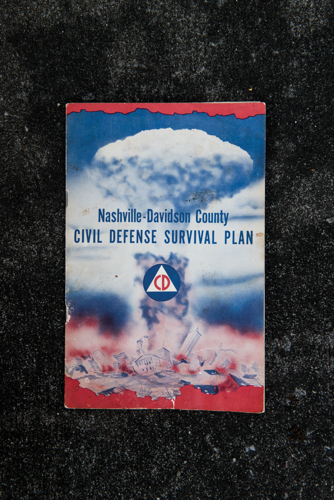
Under a red, all-caps heading that reads “IT CAN HAPPEN HERE …” those words appear in a faded brochure called the “Nashville-Davidson County Civil Defense Survival Plan.” An illustration on the cover shows a mushroom cloud rising from downtown Nashville, the state Capitol and the Life & Casualty Tower visible among the city’s crumbling buildings. The introduction goes on.
“Our detection system, fighter planes, anti-aircraft guns and guided missiles are all being made bigger and better. But still, ONE enemy plane getting through with one modern H-Bomb could destroy or severely damage MORE THAN HALF the Davidson County area.”
Relevant as it seems to the current news cycle, with President Donald Trump making off-the-cuff remarks about “fire and fury” and tweeting us to the brink of war with North Korea, the booklet wasn’t released this week, but rather some 60 years ago amid the Cold War-era nuclear panic. David Ewing, the esteemed unofficial Nashville historian, posted a photo of the survival plan last week on the local-history Instagram account he runs, The Nashville I Wish I Knew. He tells the Scene he found it at an estate sale, adding it to what he believes is the largest collection of Nashville memorabilia in existence.
The pamphlet doesn’t include a date, but Ewing guesses it was printed and distributed in the late 1950s, probably 1958 or 1959. That guess is based on a couple of context clues, the first of which is right on the cover. The illustration of downtown Nashville being incinerated includes the Life & Casualty Tower, which opened in 1957. Moreover, the first page notes that the survival plan was approved by then-Nashville Mayor Ben West and then-Davidson County Judge Beverly Briley, indicating that the book was produced before the creation of the Metro government in 1963.
It provides a surreal view of the fear that marked that era, when local officials in places like Davidson County — which then had a population of less than 400,000 people — felt compelled to create contingency plans for a nuclear bomb being dropped on their heads. Even now, when Nashville has grown into a much more populated and prominent city, one finds a dark sort of solace in the fact that Music City isn’t likely to be near the top of any list of potential targets. But more than half a century ago, Nashville-Davidson County officials believed it to be their patriotic duty to prepare for this possibility.

“The key to our progress and survival lies in the total strength of our people,” wrote Leslie E. Jett, director of the Nashville-Davidson County Civil Defense, in a letter accompanying the widely distributed booklet. “We must be made to understand that since there is no absolute military defense against modern terror weapons, an effective Civil Defense is vital to the security of the United States. This homefront preparation would provide the means whereby this country, if attacked, could get up from the rubble and fight on to victory.”
Indeed this was a national policy. In the introduction to In Case Atom Bombs Fall: An Anthology of Governmental Explanations, Instructions and Warnings from the 1940s to the 1960s, Michael Scheibach lays out the history. Congress passed the Federal Civil Defense Act in 1950. The following year, then-President Harry Truman created the Federal Civil Defense Administration, which began distributing information to state and local agencies. Local organizations began printing and distributing survival plans through the 1950s and early 1960s.
The anthology highlights such plans from across the country, some of them darkly humorous in hindsight. The Birmingham-Jefferson County Civil Defense Corps published a brochure called “When the Bomb Goes Off — Don’t Be There!” On behalf of the New York State Civil Defense Commission, the New York State Department of Health published “Assisting at the Birth of a Baby After Enemy Attack if No Doctor Is Available.”
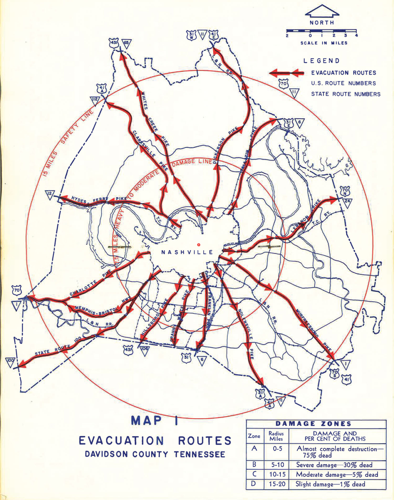
The Nashville survival plan features maps showing the quickest evacuation routes out of the city and the location of evacuation centers in surrounding counties, lists of first-aid and survival-kit items to stock up on, and even a section devoted to helping one deal with the anxiety that might follow the nuclear bombing of your hometown. For good measure, one page offers what you should know about germ warfare.
The brochure, and its dramatic language, may seem outdated now, but a declaration on its final page is worth heeding in any era.
“Prepare now … Before disaster strikes.”

Nashville Mayor Beverly Briley visits a Civil Defense training class in 1964



