
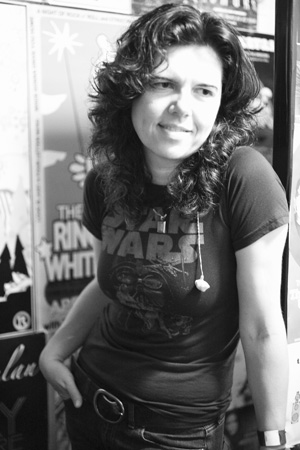
Something about this moment, driven as it is by celebrity, hype and the mendacity of authority, has put a premium on things that are genuine—from "reality" television to amateur porn. But whether it's posed as art imitating life or keeping it real, what people seek from music isn't really authenticity so much as truth. The culture's honed our bullshit detectors such that we zero in on songs that sound merely written, not lived. That's the quality that Maia Sharp comes back to when discussing her terrific fourth album, Echo.
It came very much out of where Sharp was in her life. She was facing a creative crossroads, after releasing three albums for as many labels since 1997. Again without a label, she took a chance, releasing Echo on her own. She met the challenge of the raised stakes with her finest release to date, an album whose rootsy songwriter pop crackles with shrewd insight, keen writing and a strong dose of carpe diem. She disses the starched strictures of "Polite Society," noting "the greater good you talk about has been redefined to keep everyone out," comes to her senses about a lover who was her "Whole Flat World," and refuses the temptation to make herself "Unbreakable."
"This album is the first album where there's a little bit of truth in every song," Sharp offers from a tour stop in Portland, Maine. "[In the past] it was mostly about the craft and trying to get a story across in a new way. There wasn't always something in them that provoked a personal response. Whether I knew it or not when I started writing the song, the truth would show up. I think it affects the presentation of the album itself. I think people are feeling it on a deeper level."
Sharp's following in the footsteps of her father, country singer-songwriter Randy Sharp, whose experiences have helped her negotiate the ups and downs of the business with an even keel. After her critically hailed debut, 1997's Hardly Glamour, her label's troubles with its distributor meant there wasn't product in the stores on the tour. With each new label it was something different, but the same ultimate result. "We never seemed to be able to get everything we needed when we needed it," she says.
So when the opportunity came to do a record with producer Don Was, but there was only a small window of time that allowed them to use the studio and engineer he wanted as well as drummer Jim Keltner, well, she jumped—label or not. She knew the chemistry she had with Was after they recorded "Polite Society" from start to finish in just 12 hours, for his in-studio Web series on mydamnchannel.com. With Keltner only available for four days, they had to work fast, finishing the entire album, including mastering, in just two weeks.
She ruefully reflects for a moment on a maxed-out MasterCard bill that's waiting for her at home, before expressing again that it was something she had to do, citing her song "Unbreakable."
"I love that sentiment because you have to lay yourself out. This album's a great example. You can't not throw your hat over the wall because you might not have a way to retrieve your hat. You have to try," she explains. "Even if it means you get slammed, it's not living unless you lay yourself open to whatever's going to happen."
It's an idea that grew stronger as she crossed into her 30s, and felt more personal acceptance about who she is and what she does. "Sprinkled throughout the old albums, and then a lot on this new album, there's a lot of celebration of flaw and blemish, not being maybe where you thought you would be," she says. "But you're here and you're somewhere, and life is good. Life is life."
This self-acceptance sharpened the edges of her songs and honed her honesty. That's part of the reason she's as happy with this album as any she's released. She recognizes it's the thing that separates a great song from a well-crafted one. It's something almost self-evident, in the same spirit with which, as they say, talent recognizes genius.
"I have to keep on doing what I connect to, because if I connect to the songs they're going to have such a better shot of connecting to the audience, and also connecting to another artist," she says. "Like I never thought 'Home' would be a song for the Dixie Chicks."
"I think it's because my dad and I, who wrote that song, felt such a connection to the song, and such a love for it," she continues. "It isn't always that it needs the clever twist of a phrase that rhymes perfectly at the end of every chorus that has the big soaring hook. It doesn't have to be the formula. It can be that it just moves you. I think that counts for a lot."
Email music@nashvillescene.com.



Post a comment as anonymous
Report
Watch this discussion.
(0) comments
Welcome to the discussion.
Log In
Welcome to the discussion.
Keep it clean. Please avoid obscene, vulgar, lewd, racist or otherwise abusive language. Comments featuring hate speech or threatening or violent content will not be tolerated.
PLEASE TURN OFF YOUR CAPS LOCK.
Be truthful. Don't knowingly lie or mislead.
Be proactive. Use the “report” link on any comment that violates our comment policy.
Share with us. We'd love to hear your feedback.