

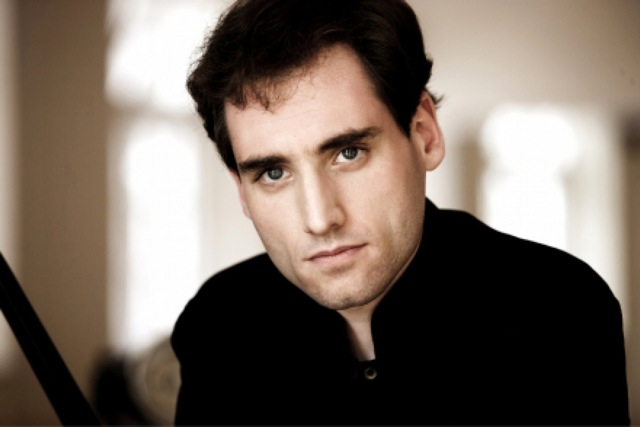
Boris Giltburg
There was a time when Nashville classical fans were lucky to hear three world-class soloists during an entire season. Now such artists appear in Nashville every week. The only miracle these days is finding an affordable parking space.
As it happens, three of the world’s finest instrumentalists were in Nashville last week. Itzhak Perlman, surely classical music’s best-loved instrumentalist, held forth at the Schermerhorn. The German violinist Isabelle Faust, meanwhile, presented the entire cycle of Beethoven’s violin sonatas over the course of three nights at Vanderbilt, and the pianist Boris Giltburg played back-to-back Rachmaninoff concertos with the Nashville Symphony. Did Carnegie Hall have a better week?
Perlman’s superstar status was apparent from the outset of his recital Sunday afternoon. He was greeted with a standing ovation the moment he appeared onstage with his superb accompanist, pianist Rohan De Silva. He basked in the warm glow of this reception for just a moment before launching into his program, which freely mixed old masterpieces with light classics. As usual, he played everything with polish and panache.
Perlman recitals are remarkably relaxed, unfussy affairs. He doesn’t spend inordinate amounts of time tuning onstage. On Sunday, he didn’t tune at all. He merely opened the score on his music stand and played whatever was on the page.

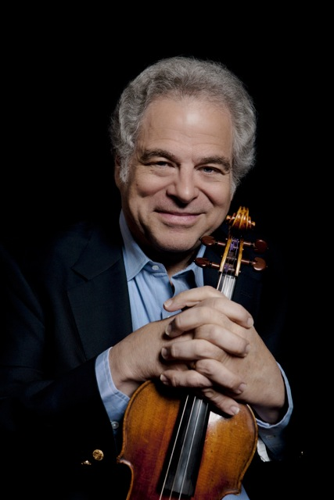
Itzhak Perlman
His approach to the opening piece, Beethoven’s Sonata No. 1 for Violin and Piano, at first struck me as inauthentic. He played with the sort of big vibrato and lush sound that one associates more with late 19th-century Romanticism than the Classical Style of the 18th century. But that latter style, with its pure tone and sparing vibrato, works best in intimate drawing rooms. Perlman has spent his career playing in big concert halls, like the Schermerhorn’s 1844-seat Laura Turner Hall, which was sold-out on Sunday. Like an opera singer, Perlman has learned to use his big sound to fill big halls.
This style was perfectly suited to Cesar Franck’s Sonata for Violin and Piano in A major. This late Romantic masterpiece is a favorite of virtuosos. Perlman played its long, lyrical lines with urgency and intensity. Yet there was also an effortlessness in his playing, a lack of physical tension that allowed him to convey his musical thoughts with absolute clarity and directness.
Perlman closed out the masterworks section of his program with Stravinsky’s Suite Italienne for Violin and Piano. Stravinsky based this piece, published in 1934, on themes from his ballet Pulcinella. Perlman’s interpretations of the work’s five movements were delightfully colorful and characterful. His playfully virtuosic renditions of the suite’s “Tarantella” and “Scherzo” drew lusty applause from the audience.
The rest of the program called to mind one of the late Arthur Fiedler’s Boston Pop concerts. Perlman announced from the stage various short encores – a Fritz Kreisler ditty, John Williams’ “Theme from Schindler’s List,” Brahms’ Hungarian Dance No. 1, among others. He played them all with joy and gusto. His excellent pianist, De Silva, distinguished himself throughout the concert with his deft, sensitive playing.
Faust’s programs at the Blair School of Music’s Turner Recital Hall had a very different feel. Whereas Perlman seemed like a genial host, Faust was more like an eminent guest lecturer. Her program – all 10 of Beethoven’s sonatas for violin and piano – was unfailingly serious. Her interpretations were equally thoughtful, penetrating and musical.
She brought two important assets with her to Nashville. The first was a 1704 Stradivarius called “Sleeping Beauty,” an instrument with a celestial sound and a diva’s attitude about staying in tune. The second was Alexander Melnikov, a Russian pianist with a velvety touch and a technique that apparently knows no difficulty.
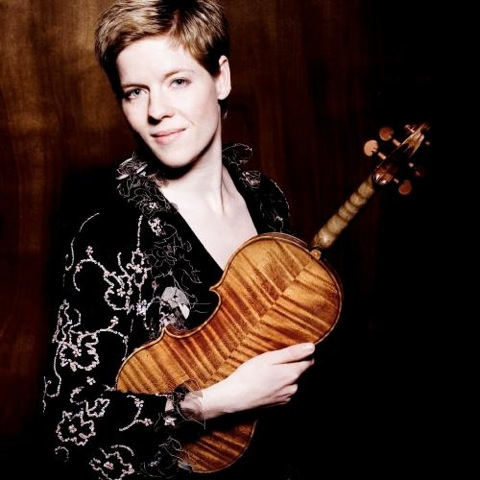
Isabelle Faust
Faust’s playing seemed very German, and thus very intellectual. A serious, stylish artist, she made minimal use of vibrato to create a very pure, luminous sound. It wasn’t a particularly big sound, but it worked well in the intimate confines of the 272-seat Turner Hall. Melnikov, who played with sweep and volume, seemed very much the Russian romantic. Listening to them together was like eavesdropping on intellectuals from different countries engaged in a serious conversation.
The duo’s cycle had many highlights, but I was most taken with the final performances from night three. Their interpretation of the Sonata No. 5 in F major “Spring” seemed almost Schubert-like in its warm, heartfelt lyricism. In the Sonata No. 10 in G major, with its translucent passages and sparkling trills, the players ventured into the realm of the sublime, creating sounds of pure sonic ecstasy.
The third virtuoso in Nashville last week was Giltburg, a Russian-born Israeli pianist who joined Giancarlo Guerrero and the Nashville Symphony to perform Rachmaninoff’s Piano Concerto No. 4 and Rhapsody on a Theme of Paganini. Playing two of Rachmaninoff’s fiendishly difficult concertos on a single program is like adding an extra 10 miles to a marathon. Fortunately, Giltburg had the stamina and chops to pull it off.
Unlike many of Rachmaninoff’s big orchestra works, the Piano Concerto No. 4 lacks a big, unforgettably beautiful melody. It’s all color and sweeping gesture. This suited Giltburg just fine. His powerful technique hammered away at the composer’s double-fisted chords, creating a veritable Niagara of sound.
The Rhapsody, on the other hand, contains one of Rachmaninoff’s most drop-dead gorgeous melodies – the work’s 18th variation – and Giltburg played it with lilting understatement. Guerrero kept the orchestra in close formation with the soloist, producing and expertly balanced, glistening performance.
In the end, Giltburg received a thunderous ovation. He responded with one encore, Brahms’ Intermezzo in A major, Op. 118, No. 2, which he played just the right amount of simplicity and immediacy.



Post a comment as anonymous
Report
Watch this discussion.
(0) comments
Welcome to the discussion.
Log In
Welcome to the discussion.
Keep it clean. Please avoid obscene, vulgar, lewd, racist or otherwise abusive language. Comments featuring hate speech or threatening or violent content will not be tolerated.
PLEASE TURN OFF YOUR CAPS LOCK.
Be truthful. Don't knowingly lie or mislead.
Be proactive. Use the “report” link on any comment that violates our comment policy.
Share with us. We'd love to hear your feedback.