
What does a Bach suite have in common with an old-time fiddle hoedown? Maybe more than you think — at least that's the premise of the Baroque Fiddling Project, which culminates Tuesday with a concert juxtaposing historically informed Baroque string playing with a variety of fiddling styles.
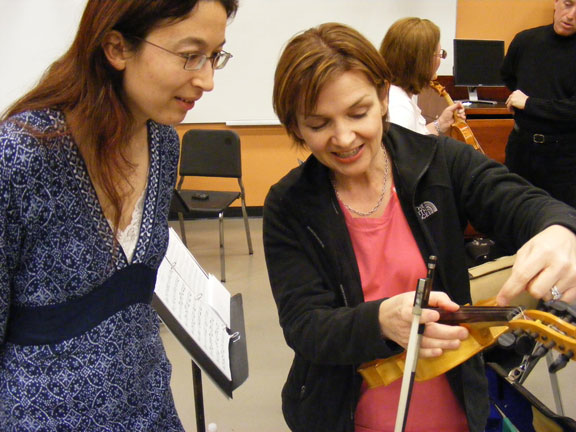
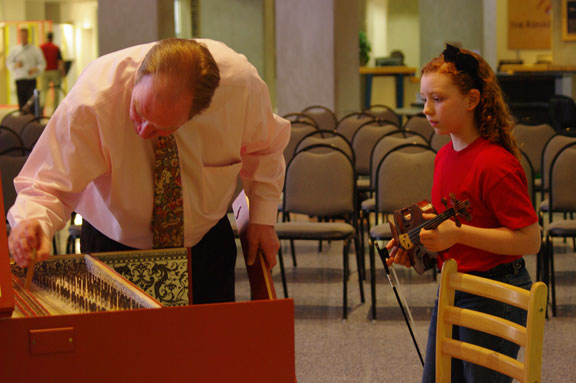
Members of the ensemble Music City Baroque (MCB) will appear alongside Montreal-based Baroque violinists Rachel Jones and Émile Brûlé as well as Nashville fiddle standout Tammy Rogers. A Tennessee Arts Commission grant also brought together violinists and fiddlers in two March workshops led by Jones, and in a delightful concert earlier this month at the Renaissance Center in Dickson, where MCB shared the bill with the polished Bowling Green youth group Red River Fiddlers.
MCB artistic director Murray Somerville recalls how the project grew out of a casual encounter: "We gave a concert in Murfreesboro, and afterward a gentleman in overalls approached [violinist] Laura Ross to ask about her playing techniques." The audience member, a fiddler, was struck by parallels between her rendering of French Baroque repertoire and his own more local instrumental tradition.
The London-born, Oxford-educated Somerville wasn't too familiar with Appalachian music, but he was fascinated when MCB concertmaster Karen Clarke remarked that tunes from John Playford's 1651 The English Dancing Master are still staples of American fiddling. And when Somerville heard an old-timey fiddle-banjo duo some months later, it was his turn to ask post-concert questions.
"I watched this fiddle player, and his bowing looked so much like a Baroque violinist's — the loose wrist, the grip high on the bow. When I asked where he'd learned these techniques, he said 'I just play the way my daddy taught me.' "
If you've never seen historically informed Baroque groups like MCB, it may not be clear what Somerville is talking about. Many musicians use essentially the same playing technique for Bach, Beethoven or Tchaikovsky, but over the past several decades a growing number of players have drawn heavily on historical research to guide performance, hoping to approach the original sound of older repertoires.
And as it turns out, this research points to a style of string playing that overlaps uncannily what you might have heard at the annual fiddle-off in Clarksville last month.
"Like Baroque violinists, most fiddle players don't use much vibrato — it's more of an expressive ornament than part of the basic sound," says veteran session fiddler Rogers, who is pursuing a master's degree in tandem with her own fiddle teaching at Belmont while continuing to perform with her Grammy-nominated group The SteelDrivers and with Reba McEntire's band. Rogers observes how rhythms and dance forms of the Baroque are echoed in present-day fiddling repertoires, and how fiddlers take naturally to the uneven Baroque bow-strokes that trained classical players might struggle to master.
Though Rogers grew up playing both fiddle and classical violin, she says that "the fiddle always felt very separate." But while studying Baroque technique at Belmont with MCB violist Sarah Cote, Rogers began to note many congruences with fiddling.
Improvisation is another area of common ground for fiddlers and early music specialists — both must be skilled with embellishing a basic melody in accord with specific regional or historical styles. Skilled Baroque interpreters use different ornamental trills and turns for French or German repertoire, just as fiddlers from Cape Breton and North Carolina would imbue a single tune with vastly different rhythmic characters.
Maybe this is one reason folk and early music performance cultures turn out to be quite compatible. Ensembles like Hesperus and Apollo's Fire perform early American songs and dance tunes using the same mixture of research, taste and speculation they bring to Baroque, Renaissance or medieval repertoire.
Jones' fluency with Baroque violin and multiple fiddling traditions brought her a part in "Come to the River," a successful touring program of early American music by Cleveland Baroque ensemble Apollo's Fire. Jones and Brûlé are active in Montreal's flourishing early music scene, and their group Feux d'Archetistes create a wonderful marriage of folk and early music techniques in both traditional and original compositions.
The pair will appear with MCB as soloists in Bach's Concerto for Two Violins during Tuesday's concert, which also features music by Corelli and Purcell — and of course Tammy Rogers plans to join in for a little fiddling.
Jones' Baroque Fiddling workshops last month appealed to seasoned pros like Rogers as well as to students from the Blair School of Music and Franklin Road Academy. Somerville reports that MCB players have also benefited from the cross-pollination — at the April 9 concert he found "fantasies awakened and inhibitions dropped." And tradition-sharing paid off sweetly when the Red River Fiddlers joined the ensemble for some Bach.
Did the long-isolated Appalachians serve to fossilize musical practices imported from 17th century England, as pioneering folklorist Cecil Sharp believed? Somerville admits that it's hard to make definitive claims about the sources of American oral traditions. But perhaps awareness of historically informed approaches will encourage fiddlers to preserve distinctive regional styles, counterbalancing the homogenization of fiddling technique that Rogers says has been occurring over the past couple of generations.
In any case, the fireworks of Jones and Brûlé's stylistic fusion prove that fiddling and Baroque violin can make a stimulating blend in today's living practice.



