
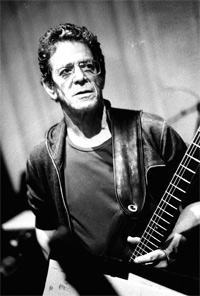
"Without question, the most Advanced figure of all time is Lou Reed,” wrote pop culture critic Chuck Klosterman in a 2004 Esquire column. “When a legitimate genius does something that seems crazy, it does not mean they suddenly suck; what it means is that they are doing something you cannot understand, because they have Advanced beyond you.”
It’s not a bad theory, and Klosterman uses it to justify the founder of the seminal Velvet Underground’s periodic attempts to seemingly undermine his own legacy as a rock icon—perversities like his 1986 “rap” single “The Original Wrapper.” And Reed has only stepped it up in recent years. In 2007 alone, he released a CD of new-agey “meditation music,” collaborated on a Tai Chi instructional DVD with Master Ren Guang Yi and appeared on “Tranquilize” by The Killers (a band Klosterman rightly tagged as “completely unAdvanced”).
But I’d like to suggest a simpler explanation for Lou’s odd projects: They’re mind games designed to maintain Reed’s mastery in the decades-long dominant/submissive relationship between him and his audience.
Think about it—the moment you become a Reed fan, you embark on a journey into abuse and self-abasement: You’re doomed to protest through the bruises to anyone who will listen how great Lou is, and how what he does really makes sense. He set Edgar Allan Poe’s poetry to music? He has his reasons. We deserve it.
In any relationship, the one who loves less is the one with all the power to set the agenda, to give and withhold. And Reed doesn’t give a shit: Even if you barely like him, it’s guaranteed he likes you less. If you have any doubts, listen to any of a number of his live albums, but especially 1978’s Live: Take No Prisoners, in which a rambling, slurring Reed seems equally contemptuous of both the audience and his own material. If nothing else, the flat monotone in which he barks his lyrics nowadays should tell you something.
And this isn’t some great secret—throughout his career, Reed’s lyrics have explored themes of sexual power games, dominance and submission, from “Venus in Furs” on 1966’s The Velvet Underground and Nico right up to much of 2000’s Ecstasy, his most recent straight-up rock record. Even The Raven contains these themes.
But Reed’s dominance endgame is really just getting started now, in the 2000s, built upon groundwork he laid in the ’70s with two confounding albums. Instead of a glammy follow-up to the hit Transformer, 1973’s Berlin was a depressing (if masterful) orchestral meditation on abuse, drugs, suicide—the works. And in 1975, he released Metal Machine Music, a double-LP set of ear-destroying feedback and noise, purportedly a middle-finger salute to his then-record label, but also to fans. “My week beats your year,” he famously wrote in the liner notes.
With these seeds planted, he just sat back and waited for his audience to gradually justify this abuse and come groveling back for more. And it worked: German new music ensemble Zeitkratzer transcribed and performed Metal Machine Music in concert with Reed as a soloist, and released it on CD in 2007. And (much more understandably) Berlin has recently come into its own, with Reed touring Europe performing the album with a 30-piece band and choir, including original session guitarist Steve Hunter. A concert film, directed by Julian Schnabel, comes out this summer.
Reed’s current mini-tour is a more straightforward affair, with Reed backed by Hunter as well as longtime cohorts Rob Wasserman, Tony Smith and guitarist Mike Rathke. Set lists so far include few “greatest hits,” instead favoring songs from 1992’s Magic and Loss, The Raven and Ecstasy. Reviewing a show for the Philadelphia Inquirer, Dan DeLuca wrote, “Reed was correct in his assumption that his lesser-known material…was more than strong enough to carry the evening.”
Maybe so. But I suspect that if DeLuca’s a true Reed fan, he’d find a way to justify whatever scraps fell from the master’s table. At the rate Reed’s going, I’m taking bets that the coming years will see a concept-musical version of his very dated-sounding 1986 record Mistrial hitting the stage, perhaps with Twyla Tharp-choreographed dance numbers re-creating the cringey music videos “My Red Joystick” and “Video Violence.” And I’ll probably praise it to the skies—because it’s Lou, and Lou’s great. He played “The Original Wrapper,” and it felt like a kiss.



