
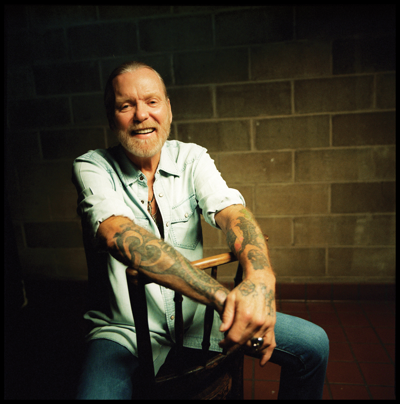

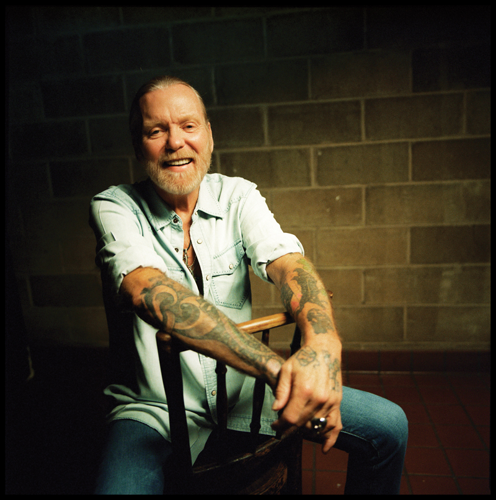
Just because The Allman Brothers Band has thrown in the towel after an impressive 45-year run, don't assume Gregg Allman's career is winding down. To the contrary, the 67-year-old singer and keyboardist is on a bit of a roll. In 2012 he released a well-received memoir, My Cross to Bear, and in October, Gregg and his Allman Brothers bandmates received rave reviews for their six-night farewell run at New York's Beacon Theater.
Just last month, Allman and Taj Mahal got a Grammy nomination for Best American Roots Performance for their duet on "Statesboro Blues" from the 2014 concert DVD All My Friends: Celebrating the Songs and Voice of Gregg Allman. Mahal sings the first half of the song, and the renowned blues artist proves he's barely lost a step at the spry age of 72. When Allman takes over, what's most striking is how little his voice has changed since he sang the Blind Willie McTell classic on At the Fillmore East, The Allman Brothers' seminal live album from 1971.
"Wow," you may be thinking. "So you're saying Allman can still sing like a 23-year-old kid."
In fact, it's more the opposite: When Allman was 23, he sounded like an old blues veteran. He sang with a force, assuredness and depth of feeling that belied his tender age. Furthermore, it's astounding how mature and confident the entire band sounded on those first three albums, considering that Allman and his older brother Duane were in their early 20s, and the rest of the band wasn't much older.
Take, for instance, "It's Not My Cross to Bear" from the group's 1969 self-titled debut. Then-22-year-old Duane's terrific guitar work was a revelation to folks who weren't aware of his budding career as a Muscle Shoals session guitarist. And for that matter, guitarist Dickey Betts showed he was no slouch at the ripe old age of 25.
But every bit as stunning is the vocal track: After a short and soulful guitar riff kicks off the song, what sounds like the gravelly voice of a seasoned 50-year-old bluesman shouts "Yeah, yeah, yeah" — except it's a 21-year-old kid. Gregg sings each line with the laid-back, behind-the-beat delivery of a world-weary veteran, someone who's endured a lifetime of pain and sorrow.
Some people might be tempted to find Gregg and The Allman Brothers, like many of their white blues-rock peers, guilty of appropriating the music of less well-known black bluesmen, but no one could accuse Gregg and Duane of not knowing suffering and loss, the experiences that have always fueled the genre. Their father was shot and killed by an acquaintance when Gregg and Duane were 2 and 3, respectively, and the boys spent some of their grade school years in the austere environs of Lebanon, Tenn.'s Castle Heights Military Academy so their now-single mother could try to better herself.
And on those first three albums, little did Gregg know that both his brother Duane and Allman Brothers bassist Berry Oakley would be dead before the end 1972, the results of eerily similar motorcycle accidents a little more than a year apart.
Of course, anytime a gifted musician dies young, it only adds to his or her mystique, and the fact that Duane was immensely talented only intensified the mythos surrounding him and The Allman Brothers. At times it seems Duane has been so deified that Gregg's contributions are taken for granted.
There's no question Duane was a brilliant guitarist who invented much of the Southern rock guitar vocabulary, particularly when it comes to slide guitar. I know as well as anyone: I spent a large chunk of my college years trying to learn every Duane solo off At Fillmore East. And he was the band's driving force and spiritual leader.
But Gregg was an exceptionally precocious musician himself, and was every bit as integral to the band's success. In addition to his trademark voice, he's always been a great keyboard player, particularly on the Hammond B3 organ. But what gets lost in a lot of discussion about The Allman Brothers Band is just how great a songwriter Gregg is. Consider the fact that he wrote or co-wrote classic rock radio staples such "It's Not My Cross to Bear," "Whipping Post" and "Dreams" — all before his 22nd birthday. Then there's "Midnight Rider," "Melissa," "Stand Back," "Don't Keep Me Wonderin'," "Waste Words," "Come and Go Blues," "Ain't Wasting Time No More" ... the list goes on.
When Gregg Allman plays the Ryman Jan. 13 and 14, it will be a homecoming of sorts — he was born in Nashville at St. Thomas hospital, and spent his early years here. He spoke with the Scene by phone recently, and reminisced about his early days here, including a particularly memorable trip to Centennial Park that involved a jungle gym, some new cowboy boots, lost teeth and lots of blood. He also discussed his and Duane's formative musical years, his Grammy nomination, his memoir and The Allman Brothers' farewell show. Read about all that and more in our interview with Allman, online now at NashvilleCream.com.
Email Music@nashvillescene.com



