
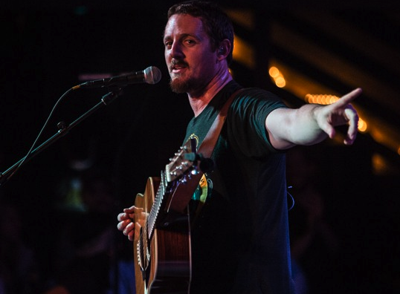


Sturgill Simpson
Nashville favorites are always welcome on Marc Maron's WTF podcast. The stand-up comedian turned sit-down interviewer has talked with locals from Jack White to Jason Isbell to Harmony Korine over the years. The latest: Sturgill Simpson.
In an episode released yesterday, Maron spends about 20 minutes talking to actor John C. Reilly and then more than an hour with Simpson, who recently released a new album A Sailor's Guide to Earth. (He's also playing two nights at the Ryman in October, but both shows sold out in about the time it took me to write this sentence).
It's a fun chat to sit in on. Simpson talks about the concept behind the new record, which he wrote for his son; tells the story of how he and producer Dave Cobb met, when Shooter Jennings introduced the two of them at a Billy Joe Shaver show at 3rd and Lindsley; and, naturally, talks a little bit about the current state of country music, though his take is more positive — or at least, less negative — than you might think. (“A lot of people from that world reached out to me, man," he tells Maron. "Keith Urban wrote me one of the nicest notes of encouragement I’ll probably ever get in my entire life.”)
A few excerpts, and the audio, after the jump:
On making it:
“[The] most fortunate aspect of everything that’s happened for me is getting to meet the heroes of mine that are still around. Merle [Haggard] and we’ve played shows with Kris Kristofferson and Willie Nelson now. My grandparents lived long enough to see me play the Opry in person. That’s stuff that I’ll always cherish. For me, the trophies and accolades and fame and money, that’s all fine and dandy but to know that I finally got to let them see me do something that wasn’t a disappointment, it means a lot to me...They grew up in coal camps in eastern Kentucky listening to it on a radio, you know.”
On covering Nirvana's "In Bloom":
“I can’t take credit for it, it was my wife’s idea. I did this 80s New Wave song on the last record, that was her idea ‘cause she...Anyway, so the record conceptually, as a letter to your son or as a new parent to their child, whatever, from far away. I had this hole in the narrative. The record was sort of arranged before a lot of the songs were finished even being written ‘cause I knew it had to form a narrative. And I came to that point where I was like, OK, well he’s gonna hit this stage in his life where he’s like this post-pubescent, adolescent, angsty, awkward little kid that we all go through and I’m not in that head space anymore, so I didn’t know how to — and to be honest, a lot of my life during that time I just kind of blocked out and just learned to play guitar and smoked pot and tried to be numb through it all. So my wife said ‘well, what were you listening to at that point in your life?’ Nirvana. You know, that shit hit in like 8th grade, 7th or 8th grade, and my parents had divorced so I was like the latchkey kid from a broken home and that record just sort of exploded.”
On fellow Nashville alt — or is it trad-country? Americana? — fave Jason Isbell:
“Don’t even get me started... That guy, he’s a hero for me. He’s probably, in a lot of ways — he’s just a good human being.”
“He doesn’t believe me — well, actually I don’t know if he does or not, he never said, but I could tell he was skeptical. I’ve never actually heard Southeastern in its entirety and I haven’t heard the new one at all. I remember Dave [Cobb] and I finished High Top [Mountain, Simpson's debut studio album] and Jason and him made the record and Dave’s like ‘man you wanna hear some of this?’ And I was like ‘absolutely,’ because I was a [Drive-By] Truckers fan. I think we got about four songs in and I was just like, ‘man you gotta turn it off, I can’t listen to this.’ It’s too good. It’s too stylistically realized, you know? I’m like, if I get into something like this now at a point in my life, everything I write for six months is gonna sound like that.”



