
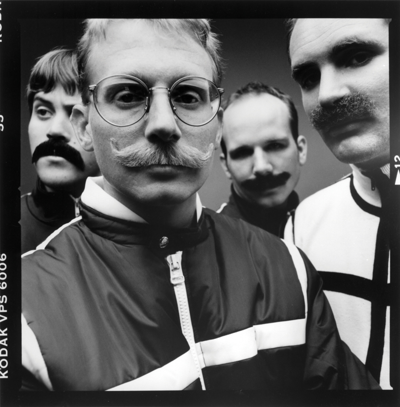

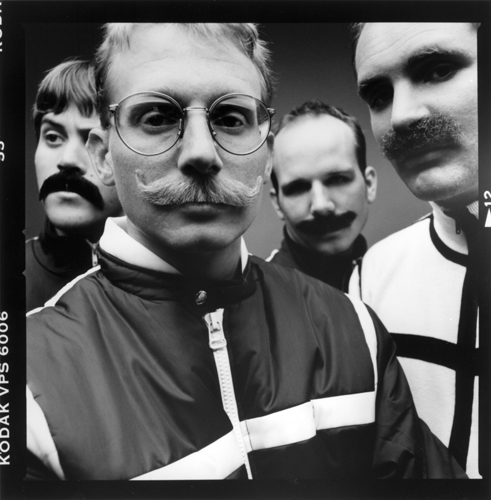
Archers of Loaf. Pavement. Polvo. Chavez. Slint. Sebadoh. And that's just off the top of my head. By now, it's harder to think of early-to-mid-'90s bands that haven't reunited this past decade. Unwound. Jawbreaker. Who's left?
Cross another off that short list — Hum is back. The thoughtful headbangers from Champaign, Ill., kick off their first U.S. tour in 17 years Friday at Mercy Lounge. The show is sold out.
Unlike some of the above groups, Hum had an honest-to-God hit. If you can remember the year 1995, this should ring a bell: "She thinks she missed the train to Mars / She's out back counting stars."
That tune — "Stars," off the band's second album, You'd Prefer an Astronaut — earned the foursome alternative-rock radio and MTV airplay, guest appearances on Late Night With Conan O'Brien and The Howard Stern Show, even a critique from Beavis and Butt-head. The cartoon couch-potato heshers were dumbfounded by the track's extended intro, in which a warm, distorted open D chord rings out for nearly 30 seconds before skinsman Bryan St. Pere comes in with the most colossal drum fill this side of "In the Air Tonight." (Butt-head: "Whoa, is this video over?" Beavis: "Yeah, it's over." Butt-head: "Well, that was pretty cool. It sucked, but at least it was short. They should make them all this short.")
In actuality, "Stars" clocks in at five minutes and 10 seconds, but they were right that it was different. Hum only made three records, and didn't sell as many as fellow Prairie State alterna-heads Smashing Pumpkins (who, by chance, close their latest tour at Ascend Amphitheater on Sunday), nor did they receive the same acclaim as Radiohead — another band once mistaken for a one-hit wonder. But Hum, one-hit wonders? That couldn't be further from the truth, as sworn fans like Deftones — the Oasis to Hum's Beatles — will tell you. The NorCal nu-metalers' platinum-selling White Pony probably wouldn't even exist were it not for You'd Prefer.
"Stars" was my introduction to Hum and, in turn, the gateway to all my favorite indie subgenres — space rock, shoegaze, Midwestern emo. I first heard it in '97, after the promotional and touring cycle for You'd Prefer had ended and cheap copies began piling up in used CD bins. I was drawn to the simple, striking album cover — a clip-art zebra on an emerald-green background — so I bought one. My 12-year-old ears took to it instantly. The guitars, tuned permanently to drop D, were aggressive yet never intrusive; singer-guitarist Matt Talbott's lyrics, which used space travel as a metaphor for feeling out of step with the world, were romantic without being schmaltzy, smart but not highfalutin.
The follow-up, 1998's Downward Is Heavenward, was the first CD I ever bought the day it came out. It ran longer, sounded bigger, took the outer-space motif further and was even more enthralling than its predecessor — especially on headphones.
But it turned out Hum had saved their best for last, and I was too late. Despite my efforts, sales of Downward were dismal. Not long after the album's release, they played their final shows in my native Southern California and, as legend has it, shattered the windows of the glorified Orange County house venue Koo's Café with the full force of their sound. I missed it because it was in the middle of the week and I couldn't drive yet. I never got another chance. The band broke up, seemingly for good, in 2000.
As time went on, You'd Prefer, Downward and Hum's 1993 debut Electra 2000 remained favorites — staples of my youth that I still found new reasons to appreciate and people to appreciate them with. One time I dressed as You'd Prefer for a '90s album-themed birthday party. "We used to hang out a lot together by my CD player!" the host, Mellon Collie and the Infinite Sadness, exclaimed when I arrived. Another buddy once asked where to start with Hum. The only answer, I said, was to get all three albums, play them in order, and play them loud.
Being a diehard fan has brought me closer to others who feel the same way. Recently, a friend who plays in a pretty popular band was in town playing a show, and I was with him when he got word they'd be sharing a bill with Hum at an upcoming festival. This is a guy's toured with many of his heroes, real household names, yet I'd never seen him this ecstatic. After the gig, I camped out with him and his bandmates in my living room and we fell asleep to live Hum videos.
It's said that Hum labored over their albums until every member was satisfied with every part of every song. That attention to quality has kept their music from being too daunting for new listeners. Because they never put out anything substandard, their legacy is secured, whereas with a lot of the '90s reunion bands there's just too much to sift through. And unlike the Pavements and Pixies of the world, Hum didn't blow up — they just stopped. Around 2003 they began playing intermittent one-offs, mostly in Chicago or their hometown Champaign, Ill., when they felt like it.
Eventually I promised myself I'd travel wherever I had to in order to see Hum, because who knew when they might play again? Imagine my disbelief last summer, then, when I found out they were headlining the same small-scale Chicago fest that my own band was already scheduled to play. At a pizza place. Without even a stage to separate us.
From the first moments of "Why I Like the Robins," the dreamy slow burn that opens You'd Prefer's B-side, to the closing feedback squall of Downward's "The Scientists," the performance exceeded every expectation. Lead guitarist Tim Lash, who's known for masterfully replicating his studio licks onstage — his doubled riffs shape Hum's trademark clean sound, a natural chorus effect — didn't miss a note. Where most drummers go one way or the other — power, or finesse — St. Pere balances both, and he crushed his kit with kindness. And true to their Midwest college-town roots, they partied — the image of Talbott and bassist Jeff Dimpsey taking turns swilling Coors Light from a beer bong during soundcheck is permanently etched in my memory. I went earplugs out, and my ears rang for days — but it was worth it. All the windows even remained intact.
That show was special for another reason — it turned out to be one of St. Pere's last with the band. For now. But before any drummers panic, keep in mind his stand-in Jason Gerken's Kansas City band Shiner was Hum's second-in-command, having shared numerous sonic traits and countless bills in the '90s. And remember, this is, after all, the band that insisted on loving every part of every song — they wouldn't do this if there were so much as a second thought from anyone.
With the press-shy Talbott keeping mum about future plans — he declined to be interviewed for this story — fans' imaginations are running wild. Will there be more shows? Tours? Will the catalog get a proper reissue on vinyl? Will "Inklings" and "Cloud City" — finished songs written after Downward that have been kicking around set lists for almost as long — ever get recorded? Have they been already? Is there more where that came from — a new album, even? Will St. Pere return?
Time will tell, but this much is true: It takes a lot to still care this much at 30 about a band you discovered at 12. But Hum is no ordinary band. They may not tour again. So go see them.
Email Music@nashvillescene.com



