
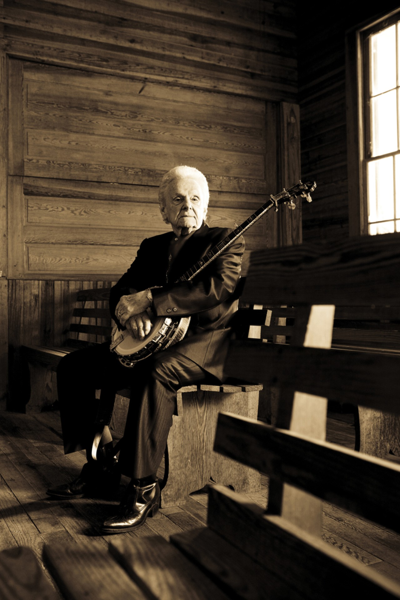

It’s hard to think of another career quite like that of iconic singer and banjo player Ralph Stanley, who died of skin cancer Thursday at the age of 89.
Nearly 70 years from start to finish, it began with a bang in late 1946, when his guitar-playing big brother Carter picked him up at the Abingdon, Va., train station — the younger Stanley had mustered out of the Army after serving in occupied Germany — and took him straight onto a stage with a band Carter was already in. “I played a personal appearance before I even went home,” Ralph recalled in 1998, and that was pretty much the story of his life from then on.
As one of the very first bluegrass bands, The Stanley Brothers struggled to make a living from playing music for nearly 20 years before Carter’s death in 1966, building an extensive catalog of songs and recordings that inspired fierce loyalty from a too-small audience. Even so, the brothers’ legacy was strong enough to put them into the Bluegrass Hall of Fame right behind Bill Monroe, Lester Flatt and Earl Scruggs, who had forged the musical foundation on which the brothers built their own sound, and they are deeply admired far and wide by followers like Bob Dylan.
Yet, as Ralph himself was prone to pointing out, his own career lasted far longer, and took him much further, than his years with Carter. The brothers' complicated personal and musical relationships were replaced by Ralph's single-minded, and now unmediated, devotion to what he insisted on describing as his kind “of old-time mountain music, that some folks call bluegrass.” And while he did it quietly and almost cautiously, it didn’t take him long to emerge from the shadow of Earl Scruggs (whose picking style he had been quick to emulate early on) and, more importantly, Carter, whose more genial demeanor made him the obvious frontman for The Stanley Brothers.
To those whose awareness of his work dates back no further than his 2000 spine-tingling performance of “O Death” for the O Brother, Where Art Thou? soundtrack (and the Best Male Country Vocal Performance Grammy it won him), Ralph Stanley seems to have been something of a remote presence. It’s not uncommon to see his singing described as otherworldly, and his frequently subdued presence onstage for most of this century underlined the feeling.
But longtime bluegrass fans and colleagues got to know a different Ralph Stanley. For during the 35 years between Carter’s death in 1966 and the O Brother triumph, he and the musicians who worked for him were relentlessly touring a mostly hardscrabble bluegrass circuit, singing and picking for fans in cow pasture festivals, murky taverns and schoolhouse auditoriums.
In these settings, Stanley held court. Sometimes that was onstage, where he’d show flashes of alternately dry and broad humor, or give ample deference to long-timer Clinch Mountain Boys bandmates Curly Ray Cline and Jack Cooke, along with schooling younger Clinch Mountaineers like Keith Whitley and Charlie Sizemore. He did all this while laying down his distinctive sewing-machine banjo roll and belting out helplessly lonesome leads and harmonies that were made even more mournful by each bit of vocal filigree. But Stanley also reigned at the table, where he was unmatched in his ability to genuinely engage fans for hours — meeting and greeting, all while making change and making sure they didn't leave his gigs empty-handed. Nearly everyone who remembers those days — whether as an adult fan or as an aspiring kid — has at least one story to tell about a Ralph Stanley encounter.
The world at large should mourn Stanley’s death as the loss of a unique artist whose greatness resided in his ability to bring the sounds of his mountain home to those who might otherwise have never heard them. Ralph Stanley showed, once again, that music’s universality and particularity are two sides of the same coin, and he did it in an especially compelling way. But to the bluegrass community, his death is also an occasion to remember what it was like when the world wasn’t ready to hear those sounds, and to pay loving tribute to the depth of feeling, the commitment and the pure and simple determination it took for Ralph Stanley to make them anyway.



Post a comment as anonymous
Report
Watch this discussion.
(0) comments
Welcome to the discussion.
Log In
Welcome to the discussion.
Keep it clean. Please avoid obscene, vulgar, lewd, racist or otherwise abusive language. Comments featuring hate speech or threatening or violent content will not be tolerated.
PLEASE TURN OFF YOUR CAPS LOCK.
Be truthful. Don't knowingly lie or mislead.
Be proactive. Use the “report” link on any comment that violates our comment policy.
Share with us. We'd love to hear your feedback.