
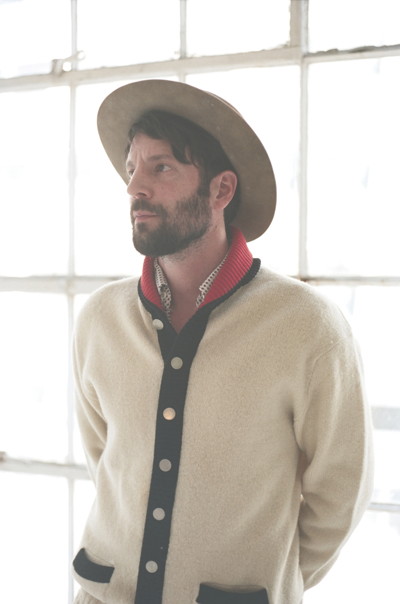
As an artist, you need to develop thick skin without letting it harden your heart. Ray LaMontagne is a shoe factory worker turned crooner, with little to recommend him beyond his old-fashioned manner and the timeless songs that emanate from his beaten old six-string. For years, his was certainly a hide-hardening slog.
A wife and two kids at home were the counterweight on his dream, driving LaMontagne's fierce pursuit. That was 15 years ago, and he's since sold more than a million albums — his last three each peaked at No. 3 on the Billboard 200 chart. But along the way, LaMontagne was psyching himself out nightly like a title fight contender, and all the negative emotion was eating him up.
"It worked for a time," says LaMontagne. "Especially when you're first starting out and you really have to prove yourself to audiences that don't know you, don't know your music, and maybe don't really want to be listening to you. You have to have a thick skin and come out swinging."
Finishing up his tour supporting 2010's God Willin' and the Creek Don't Rise, LaMontagne realized something needed to change.
"That kind of negative energy just turns on you," he says. "It begins to deplete you more than it feeds you. It's exhausting because it closes you off from any positive energy that is coming off the audience. So instead of recharging yourself, you're just depleting yourself every night."
This was the beginning of a personal chrysalis for LaMontagne, which culminated with Supernova, his most adventurous and arguably finest album to date. Each of the New England musician's four previous albums is distinct, but they all fall within in a rootsy, storytelling singer-songwriter mien. On Supernova, LaMontagne turns musically toward '60s garage, pop and psych for the first time. Songs range from the title track's echo of Big Star's Beatles-biting power pop, to the Cream-y garage psych "She's the One" and the trippy Tropicália of "Airwaves," which suggests a pop counterpart to Pink Floyd's "San Tropez."
Produced by Dan Auerbach, Supernova is still very organic and vibrant, even though it's keenly detailed and textured. There's pop richness without losing the homey intimacy. Auerbach and LaMontagne had long spoken of collaborating, and LaMontagne had been restless for a new direction.
"I really wanted to explore other types of songs that I'd wanted to write, but didn't feel like it was the right time or the right band," LaMontagne says.
Indeed, before arriving at the tone and songs he wrote for Supernova, LaMontagne started another batch in the vein of his earlier material. But it didn't feel right.
"Sometimes maybe you hear a song that another songwriter has written, and it just bores you so completely that you [wonder], 'Am I contributing anything or am I just making a living?' " he asks. " 'Is the art that I'm putting out there really serving a purpose for other people? Does it mean anything to anybody?' It's hard to tell sometimes."
Beset by this crisis of confidence, LaMontagne reached out to Elvis Costello, whom he surmised might've endured a similar feeling. Of course he had, and Costello encouraged LaMontagne to push on through.
"I had hit a wall, and I couldn't write or see the clear path for myself creatively," says LaMontagne. "It really did help to hear that yes, other guys had been through it before."
In the course of letting go of the negative energy and giving his muse permission to go wherever it wanted, LaMontagne created a striking album with an open-hearted manner that mirrors the turn in his own life.
"I think it comes with age, really," he says. "I just feel really positive about life in general."
LaMontagne's creative crisis doubled his typical time between albums, but he's so excited right now that he intends to return to the studio this fall for work on a sixth album, which he hopes will come out next year. The attitudinal change manifested in the live show as well, where LaMontagne's less adversarial mindset is reaping self-reinforcing waves of good vibrations.
"The energy out here is great," he says. "Everybody feels it. From the crew to the band. We're having a great time, and we're all looking very forward to that gig every night. That's the best part of the day, which is really new to me."
Email Music@nashvillescene.com.



