
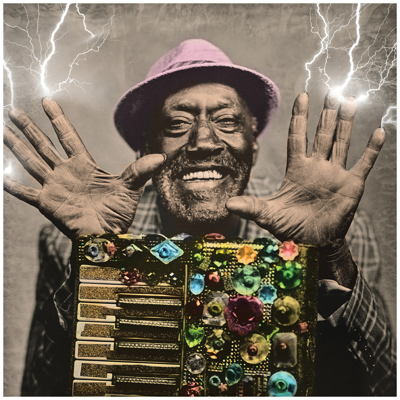
On a Friday night in 1965, in-the-know music fans across Middle Tennessee tuned in to WLAC-Channel 5. In tight focus on a multitude of cathode ray tubes was a skinny singer in dark shades with a pencil-thin mustache and glistening black curls, his face framed by the sparkling lapels of his jacket. Nodding out a one-two count, he launched into a powerhouse version of Titus Turner's "Sticks and Stones," a 1960 No. 2 R&B hit for Ray Charles. After he barreled through the first verse, the camera cut to his fingers as he slammed out the melody and bass line on the keyboard.
It's a moment of pure, rockin' soul transcendence that hasn't lost an iota of its power to move feet and shake hips more than half-a-century later. For music fans who tuned in each week to the Nashville-produced music program Night Train, Ironing Board Sam was a superstar.
The legacy of Ironing Board Sam will be honored with a screening of the documentary Ironing Board Sam's Return, along with rare footage from Night Train this Sunday at the Country Music Hall of Fame and Museum. Sam was scheduled to appear at the event but had to cancel due to illness. The screening is presented in partnership with the National Museum of African-American Music (projected to open its doors in downtown Nashville in 2017), and is a follow-up to the Hall of Fame's acclaimed Night Train to Nashville: Music City Rhythm & Blues 1945-1970 exhibit that ran from 2004-2005.
"I can't begin to tell you how many visitors went through the Night Train to Nashville exhibit and were quick to bring up their memories of Ironing Board Sam," exhibit curator Michael Gray tells the Scene. "He really left his mark on people's memories."
A native of Rock Hill, S.C.., the young Samuel Moore learned to play piano and organ before he could reach the top of an ironing board. He began his professional career in the late '50s, building a following in Winston-Salem, N.C., and Miami with charismatic performances and keyboard calisthenics on a Hammond B-3 electric organ.
After losing his B-3 in a fire and low on funds for a replacement, Moore cobbled together a patchwork of electronic parts to create his first self-built keyboard. Strapping the result to an ironing board for a stand, the stage name of Sam Moore passed into the minutia of musical history and Ironing Board Sam was born.
In the early '60s Sam wowed audiences on Beale Street in Memphis. That's where Nashville nightclub owner Theodore Acklen spotted him. With a handshake and a long-term booking at the Club Del Morocco on Jefferson Street, Sam brought his ironing board to Music City. He was soon sharing the stage with hot local talent that included Johnny Jones, Jimi Hendrix and Billy Cox.
It didn't take long for him to come to the attention of the Night Train's producers. Hosted by WVOL radio executive Noble Blackwell and taped at Channel 5's studio, Night Train was a weekly showcase for Nashville's local R&B talent as well as national acts passing through the Music City.
Leaving Nashville in 1966, Sam worked the local music circuits in Chicago and L.A., eventually settling in New Orleans. Billed as "The Eighth Wonder of the World," he became a Big Easy fixture, known for his knockout performances and outrageous stunts. Such antics included playing the New Orleans Jazz Fest from inside a 1,500-gallon aquarium, busking in the French Quarter with a wind-up toy monkey for a rhythm section and performing inside an 8-foot-tall wooden jukebox.
After the devastation of Hurricane Katrina, Sam returned to his native South Carolina in 2005. Five years later, he was "discovered" by the Music Maker Relief Foundation, a nonprofit organization that assists older Southern roots musicians. Four new albums followed, and Living Blues magazine named him "Comeback Artist of the Year" in 2012 and "Musician of the Year (keyboard)" in 2013.
In addition to Sunday's documentary screening, the Hall of Fame is also hosting an interview and performance with renowned drummer Philip Paul. A session man for King Records in the '50s and '60s, he beat skins on such R&B and country cuts as Freddie King's "Hide Away," Little Willie John's "Fever," Hank Ballard's "The Twist" and the Stanley Brothers' "Finger Poppin' Time."
"The museum has continued to look for ways to keep the Night Train to Nashville story alive," Gray says. "It's important to shed light on Nashville's rich rhythm and blues history, but it's also a thrill to spotlight Ironing Board Sam and have guests like Philip Paul to share their part in that story."
Email music@nashvillescene.com



Post a comment as anonymous
Report
Watch this discussion.
(0) comments
Welcome to the discussion.
Log In
Welcome to the discussion.
Keep it clean. Please avoid obscene, vulgar, lewd, racist or otherwise abusive language. Comments featuring hate speech or threatening or violent content will not be tolerated.
PLEASE TURN OFF YOUR CAPS LOCK.
Be truthful. Don't knowingly lie or mislead.
Be proactive. Use the “report” link on any comment that violates our comment policy.
Share with us. We'd love to hear your feedback.