
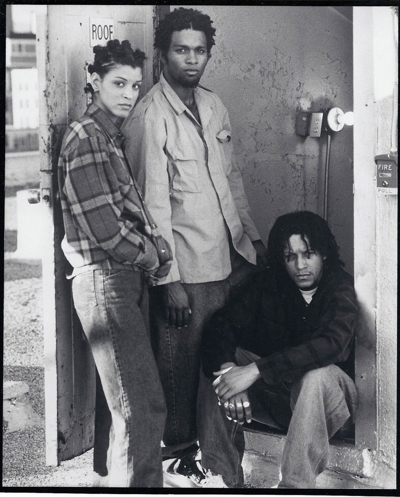

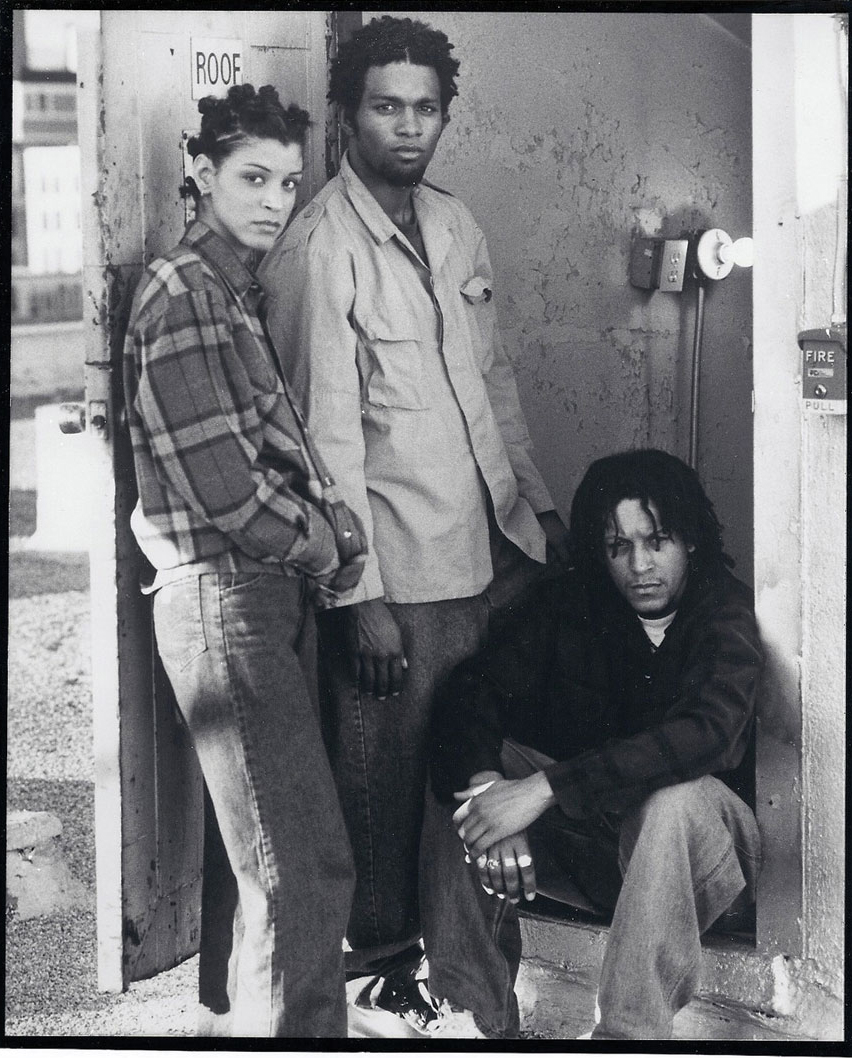
Digable Planets in 1994
From lovers of The Germs to Jeff Buckley to Young Marble Giants, rock ’n’ roll fans love to wax romantic about bands that made their mark and forever preserved their legacy with one album, but that’s a less-common phenomenon in the hip-hop realm. As a genre that’s survival is so contingent on constantly reinventing itself and forging new trends, hip-hop doesn’t have a lot of room for nostalgia. That said, let’s discuss recently reunited ’90s jazz-rap trio Digable Planets, playing Exit/In on Thursday, July 21. More specifically, let’s discuss the Grammy-winning group’s two-album catalog. Those records — 1993’s Reachin’ (A New Refutation of Time and Space) and 1994’s masterwork Blowout Comb — hold some of the most unanimously praised music of their time.
Along with Gang Starr’s Guru and his side project Jazzmatazz, Eric B. and Rakim, and British one-hit wonder Us3, Digable Planets were on the forefront of a popular, short-lived collision of hip-hop and jazz that mixed up classic funk and soul breaks with samples of hard bop and cool jazz, fusing the past with the present to critical and commercial acclaim. Borrowing the calm and clean delivery of beat poetry, Digable Planets’ MCs, originally known as Butterfly (Ishmael “Ish” Butler), Doodlebug (Craig “C-Know” Irving) and Ladybug (Mary Ann “Mecca” Vieira) trademarked an intimate, unhurried flow with a strong Black Power message they peppered with elements of science fiction that repped their Brooklyn neighborhood of Fort Greene as often as possible.
Onetime home of Walt Whitman, Chris Rock, countless jazz legends and Spike Lee’s 40 Acres and a Mule Filmworks offices, Fort Greene was a perfect point of origin for the three, who originally met at college in Massachusetts. The early ’90s alterna-boom was just getting started, and like many other young upstarts, the trio was snatched up by a major label (EMI imprint Pendulum Records) right out of the gate. Their first single, “Rebirth of Slick (Cool Like Dat)” — an infectious ode to the hipster cool of decades past, centered around a sample from Fred Wesley and the J.B.’s “Blow Your Head” — became a staple in MTV’s “Buzz Bin,” making Reachin’ a surprise critical and commercial success.
Released in 1994, Blowout Comb was an even stronger effort on the content front, but it suffered a similarly bittersweet sophomore slump-turned-triumph as Weezer’s 1996 cult-favorite Pinkerton. Blowout got little support from Pendulum, resulting in a commercial flop that was a devastating blow to the band. Though every bit as catchy and memorable as its predecessor, the album packed considerably more artistic merit. Mixing live instrumentation with intricate sampling that mimicked the greasy swing of New Orleans second-line funk, it boasted some of the most sophisticated production ever heard on a hip-hop album at the time. Lyrically, on one hand, it was an affectionate ode to Brooklyn, urban culture, block parties, corner stores, barbershops, public housing, incarcerated freedom fighters and a host of African-American influences. On the other, it was a black nationalist manifesto referencing the Black Panthers, the Nation of Islam, police brutality and other issues of urban struggle, while maintaining the band’s inimitably confident, disciplined and laid-back delivery.
Without a high-charting single to carry the album, Blowout’s sales paled in comparison to the gold-certified Reachin’ — which won the Best Rap Performance by a Duo or Group Grammy in 1994 — it was the beginning of the end for the group, which, citing “creative differences,” disbanded in 1995. Butler released an album as Cherrywine in 2003, before joining forces with multi-instrumentalist Tendai “Baba” Maraire as psychedelic hip-hop duo Shabazz Palaces. Irving formed Cee Knowledge and the Cosmic Funk Orchestra, and Vieira continued recording as a solo act, Ladybug Mecca.
With the recent success of artists like Kendrick Lamar — whose To Pimp a Butterfly is confrontational and unapologetically Afrocentric — as well as Kamasi Washington and even groups like offbeat R&B ensemble The Internet, it would appear we’re witnessing yet another jazz revival in pop music. But if history’s shown us anything, it’s that it probably won’t last long. After all, jazz is still America’s least favorite music — not far behind 22-year-old hip-hop albums, no matter how game-changing they may have been.
Email music@nashvillescene.com



