
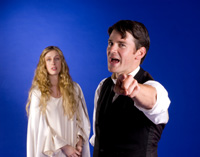

People don’t refer to Nashville as the Protestant Vatican for nothing. After all, this is an extremely religious place, the home of several seminaries, numerous Christian music companies, hundreds of churches and Thomas Nelson Inc., the world’s largest producer of Bibles. It’s a town where a 9-foot, 4-inch statue of Billy Graham hardly warrants a second glance, and it’s surely the ideal location for the world-premiere performance of an opera called Elmer Gantry.
“We just spent two hours listening to the chorus, and it was clear that everybody here really gets what this opera is all about,” says librettist Herschel Garfein, who was in town to help Nashville Opera rehearse his new work. “In fact, a lot of people in the chorus grew up in an evangelical environment, and they were able to draw on those experiences when interpreting the music. Hopefully that will create an authenticity in their performances that will resonate with the audience.”
Garfein and composer Robert Aldridge’s Elmer Gantry, which is based on the famed 1927 Sinclair Lewis novel of the same name, tells the story of a hard-drinking, womanizing charlatan who nonetheless possesses a certain gift for evangelical gab. “He never said anything important, and he always said it sonorously,” Lewis wrote of his title character.
Lewis’ novel was one of the great literary works of the early 20th century, and its significance was cited in 1930 when the author became the first American in history to win the Nobel Prize in Literature. Naturally, Garfein and Aldridge were familiar with the novel. “At one time, Sinclair Lewis was an essential part of most high school curriculums,” says Garfein. But it was the 1960 film adaptation starring Burt Lancaster that ultimately persuaded Aldridge and Garfein to write an opera.
“We basically stumbled upon the Burt Lancaster movie and found much to recommend it,” says Garfein. “Lewis’ novel is highly panoramic and covers something like 30 years of Gantry’s life. The film focused more on Gantry’s relationship with [the healer and revivalist] Sharon Falconer, and I think that was a correct decision since the story loses a lot of its interest and momentum once Sharon is out of the picture.”
The decision to write an opera based on the Lewis novel may seem like a no-brainer, since these days it seems you can’t even walk into an opera house without tripping over a literary property. In recent years, opera companies have produced John Harbison’s The Great Gatsby, André Previn’s A Streetcar Named Desire, Mark Adamo’s Little Women and Ricky Ian Gordon’s The Grapes of Wrath, to name only a few of the most prominent works.
Yet when Aldridge and Garfein first began working on Gantry about 17 years ago, operatic adaptations of American literary works were still few and far between. “When we first started working on this opera it was actually criticized for being too American and too vernacular,” says Aldridge. “At the time, the emphasis was still on writing operas that were through-composed and atonal. That’s probably why it’s taken us so long to get this opera onstage, because we were trying to bring back a numbers opera before it became fashionable.”
Of course, the sort of musical numbers that are most important in Elmer Gantry are gospel songs, and that’s a style with which Aldridge is intimately familiar. He grew up in North Carolina as the son of a Protestant minister. So as you might expect, gospel is a part of his musical DNA.
“I certainly feel comfortable with it,” says Aldridge.
John Hoomes, Nashville Opera’s artistic director, goes further. “Bob Aldridge understands gospel implicitly, so when you listen to this opera you’re not going to hear a parody of gospel, but rather a serious mix of real gospel and real classical music.”
A quick sampling of choruses, arias and duets from Elmer Gantry would seem to bear Hoomes out. “Who’s The Man,” arranged for male chorus, proves to be such a life-affirming, foot-stomping romp that it could probably win converts at an actual revival meeting. “Sharon’s Aria,” on the other hand, is a thoughtful meditation, one full of dark and surprising minor-key harmonies, while the “Love Duet” for baritone and mezzo-soprano is an impassioned song in opera’s best melodramatic tradition.
Nashville Opera has hired two notable opera stars, baritone Keith Phares and mezzo-soprano Jennifer Rivera, to sing the lead roles of Gantry and Falconer. All the same, the company has lavished much of its attention on the chorus, which in this opera serves as the congregation.
“Our chorus master, Amy Tate Williams, asked everyone in the chorus to look into their family backgrounds and come up with names for our characters,” says chorister Barbara Arrowsmith, a veteran of 37 Nashville Opera productions. “I named my character Ina Mae Simmons, after my grandmother who was Southern Baptist. Amy believes that if we assume these identities we’ll sing more authentically. She also told us to think less about operatic diction and more about gospel singing. We did something similar a few years ago when we performed Susannah.”
Garfein and Aldridge readily admit that Carlisle Floyd’s 1955 masterpiece Susannah had a considerable influence on their work. In Susannah, Floyd created a brilliant synthesis of classical music and Appalachian folk song. He also filled his opera with unforgettably beautiful tunes.
“Whenever I’m at auditions, I always hear a lot of young vocalists perform arias from Susannah, since the music is so beautiful,” says Hoomes. “For the same reason, I suspect one day I’ll hear a lot of young vocalists sing arias from Elmer Gantry.”



Post a comment as anonymous
Report
Watch this discussion.
(0) comments
Welcome to the discussion.
Log In
Welcome to the discussion.
Keep it clean. Please avoid obscene, vulgar, lewd, racist or otherwise abusive language. Comments featuring hate speech or threatening or violent content will not be tolerated.
PLEASE TURN OFF YOUR CAPS LOCK.
Be truthful. Don't knowingly lie or mislead.
Be proactive. Use the “report” link on any comment that violates our comment policy.
Share with us. We'd love to hear your feedback.