
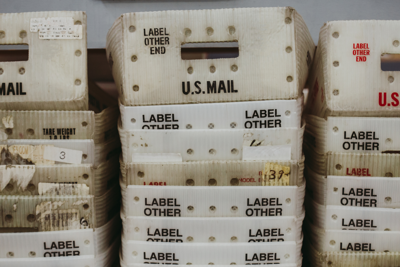


The United States Postal Service has had a challenging year. First, it struggled to cope with a massive increase in shipping volume due to the COVID-19 crisis. Then, Trump donor and recently appointed Postmaster General Louis DeJoy introduced significant measures to cut costs and reduce capacity. Following a warning from the agency that it couldn’t guarantee timely delivery of mail-in ballots, the embattled DeJoy is testifying before Congress. But it’s not expected that a relief bill for the postal service passed by the House of Representatives on Saturday will become law.
Meanwhile, thousands of customers continue to struggle with an element of unpredictability that the overloaded mail system has introduced. For individual musicians as well as small businesses like indie labels and record stores, the U.S. mail is incredibly important to navigating the COVID-19 crisis. In a time when shipped merchandise is crucial for offsetting lost income from live events, the USPS is a popular and cost-effective solution for shipping. It doesn’t come without issues, however.
Standout songsmith Kyshona Armstrong, who performs as Kyshona, has made fans around the world with phenomenally nuanced and stylistically diverse music. Those fans backed the release of her recent LP Listen through a Kickstarter campaign, and they’ve continued to buy merch from her website while she’s unable to tour. In addition to writing and performing, she does grant-funded nonprofit work, and she handles all the shipping related to her music herself. Delays in USPS shipping have not only affected her ability to get orders out rapidly, but also wreaked havoc on receiving her grant checks.
“I’m relying on those that have invested in me for payment," says Armstrong. "And I can't even get payment on time through the postal service because of what they're having to deal with right now. … They've already been pushed to the limits to try to operate and keep people's mail going at a good rate throughout the pandemic. Even if my work is being hindered, why must postal service workers be hindered right now as well? Why does another job market have to be put in jeopardy because of selfishness?”
Before the pandemic, people walking into the store were by far the biggest source of business for Grimey’s New and Preloved Music. You could buy a sticker or a T-shirt on their website, and occasionally participate in a presale promotion, but that was about it. During the weeks in the spring when nonessential businesses were closed under Metro’s Safer-at-Home order, Grimey’s upgraded its online store, loaded it up with stock, and saw online business skyrocket.
Even after the store was able to open for limited in-person shopping and curbside service in June, many customers — even ones who live in Nashville — have continued ordering LPs, CDs and books to be shipped to them. Manager Anna Lundy estimates that Grimey’s shipping volume is up by 2,000 percent this year. But inconsistencies in delivery speed and especially in shipment tracking have made it a daunting task to keep up.
Each business day, orders are pulled from the shelf and packed. A shipping label is printed, which automatically sends the customer an email with a tracking number. The packages are then delivered to the post office, and that’s where things get tricky. In a USPS system that isn’t under immense strain, each package would be scanned at the post office where it’s been dropped off, and then again at each subsequent facility it goes through until it arrives at its destination. Right now, that doesn’t always happen.
“Customers have these tracking numbers, and then they go to track [their packages], and all it shows is that the label has been printed and it's awaiting arrival at the USPS,” says Lundy. “However, in all those instances, they actually have the records. … There've been instances where we'll drop something off, and two weeks later the box is finally scanned in Memphis. It was never scanned here. Or something will be scanned initially on the intake, and then nothing will happen for an extended amount of time. Or it'll move a little bit, and then just seem to kind of sit somewhere, and there will be no updates. It will just not be scanned again until several weeks pass.”
Most packages eventually end up at their destination, though not without Lundy wading through a sea of text-message and email alerts, and keeping customers updated. More than once, she’s seen an issue with the customer’s address result in a package just disappearing into the system.
“We get that the volume is really, really high,” Lundy says. “There's no problem with things taking longer and waiting. It's when the communications disappear — when we can no longer track items, because they just seem to sit and be in limbo — that's where the real frustration is.”
Independent labels have also been shipping at significantly higher rates. Katie Studley, Third Man Records’ vice president of operations and marketing, says that online orders have been at holiday-season levels since March. TMR has a significant international customer base, and they’ve seen delays in those shipments as well. Third Man’s long-running Vault subscription program, in which members get a package of exclusive records and other merchandise by mail several times a year, relies extensively on the USPS.
“Our site says we're experiencing shipping delays ‘due to COVID-19,’ but at this point, COVID isn't the culprit,” Studley says. “We made some changes to how we sent out our most recent Vault packages … to international customers due to restrictions and delays caused by COVID. Though we finished shipping weeks ago, many of those packages are still in transit.”
USPS Media Mail, a special mail class for items like records or books, is the most popular shipping method for customers of many businesses selling records. USPS Priority Mail shipments move more quickly and seem to experience fewer delays and tracking problems. But Priority Mail service often costs twice as much as shipping by Media Mail, and most customers stick with Media Mail. Working with other carriers is an option that Studley and her team have considered, but the cost is prohibitive.
“If we moved our Vault business to FedEx, we would pay over double to ship each parcel,” says Studley, “and we aren't convinced the transit times would be significantly better. So, our only avenue is to communicate openly with customers, set expectations and keep our handling times as minimal as possible.”



Post a comment as anonymous
Report
Watch this discussion.
(0) comments
Welcome to the discussion.
Log In
Welcome to the discussion.
Keep it clean. Please avoid obscene, vulgar, lewd, racist or otherwise abusive language. Comments featuring hate speech or threatening or violent content will not be tolerated.
PLEASE TURN OFF YOUR CAPS LOCK.
Be truthful. Don't knowingly lie or mislead.
Be proactive. Use the “report” link on any comment that violates our comment policy.
Share with us. We'd love to hear your feedback.