
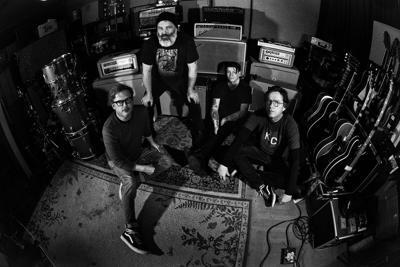

In the current print issue of the Scene, I talk with Allen Epley of Shiner, builders of the 1990s Kansas City post-hardcore sound — complex, workmanlike and melodic, but above all else, loud. After peaking creatively with 2001's The Egg, Shiner disbanded. From there, the Louisville-raised Epley led the heavy pop power trio The Life and Times while finding a second calling as host of Third Gear Scratch, a podcast about indie musicians' off-stage enterprises.
In the wake of intermittent reunion shows through the 2010s, Shiner's core four — Epley, guitarist-keyboardist Josh Newton, bassist Paul Malinowski and drummer Jason Gerken — decided it was time for a new record. The resulting prog-punk tour de force Schadenfreude had the misfortune of coming out mid-pandemic, but the band is touring it at last. They'll play Drkmttr Wednesday, March 9, with Tape Deck Mountain opening. There was no way to fit my entire interview with Epley into the story, so check out more of our conversation.
Interviewing the interviewer. This should be fun.
[Laughs] I always get nervous when I'm interviewing interviewers. “This person knows their shit, so I've got to be on my game.”
Shiner recently got back from a West Coast tour. How was it?
We've missed so much the past two years, so just getting to play shows in front of real moving, breathing human beings again was a real special thing.
I know Gerken played with Hum in 2015, but what did Newton and Malinowski get up to since The Egg?
When we split, Josh joined Reggie and the Full Effect. He went on to a band called From Autumn to Ashes, then Every Time I Die. They just broke up. But they were huge. Paul is an audio engineer and producer. He's steadily been recording bands in his home studio, becoming a wizard in that respect. Literally looks like a wizard these days, too. [Laughs] Jason moved to L.A. for 12 years and played in different bands, on different recordings. Did that Hum tour, some session work … started a new band with ex-Molly McGuire guys called Kingdom of Snakes … and managed a bar there, The Griffin.
The definition of “schadenfreude” is “pleasure derived from someone else's misfortune.” Why this title for your new record? Is there someone in Shiner's sphere that karma did a number on?
[Laughs] We thought it was appropriate for the time … feeling surrounded by opposing sides, laughing at each other over bad things that happen. It's inescapable. I grew up in the church, in Louisville. My folks were music professors, but that didn't pay much, so being ministers was their weekend job. It was at church and youth group where I met the first girl I made out with, and the friends I smoked dope and drank beers with. Still, we showed up every Sunday. It wasn't so contentious then. You didn't have to be a Jesus freak. You might’ve even been a passionate nonbeliever.
Lula Divinia — Shiner's second LP, and first great one — turns 25 on March 11. Are there plans to observe this?
Holy shit. [laughs] I'm sure we will. I'm just like, oh my God … life. The demos for [Lula] were all done in my basement on a TASCAM 388, quarter-inch reel-to-reel. A real time capsule. We loved The Smashing Pumpkins, Swervedriver, Failure, The Jesus Lizard and Slint, my Louisville compatriots.
Growing up, did you ever cross paths with members of Slint?
I did not know those cats. They were a couple years older, and went to The [J. Graham] Brown School downtown, while I was in public school in the suburbs. But watching [Lance Bangs' 2014 documentary] Breadcrumb Trail, it was amazing how ahead-of-the-curve they were musically when they were just boys. Even their jam-box demos sound like the records.
Shiner's first record Splay reminds me of Slint's debut Tweez a bit.
Definitely. Because it hadn't realized itself. We loved Tweez, but it is imperfect. And on Splay, we were just learning. We had a bass player, Shawn Sherrill, who'd never played in his life. He could play, and it was enough for a while. Before we made Splay I'd never played electric guitar in a band. I'd played acoustic and classical in college, but I'd never played a guitar solo. I did know how to make cool chords, however, and how to sing. So that was what we leaned on.
Working on Schadenfreude, were you aware that Hum was making Inlet, and that they'd end up coming out so close together?
Those motherfuckers. [Laughs] I'd heard some tracks, which were great, of course. [Hum’s singer-guitarist Matt Talbott] knew we were doing this, too. We both felt we'd probably end up with these at the same time, though it kind of snuck up on us when they released theirs. Such a great record.
In what ways would you say your voice as a songwriter grew and evolved in The Life and Times?
I allowed myself to sing more melodically. After Shiner, it was nice to sing in major keys and play normal chords rather than such difficult ones — find a vibe, and feel it. Or write an entirely quiet song. The Life and Times was a great release for me. The music has always flowed easily.
What's your process for songwriting?
I'll set aside a few weeks just to stand in front of my amp and play. Smoke some weed, let it happen organically, track it somehow. Write for a while, see what comes out. You've just got to chop wood.
Is your guitar setup the same in both bands?
I have to dial it back in Shiner to make room for Josh's atmospheric stuff, where in Life and Times I'm covering a lot more ground so I've got more of the noisemakers, the “do-it-again” pedals. [Laughs]
What's the nature of your job with Blue Man Group?
I play in the band above the Blue Men. We float in a loft. There's a black light up there, and we have Day-Glo paint on us. We're musical shamans, who score the entire show. I play bass, and an instrument called Chapman Stick. It's a well-paying, music-related gig — a unicorn for working musicians. As corporate as it is — and it is, we're owned by Cirque du Soleil — it's fun and very satisfying to mix it up with a bunch of loose, free-thinking theater folks.
What was the catalyst for starting Third Gear Scratch?
I was seeing my therapist — and I would recommend that to anyone and everyone, even if you're feeling healthy. I wasn't, and needed clarity on what to do with my life. I was turning 48, and feeling lost. Starting the podcast solidified my belief in my own choices. The thrust of it is to talk to artists, musicians, actors, filmmakers and others who've chosen art as a career. Life is hard for everybody, work is work … and I feel confident now that I've chosen the right path.
Making a hundred of anything is a big accomplishment, and you celebrated the 100th episode of Third Gear Scratch interviewing Talbott live in Chicago.
Yeah. Turns out holding a conversation in front of 180 people in a room is different than talking one-on-one from your basement. [Laughs] But people loved it, and Matt was a willing participant.
You're the only person he let interview him. I know — I've tried.
[Laughs] Well, he and I are simpatico. We've got history together, love each other and have a lot of parallels in our lives. It was a good talk. It was just a week after [Hum's drummer] Bryan St. Pere died. I initially called Matt just to say I was sorry, and that maybe we should postpone. But [his wife] Sue said it was a thing he should do. She's the boss — so we did. Matt performed a couple solo songs, too, that he'd only previously played at house concerts.
I've seen one of those. It was awesome. I'm ready for recordings.
Definitely. And Matt has been putting all that material down.
I can't wait to find out what it's like sonically.
It's just six-string nylon guitar, and his voice. But you'll recognize the melodies. It's like Hum stripped back a thousand percent. He whispers into the mic. There's cool effects on his voice. It's an affecting performance. And just like how the Hum and Shiner records came out at the same time, I have a finished solo record too. Chris Prescott from Pinback and No Knife plays drums, and Mike Burns of Electric Hawk is on lap steel. It's under my own name; the working title is Everything. So excited. We've got rehearsal tomorrow night.



Post a comment as anonymous
Report
Watch this discussion.
(0) comments
Welcome to the discussion.
Log In
Welcome to the discussion.
Keep it clean. Please avoid obscene, vulgar, lewd, racist or otherwise abusive language. Comments featuring hate speech or threatening or violent content will not be tolerated.
PLEASE TURN OFF YOUR CAPS LOCK.
Be truthful. Don't knowingly lie or mislead.
Be proactive. Use the “report” link on any comment that violates our comment policy.
Share with us. We'd love to hear your feedback.