
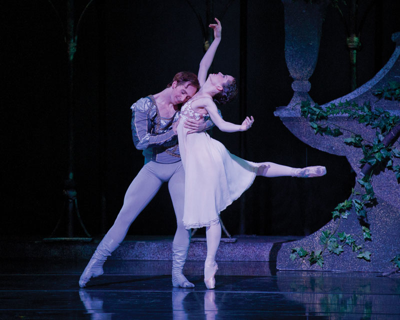


Nashville Ballet's Romeo and Juliet
“Isn’t it ironic that the quintessential American ballet was conceived during the Second World War by a woman, a Japanese designer and a gay Jewish composer?” says Nashville Ballet artistic director Paul Vasterling.
Vasterling was on the phone with the Scene to discuss his company’s latest project, a performance this Friday at the Schermerhorn of Aaron Copland’s Appalachian Spring with Giancarlo Guerrero and the Nashville Symphony Orchestra. Vasterling was recalling a conversation he’d had with music education guru Mitchell Korn about the origins of Copland’s timeless classic.
Appalachian Spring is best known for its glorious, magisterial final statement of the Shaker hymn “Simple Gifts,” a theme that readily calls to mind the rustic simplicity and decency of a bygone era. But did Copland and his collaborators — famed choreographer Martha Graham and Japanese sculptor and set designer Isamu Noguchi — merely celebrate an idealized American past, or did they have a deeper meaning in mind? Clearly, Vasterling and Korn believe these artists were after more.
“I think they were exploring the complex and nuanced relationships between individuals and their communities,” says Vasterling.
The genesis of Appalachian Spring dates to 1942, when philanthropist Elizabeth Sprague Coolidge by chance caught one of Graham’s contemporary dance performances. Inspired, she invited Graham to create three new dances, which would be performed the following year at Coolidge Auditorium at the Library of Congress in Washington, D.C. Three heavyweight classical composers were commissioned to write music — Paul Hindemith, Darius Milhaud and Copland.
The story in Copland’s ballet centers on a newly built farmhouse in rural Pennsylvania during the 19th century. A young bride and her farmer husband express the emotions — joy and apprehension — of their new domestic partnership. An older neighbor offers sage advice. Later, a revivalist and followers remind everyone of mankind’s strange and terrible fate.
Vasterling has created his own choreography for Appalachian Spring, taking his lead from Graham. “The work is entirely modern, with nothing danced en pointe,” says Vasterling. “All of the dancing has a great deal of weight to it.”
The biggest change Vasterling brings to the ballet is the focus of the story. “Graham and Copland were looking at how a young couple faced the American frontier on their own,” he says. “I’ve changed the focus to look at how the young woman relates to the people around her.”
Although Appalachian Spring is known for its huge orchestral score, Copland initially wrote it for a tiny chamber ensemble of 13 musicians, consisting of a string combo along with flute, clarinet, bassoon and piano. The reason for this lean, mean arrangement had more to do with logistics than aesthetics.
“The problem that Copland faced was the size of Coolidge Auditorium at the Library of Congress,” says conductor Guerrero. “The only way to fit the dancers and the musicians in that small space was to have a tiny chamber ensemble. But Copland knew he had a hit on his hands, so after the performances in Washington he rearranged the piece for the New York Philharmonic. That’s the version we know.”
Nashvillians will get the rare chance to hear the original incarnation of Appalachian Spring this weekend, since Guerrero and Vasterling opted to present the chamber version of the score. “We wanted to give the dancers more room to move about the stage,” says Guerrero. “We also wanted to give people the chance to hear this extraordinarily intimate and transparent arrangement of the music.”
This weekend’s performance will also feature excerpts from Vivaldi’s The Four Seasons along with Prokofiev’s Romeo and Juliet. Vasterling created his Vivaldi choreography for Oregon Ballet Theatre in 1997. Friday’s performance of it will give the NSO the chance to showcase the dazzling virtuosity of its concertmaster, Jun Iwasaki. Guerrero has created his own arrangement of Romeo and Juliet, combining music from Prokofiev’s several different orchestral suites.
“This will be the first time the ballet and the Nashville Symphony have performed together inside the Schermerhorn,” says Guerrero. “For such a special performance, we obviously wanted an original and memorable program.”
Email arts@nashvillescene.com



Post a comment as anonymous
Report
Watch this discussion.
(0) comments
Welcome to the discussion.
Log In
Welcome to the discussion.
Keep it clean. Please avoid obscene, vulgar, lewd, racist or otherwise abusive language. Comments featuring hate speech or threatening or violent content will not be tolerated.
PLEASE TURN OFF YOUR CAPS LOCK.
Be truthful. Don't knowingly lie or mislead.
Be proactive. Use the “report” link on any comment that violates our comment policy.
Share with us. We'd love to hear your feedback.