

Long before über-hipsters indulged their caffeine cravings at chic third-wave coffee bars, there was Café Zimmermann.
This famed German coffee house, towering four stories above Catharine Street in the old commercial city of Leipzig, was the 18th century equivalent of a smoky jazz club, a sort of Teutonic Village Vanguard. It was a place where men — and for perhaps the first time in European history, even women — could sip the finest East African brews while listening to the most fashionable music of the time. The cafe's house band was called the Collegium Musicum, which during the 1730s was led by none other than Johann Sebastian Bach.
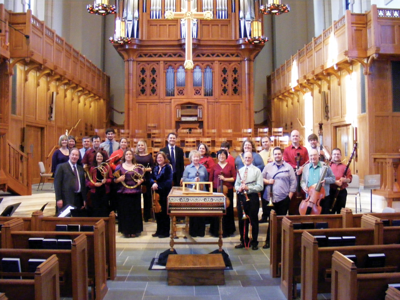
On Sunday afternoon, Nashville's premier period-instrument group, Music City Baroque, will attempt to re-create the Café Zimmermann experience (minus, of course, the now-prohibited tobacco smoke) with its performance at Bongo Java in the Gulch. The concert will feature the sort of music that was performed at the old coffee house. Naturally, the program will culminate with (what else?) Bach's famed Schweigt stille, plaudert nicht, often referred to as the "Coffee Cantata."
"Bach's 'Coffee Cantata' is a fun piece," says Christopher Stenstrom, who plays an 18th century style cello with Music City Baroque. "It's all about a father who nags his daughter about her coffee addiction. There's not a serious moment in it."
Music City Baroque's performance at Bongo Java, on the other hand, is part of a serious musical trend. In recent years, a number of classical groups and artists have been abandoning the elitist trappings of the formal concert hall in favor of performing in alternative venues. Noted classical cellist Matt Haimowitz, for example, often performs in bars and clubs, where he freely alternates the music of Bach and Hendrix. And at New York City's (Le) Poisson Rouge, contemporary classical music fans can munch on nachos while listening to the mind-bending sounds of David Lang, Laurie Anderson and other exponents of the avant-garde.
Interestingly enough, the idea for Music City Baroque's collaboration with Bongo Java originated with Vanderbilt University's Center for Latin American Studies and its Institute for Coffee Studies. (Yes, Vandy seriously studies the flavorful brew.) The institute's official findings: Drinking moderate amounts of black coffee is actually good for you (something Scene writers have long suspected). Moreover, coffee has had a bigger impact on history and culture than you may have imagined.
Europe first obtained its East African coffee from Arabic traders, who shipped it through Venice to such commercial centers as London and Leipzig. Coffee was quickly established as a luxury drink that was often sold at pubs and coffee houses. Gottfried Zimmermann built his coffee house in 1715, and to attract customers he offered free music on Friday nights. That offering — commonplace at any bar, club or honky-tonk today, as Music City denizens well know — had huge implications for 18th century music and musicians.
"Musicians suddenly had a new outlet for their music," says Mareike Sattler, a vocalist with Music City Baroque. "They could now write music that wasn't subject to the restrictions of the court or the church."
Bach was a busy church musician when he took over the part-time gig of music director of the Collegium Musicum in 1729. Over the course of the next eight years, he would lead the group in a staggering 500 concerts. Exactly what he conducted is unknown (the programs have not survived), though it is believed he performed his orchestral suites at the coffee house. He surely introduced his "Coffee Cantata" to the Zimmermann audience. This secular cantata, with its hypercaffeinated female protagonist, was a sign of the times.
"The Coffee Cantata shows women had a new place in society," says Sattler. "They could no longer be ignored."
Email arts@nashvillescene.com



