
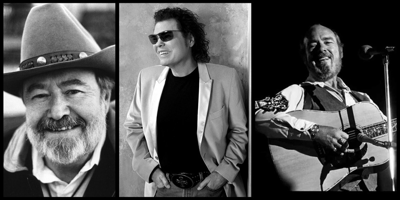

Sure, there was a red carpet, and wait staff working the room with trays of champagne flutes and an elegant, catered reception afterward. The Country Music Hall of Fame’s Medallion Ceremony is that sort of occasion. But once the roughly 800 guests were ushered to their seats in the CMA Theater Sunday night, they were soon hearing about the humble origins of each of this year’s Hall of Fame inductees: One with a Depression-era, Shenandoah Valley upbringing; another surrendered to an orphanage by destitute parents; the third falling into rough hands at a state-run school for the blind. Really, though, that’s where the similarities between Mac Wiseman, the late Hank Cochran and Ronnie Milsap — and the tributes paid to them — ended.
Besides the fact that they were nominated in different categories — Wiseman in Veteran Era, Cochran in Songwriter and Milsap in Modern Era — they were honored for doing very different things, for exemplifying very different facets of quintessential country identity during their careers.
A jaunty, gentlemanly 89 years-old in his driving cap, black suit jacket and wheelchair, Wiseman was hailed as a keeper of the flame for country’s folk roots, a polished singer of old sentimental songs and mountain ballads who made a mark on first-generation bluegrass. Between turns at the microphone by Jim Lauderdale and Vince Gill, Charlie Daniels emerged from the wings in his standard stage attire — big, broad cowboy hat, pressed jeans and belt buckle the size of a dessert plate — to recall emulating Wiseman’s records in his youth before performing “Jimmy Brown the Newsboy,” a 19th Century tune-turned-Carter Family standard-turned chart hit for Wiseman.
Fellow Hall of Famer and longtime Country Music Association executive director Jo Walker-Meador hung the medal around Wiseman’s neck and drew attention to the way he navigated the business. He’d served on the CMA’s founding board, and returned for several more terms — “He did actually work,” Walker-Meador emphasized. That was offered as one among many ways that he’d crusaded, with commercial instincts and finesse, for the respectability and accessibility of the music. Or as he put it, “I tried to be true to myself, and to the business itself.”
Next, Cochran, who died in 2010, was celebrated for the unpretentious poetry of his songwriting. “Make it short; make it sweet; make it rhyme,” he quipped in interview footage projected onto a giant screen above the stage, adding in a later clip that he couldn’t take credit for the songs that God gave him.
Bobby Bare, a buddy of Cochran’s for at least half a century and the most irreverent speaker of the night, himself a 2013 inductee, did the speech-making honors for his old friend.
“He could feel things that nobody else could feel,” reflected Bare. “He wasn’t afraid of falling in love.” Bare couldn’t resist throwing in that Cochran won over his future in-laws by passing off a song that he’d written and Bare had recorded years back, “I’d Fight the World,” as a token of love he’d penned for their daughter only the night before.
Performances by Alison Krauss, Cochran’s favorite singer, and Gene Watson, the under-appreciated ‘70s honky-tonk balladeer, underscored the mixture of plainness and emotional depth, the standard-setting country expression for which Cochran was being recognized. Krauss gushed about how intimidated she’d once been to sing a song of Cochran’s at Carnegie Hall, then proceeded to give her sumptuously demure vocal caress to a pair of them, “Make the World Go Away” and “Don’t Touch Me.” Watson chimed in with a story of how he’d been too nervous and naive to record a Cochran song he loved without getting the great writer’s permission first.
Milsap, the evening’s final honoree, was heralded for the superstar-level success he found by incorporating his silky take on R&B, which country music history treats as its black-pioneered, working-class cousin and one among its many musical tributaries. He was shown on screen dueting with Ray Charles, and feted by soul shouter Sam Moore, of the legendary Sam & Dave, who recalled his first encounter with Milsap on the African-American R&B circuit in the ‘60s. “He’s a white boy!” shrieked Moore, reenacting his surprise.
Joined by a harmony-singing, joke-cracking Vince Gill (who called himself “a lighter shade of Dave”), Moore gave the most off-the-cuff performance of the evening, a rendition of Milsap’s retro-R&B number “Lost in the Fifties Tonight.” Then came hot, young multi-instrumentalist Hunter Hayes, who’s been covering Milsap live, and Martina McBride, fresh off her own soul covers album.
Inducting Milsap was diminutive rock, pop and country spitfire Brenda Lee, a well-chosen last-minute stand-in for Reba McEntire, whose father had just passed. Lee recounted urging Milsap’s longtime manager to sign her fellow genre-bridger in the first place, before delivering the take-charge line of the night to her considerably taller inductee. “I’m coming over there with this medal,” she warned, “and you’d better bend over.”
After Milsap was helped to the piano, ever-present sunglasses on his face and medal around his neck, he kicked off a slow-as-molasses, gospel-blues rendition of the spiritually unifying, standard sing-along show-closer “Will the Circle Be Unbroken.” Wiseman, the Medallion Ceremony’s first-rate house band, all of the featured singers, a local Methodist choir and, arrayed in front of the stage, the crowd of other Hall of Famers in attendance dutifully fell into the shuffling groove, like they meant to demonstrate the elasticity of the institution a final time before calling it a night.



