
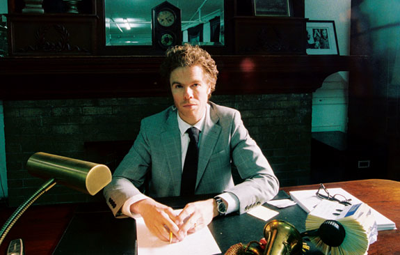

When Josh Ritter stepped onstage on the Fourth of July last year, he was given the kind of welcome usually reserved for war heroes and Robert Pattinson. Backed by his usual band of folk-rockers (now dubbed "The Royal City Band") and a 24-piece orchestra, Ritter played a set of his classics, mixed in with cuts off what would become So Runs the World Away and a performance of "The Star-Spangled Banner" on the violin. In the eyes of the crowd, he could do no wrong. And yet it wasn't a hometown show in Idaho or a stateside music festival — it was under a big-top tent in Cork, Ireland.
"I guess the thing that has been more and more clear to me is that when I'm in Japan or I'm in Germany, I'm playing 'world music,' " Ritter says from a Minneapolis airport, just prior to leaving for another three shows in Ireland.
There was a time when being a folk singer also meant having significant ties to your roots that dominated your music, even if not overtly so. While an artist's regional heritage didn't necessarily define their career, it was an unshakable part of their identity as a musician. Bob Dylan and Shirley Collins sounded like the Midwest and Southeastern England, respectively, and no matter what they did — ill-conceived gospel albums and all — those inflections were there.
In 2010, it's not so clear-cut. Mumford & Sons have dominated the Billboard folk charts for more than 20 weeks with their decidedly Americana, Southern Delta by way of London debut record Sigh No More. Meanwhile, indie folk in America has shifted toward Europe in a big bad way, with bands like Beirut and DeVotchKa gleefully poaching the styles of French chansons and Spanish gypsy music. Thanks to globalization and the Internet, potential influences have become endless. But where does that leave Ritter, whose squarely by-the-numbers Americana folk rock has quietly been living under the U.S. radar for more than 10 years?
"I don't think it's necessarily the bands that have become more globally aware, it's that the audiences have become more globally aware," he says. "There's a way for people to search out things that are a lot more interesting than maybe they would be able to find before."
Ritter's style is textbook in the most literal sense possible. Even when disregarding the fact that he has a degree in American History Through Narrative Folk Music, Ritter's albums show an acute awareness of historical context. So Runs the World Away, Ritter's sixth album and his first independent release since Golden Age of Radio in 2000, culminates in a love letter to the genre: "Folk Bloodbath" weaves together a couple hundred years' worth of murder ballad characters into one flowing narrative.
Ritter has seemingly come to terms with his less-than-stellar record sales, and instead found success in cultivating an international audience of devotees willing to go down that road of upper-division folk songs about Joan of Arc and World War III.
"I've come up in an era where record sales have been declining, and you can't look to that as a source of income. So I do believe really strongly that it's about a level of rapport with the audience," he says. "But that has always been the case. I think we had an aberration where record sales were the thing that could support a career. We all know now that if you're a jerk to your fans, you don't have much of a career going anymore."
Email music@nashvillescene.com.



