
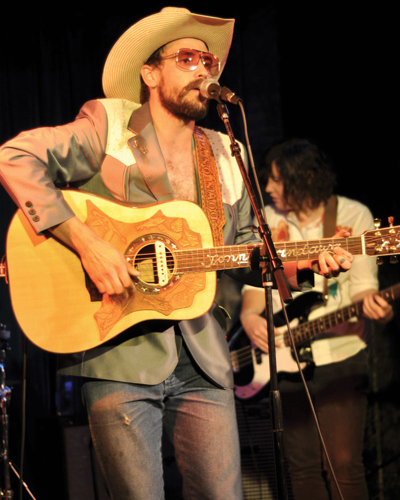
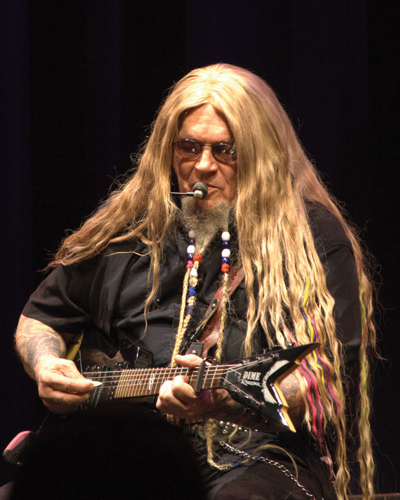

There may be a pairing that could express the evolution of the outlaw in country music better than the double bill of David Allan Coe and Jonny Corndawg, but it's hard to imagine what that would be. Nowadays, Nashville country music seems very far away from any lingering smell of the long-haired, dope-smoking country rebel who once haunted the city's recording studios and stages — and yeah, I think Jamey Johnson has some of the most evocative feral-biker hair in all of pop music. But it's the seemingly subcultural work of Corndawg that illustrates what's happened to outlaws and American men in the last decade.
Released last year, Corndawg's epochal full-length Down on the Bikini Line was one of the filthiest, funniest and most innocent country records in recent memory. No great vocalist, the leather-working, marathon-running singer nonetheless is an effective communicator — a gentle soul who is interested in laser hair-removal billboards and the women who need a little help below the bikini line, not to mention the responsibilities of a father who happens to be a filthy-minded but responsible parent.
Yet Down on the Bikini Line is an angst-free ride that appears to have thrown off all countercultural reference points. If Coe's 1969 debut full-length Penitentiary Blues derived its musical energy from such rhythm-and-blues performers as Junior Parker and Muddy Waters, Corndawg's songwriting and performance style seem indebted to the distinctly post-hippie tunes of Michael Hurley, Tom T. Hall and Bobby Bare. Like Coe, Corndawg writes about how his unconventional life has taken him into new places, but Corndawg is a modern outlaw who has moved beyond confrontational politics.
This is significant, and I think it has to do with the urge to get into showbiz — to make your case and your art to everyone at all times, despite your relative lack of talent or vision — that has dominated American culture for the past 10 years. If the fictional Michael Scott of the television show The Office could make a record, it wouldn't necessarily sound like Corndawg's Bikini Line, but it wouldn't flaunt its eccentricity or its roots in the blues, as Coe did back in 1969.
As everyone probably knows, Coe went on to write successfully for the country music industry, even though the Ohio native had been a stone R&B fan before coming to Music City to make his name. Yet Penitentiary Blues is a sly declaration of freedom done in the idiom of Chicago blues. Much like Willie Nelson, Waylon Jennings and Tompall Glaser in the early '70s, Coe both simplified his music and looked outside Nashville and mainstream country for inspiration.
For Corndawg, writing about junk food and trucks — not to mention oral sex and his fictitious daughter's teenage sex parties — isn't an act of cultural rebellion or even music on a grand scale. Just like the hapless but somehow sexually empowered Michael Scott, Corndawg seems post-everything and glad to be rid of the shackles of conventional masculinity, although both men appear to have a healthy interest in sex. Coe plays a guitar that resembles a Confederate flag; Corndawg makes leather billfolds with cute dogs on them.
I managed to catch up with Corndawg via email. I admire his music, which really is country, and wondered about the influence of Hurley and other songwriters. "I'm a bit of a snob," he writes. "I get really excited about some folks and then really upset about most everyone else. I'll get in trouble if I open up too much more about my musical opinions."
That's neither surprising nor perplexing — I've asked far more famous "outlaw" performers the same thing and gotten even less of an answer. These more famous figures are, of course, handled by the kind of careful, hovering folks who oversee these big Nashville country performers, so a journalist is lucky to get even a straight answer from them, let alone anything profound.
But it was Corndawg's response to my question about his connection to the old-time rule-breakers of Nashville — Coe, Jack Clement, Johnny Cash, Jennings — that surprised me. "Not really," answers Corndawg. "Honestly, I think they would hate me. I'm not worried about it, though. I'm not looking for anyone's approval. I'm just doing my thing."
This is the voice of a man unconcerned about rebellion. Corndawg told me he was happy being out on the road after a period, as he put it, of "wife-swapping peaks and suicidal valleys." I do think he's wrong about those old outlaws, though — they probably love him and wish him well as he explores the limits of expression in a world where freedom is just another word for everything that's left to gain.
Email music@nashvillescene.com.



