
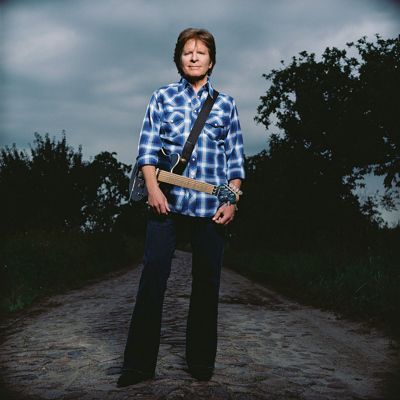

On Sunday, John Fogerty comes to Nashville's Carl Black Chevy Woods Amphitheater (formerly The Woods at Fontanel), where the rock icon will crank out a set list mostly drawing from Creedence Clearwater Revival's most prolific year: 1969. CCR released three (count ‘em, three!) albums that year — Bayou Country, Green River and Willy and the Poor Boys. Those albums outpaced The Beatles in sales that year and yielded era-defining classics including “Proud Mary,” “Lodi,” “Bad Moon Rising,” “Green River” and “Fortunate Son.”
In this Q&A (below), Fogerty regales the Cream with memories from that magical year, the three Creedence albums released during it and how, in 1997, he embraced his Creedence catalog after more than a decade of refusing to play those songs live.
Let’s talk about the 1969 tour. How did the idea for this happen?
The actual idea comes from my wife, Julie. Even though, how can I say it, I’ve been dancing around that for years and years because people would make note of the three albums in 1969, and sometimes I’ve gone out and done shows that presented this album or that album in its entirety. It’s funny that it was staring me in the face. I never thought of it. Julie, finally one day said, "Why don’t we focus on that one year?" ... I think at the time I thought it was a pretty cool thing. But now, as a concept for a show, I think it’s just a really great idea.
What prompted you to create so much music in the space of that year?
I guess the reason that I did that, of course, was I had taken stock of my situation. Basically my band had one hit — "Suzie Q" — so we were in dire danger of ending up on the rocky shore of all the one-hit wonders down through the years of rock 'n' roll. And I really, I’m a competitive person. I just really didn’t want that to happen. But when I looked at our situation, we weren’t on a big label. We were on a tiny little label (Fantasy Records), and a jazz label at that. They were very unaware of rock 'n' roll, let’s say. We didn’t have a manager. We didn’t have a producer. We didn’t have a publicist, none of it — the usual trappings. And by then we had started to see things like, of course The Beatles had their famous sort of team. We knew all the names, of course. I don’t know if it was before that year, but certain artists were getting signed to these, kind of like bonus babies [contracts] in baseball. I know Johnny Winter got signed to Columbia right out of [nowhere]. I’d never heard of this guy, and suddenly he was getting what was a lot of money to sign and stuff. And we didn’t have any of that.
So I just kind of made up my mind. ... I actually said this to myself, "I guess I’m just going to have to do it with music." So I set, kind of put my shoulder to the grindstone, I guess you’d say, and just got really, really busy. I mean, that’s what happened.
Bayou Country is considered by many the album on which you really found the Creedence sound. Some of that had to do with discovering a Gibson 175 model guitar tuned down one step from E to D and writing in that key. But I’ve read that it was actually a bit of misfortune that really helped you find that unique guitar sound you brought to quite a few of the Creedence songs. What’s the story?
I finally had settled on "Bad Moon Rising" and "Lodi" to be the next single[s]. And one day I was down at kind of the new place that Fantasy had moved to over in Oakland, and I had just come from a practice with the band. So my car was parked out front with my amplifier and my 175 guitar in the back seat. And somebody put a brick through my window and stole the guitar and amplifier. So I immediately; I hadn’t recorded "Bad Moon Rising" yet and "Lodi," which are both songs in that tuned down D mode, I guess you’d say. So I rushed over to this guitar store.
I just walked in and I had heard about these guys in England and their Les Pauls. I said it’s time for me to kind of move over from the Rickenbacker stage and go to a Les Paul. I walked in, and I was in dire need because we needed to record "Bad Moon Rising" and "Lodi." So I walked in and said, "Do you have any Les Paul guitars?" He said, "Sure, there’s one right there." It didn’t look like the other Les Pauls. They were Sunbursts. This one was black. It turns out it was called a Les Paul Custom. I didn’t really know all the ins and outs of why it was different. Anyway, I said what I’ve got to do is tune it down to D and then see what it sounds like. And remember I had already been playing the other guitar. So he had a big Fender amp there and I told him what I was going to do. And he said "Yeah, that’s fine." So I kind of tuned it down by putting my ear on the neck. I just tuned it acoustically. Then we turned on the amplifier and I plugged it in and I hit that basically big D chord, and you might say all the bells in heaven rang out because what it was is that sound that you hear at the beginning of "The Midnight Special," that chord. I’m sure my eyes got real big and somewhere I’m sure I said "Oh my God." ... I knew that was it. So that was a huge change because it really sounded better than the 175 tuned down to D.
Bayou Country was also the album that included the hit song that buried any notion that Creedence would be one-hit wonders — “Proud Mary.” I know that was a watershed song for you.
Once I had written "Proud Mary," the heavens opened up. I [knew] right there that afternoon as I was writing that song, I knew that this was a great song. I knew this was what they used to call a standard. ... So right there, with "Proud Mary," not only was I shaking with the, you know, it’s very hard to put in words what that was, but I was very aware, even right at the time. I was completely aware that this happened. … It was just such a miraculous feeling.
You already mentioned “Bad Moon Rising” and “Lodi.” They were both going on the second of Green River. Did you feel you rose to the standard you set with “Proud Mary” with the songs on that album?
[Green River] was my favorite album of the era because it was closest musically to the, I don’t know, to my bulls-eye.
How did that idea for a group fictitious band called Willy and the Poor Boys happen?
I know we were doing an Andy Williams Show [appearance], which was the week before Woodstock. And while the fellas were out kind of hanging at the pool and all that, waiting to be picked up and taken to [the taping], I was in my room working on this song called ‘Down on the Corner.’ And so I was, how can I say it, I was really trying to get ready for what would be the next single, and then therefore probably the next album, too. And it all just started to kind of come together. The characters of Willy and the Poor Boys spoke to me like a cartoon almost. I really had daydreamed at the time of somehow being able to make a cartoon that was far beyond, let’s say, the vision of anybody I knew. I remember mentioning it to Saul Zaentz (head of Fantasy), but he kind of didn’t [get it]. He wanted to be in the movies then. So that didn’t go anywhere, but I thought of it very much visually.
There was a time, from the '80s up to 1997 when you didn’t play any Creedence songs live. How does it feel to play Creedence material now?
I’m having a lot of fun with it. It’s finally quite normal. Back in 1997, when I started touring again after ages, it was a bit, I mean, I noticed everything, because it was not normal, I’d say. But now I don’t even blink, I don’t even think about it. Wow, was there a time when I didn’t do these songs? That whole episode seems pretty wacky now. Obviously, how can I say it — a questionable decision. But I always say it now or look at it, it must indicate there were some pretty strong feelings inside of me to make a severe decision, an almost suicidal decision. I mean, of course you should go out in front of your fans and play your most famous songs. That’s what they want to see.



