
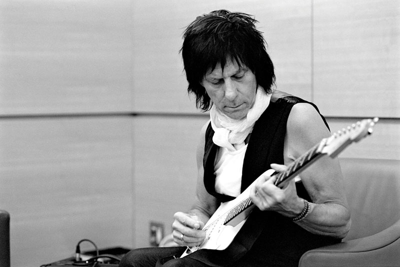

Jeff Beck may be the least famous of the three rock guitar gods who cut their teeth in The Yardbirds — the other two being Eric Clapton and Jimmy Page — but he was (and still is) the most talented musician of the bunch.
Sure, Clapton played in Cream and Derek and the Dominos before enjoying an enormously popular (if somewhat yawn-inducing) solo career, and Page, as a member of Led Zeppelin, wrote some of the greatest and most enduring rock riffs of all time. But Beck elevated guitar playing to a completely new level, somehow blending ferocity, melody, fabulous tones, impeccable phrasing and mind-bending whammy bar pyrotechnics without stepping over the line into the mindless indulgence that plagued so many of his six-string virtuoso peers.
Here's a little exercise to help put his legacy in perspective: Try to imagine a guitar player of today releasing an album of completely instrumental music and having it go platinum. Beck did that. Twice! His 1975 album Blow by Blow and 1976 album Wired hit No. 4 and No. 16 respectively on the Billboard 200, and both were certified platinum.
But for lovers of psychedelic rock (myself among them), it's the guitarist's output with The Jeff Beck Group from 1968 to 1972 that has most successfully stood the test of time. Yes, I enjoy spinning Blow by Blow and Wired from time to time — favorites include "You Know What I Mean" and the Stevie Wonder composition "Cause We've Ended as Lovers" from the former, "Led Boots" and "Sophie" from the latter — but it's the gritty rock of those early albums that still resonates most, and whose influence is most evident today, in acts like The Black Keys and Jack White. (Though White might not seem like an obvious musical progeny of Beck's, there are a lot of stylistic parallels between the ways both play guitar — and Beck sat in with The White Stripes at London's Royal Festival Hall in 2002.)
The Jeff Beck Group's Truth (1968) endures as one of the greatest examples of late '60s rock 'n' roll, brimming with primal energy and the sense of infinite possibilities that characterized the era. Sure, it doesn't hurt that the band featured a young up-and-coming singer named Rod Stewart, or that folks like Ronnie Wood, Nicky Hopkins, Keith Moon, John Paul Jones and Page made contributions. But it's Beck's fearless and groundbreaking guitar work that carries the album, on tracks like "Let Me Love You," "Beck's Bolero" and an insanely cool wah-wah-pedal-fueled version of blues legend Willie Dixon's "I Ain't Superstitious."
1969's Beck-Ola continued in a similar vein. Though it wasn't quite as strong as Truth, there's a lot of great guitar work, and the seeds of heavy metal can be heard in "Spanish Boots," "The Hangman's Knee" and "Rice Pudding."
But the Beck song that changed my life, oddly enough, came on the eponymous fourth and final album from The Jeff Beck Group in 1972, a work that was dismissed by critics, and frankly, was probably the weakest of the bunch. Stewart and Wood had departed the band before the previous album, Rough and Ready, to join Faces, after Beck was sidelined for most of a year due to a head injury in a car accident. The new group featured Bobby Tench on vocals and rhythm guitar, Max Middleton on keys, Clive Chaman on bass and Cozy Powell on drums.
Though the album may have been uneven, the first track on Side Two, a remake of the Don Nix song "Going Down" — first recorded by Moloch, a band so obscure that the all-knowing Internet bears only faint echoes of its existence — remains what is quite possibly the greatest example of rock guitar ever documented. Admittedly that's a bold statement, and from someone who has worn out at least two vinyl editions of Jimi Hendrix's Electric Ladyland.
But few if any rock guitar workouts have stood the test of time or held up to repeated (and repeated and repeated) listenings, at least to these ears. Powell and Middleton turn in strong performances on the track, but it's Beck's off-the-charts riffing that makes it a masterpiece. This was the period when Beck's playing really began to morph from standard rock-god fare to take on a completely unique and unmistakable personality. There are gritty blues licks, killer tones, whammy-bar dive bombs, staccato rhythmic stabs, great melodic sense, musical humor, feedback, uncanny phrasing. In fact, you could turn in the song as your master's thesis, "How Rock Guitar Got From Hendrix to Eddie Van Halen, in Six Minutes and 51 Seconds." (But don't ask me to refund your tuition if you fail.) Oh yeah, and it has not one, but two fake endings.
If you think I'm heaping on excessive praise, I suggest you bring up "Going Down" on iTunes, Spotify, YouTube or wherever you get your kicks these days. Give it a few listens — then we can talk. I've listened to it at least 15 times while writing this piece, and I'm still grinning from ear to ear.
And if you're among the 2,300 dudes and 62 women at the Ryman when Beck plays Sunday night, you're in luck, because a review of recent set lists suggests that it's his standard encore for the tour.
Email music@nashvillescene.com



