
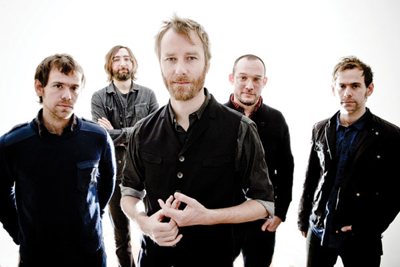

Whatever your perspective on this Brooklyn-by-way-of-Cincinnati post-punk outfit, consider the following: The National is a "grower" band. If you associate with even just a handful of record-store-frequenting rock 'n' roll connoisseurs, you likely know at least one diehard who considers Alligator his or her gospel and swears by frontman Matt Berninger's lyrics. Even so, said fan at one point felt the very same way you might about The National: Their lush arrangements are gorgeous and you appreciate their influences, but you just can't get into Berninger's brainy, baritone vocals. It's too brooding and thoughtful. It rocks ... in a way. But you haven't quite crossed that threshold — you don't yet find yourself enraptured.
Case in point: I once was trying to ease a hesitant friend into National fanhood. Her reservations were the usual — Berninger's voice was a bit affected for her taste, the song's tones too heavy. But as I slipped a song or two onto some mixes — Alligator's "All the Wine," and "Conversation 16" from this year's High Violet — she slowly began to come around. And then? Boom! A super-fan coworker played their entire catalog for her, and she found herself overexposed.
It's a delicate process, this one.
But that's all right. This isn't easy music, per se. And just as it isn't easy music to immediately fall in love with, it isn't easy music to make. As bassist/guitarist Scott Devendorf will tell you — he belongs to one of The National's two pairs of brothers, by the way — the road to making a record typically takes the band about a year to travel, and it's riddled with spats and debates along the way.
"It's never usually Dessner v. Devendorf," he says. Guitar duties are mostly handled by the Dessner brothers — Aaron, who "writes a lot of the music," and Bryce — with Scott's brother Bryan on drums. "It's more like Dessner v. Berninger with, like, Devendorf as U.N. or something. ... It gets heated, but it's never downright mean. It's usually just that everyone really wants one thing or another from a song. It's kind of a democracy, albeit a messed-up one."
The process, best illustrated by the making of High Violet — which was recorded and mixed between approximately March of 2009 and February of 2010, and released in May — usually goes like this: The Dessners and Devendorfs start with a few dozen instrumental ideas. Scott calls them "sketched demo things," and he places their initial number near 50 or 60. From there, Berninger — who plays no instruments and knows nothing of music theory, but is known for his stirring, poetic lyrics and wine-soaked, tousled-but-charming stage presence — combs through the ideas, keeps what he likes and throws out much more. "Having [Berninger] say, 'Oh, we don't want that at all,' " explains Scott, "is kind of like, 'Oh. [Pause] OK.' " Then it's a months-long process of scrapping ideas, fighting for ideas, coming up with better parts, and doing it all again during mixing.
"For us it's a little archaeological," says Scott. "We just kind of throw a bunch of stuff on there and take it away, throw more stuff on, take stuff away."
The archaeology analogy works for National listeners about as well as it does for the band itself. For those willing to commit, listen, re-listen, sift and dig, records like Alligator and Boxer often turn out to be incredibly rewarding. High Violet is a bit more immediately gratifying — probably because The National have hit their stride with over a decade of fraternal collaboration under their collective belt. With triumphant, rousing choruses and striking string and woodwind parts, High Violet isn't an enormous departure from The National's previous four studio albums. It's not a leap of faith for those acclimated to their prep-school-meets-garage-rock idiosyncrasies, but it's perhaps their most deliberate, elaborate effort. Over excruciatingly arranged, complex walls of sound, Berninger provides sharply articulated if cryptic glimpses at realistic, adult relationships: stories of love that aren't all flowers and wedding cake; scenes of partnerships that —despite complexity, distrust and first-world problems — don't crumble.
"He writes a lot of lyrics with his wife as well," says Scott. Carin Besser — Berninger's wife and quite clearly the inspiration for many of his fractured love stories — was once an editor at The New Yorker, and is credited as co-writer on three of High Violet's 11 tracks. "She kind of wrote a big part of or helped write stuff. ... So they have a little collaboration thing going on, which is kind of fun to watch for us. Because when we're not fighting with him, we get to watch her fight with him. [Laughs.] It's not really that bad either. I'm being a little dramatic."
But shouldn't there be drama in the process? As most National fans will tell you, falling in love with their catalog is not unlike committing to a long-term relationship. There's drama. There's frustration. There's compromise, uncertainty and moments of starry-eyed infatuation. On your first date, you just see this tall, rakish, strawberry-blond poet and his Ivy League friends, all of whom seem to be blood-related one way or another. They're smart and they're impressive, but you can't quite get comfortable around them yet, and you feel like you might end up disappointed. Maybe you were pretty heartbroken when Silver Jews broke up, and, truth be told, you never really got over Guided by Voices. Your friends tried to set you up with Interpol, but we all know that didn't go well at all. Well, I'm here to tell you something: If you haven't already, go home with The National. They're the real deal. You'll be moving in with 'em before you know it.



