
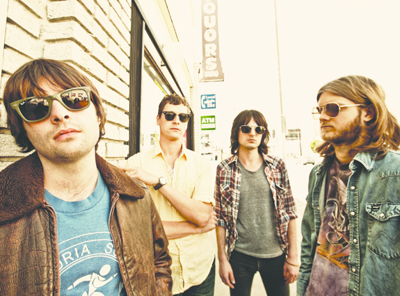

"I don't think the sound, or the look, or the overall vibe of the band's presentation and music are really gonna be much different at all," says Rooney guitarist Taylor Locke, referring what you'd find if you searched for video footage of his band in 2002, when they opened for The Strokes, or his band in 2008, when they opened for The Jonas Brothers. And he's right.
(Full disclosure, I've known Locke nearly half my life. From seeing his band's first rehearsal, to watching him shake hands with Al Sharpton on The Tonight Show, I've followed his band's story from the sidelines.)
In 2001, an apt description of the band might have read something like this: "Rooney assimilate the sun-drenched pop motifs of influences like Weezer, The Zombies, The Beach Boys, E.L.O. and The Beatles with a sanguine mixture of good vibrations, prodigious musical dexterity and camera-readiness all their own." Less than a minute into "Holdin' On," the opening track of their latest, Eureka, and that description still holds.
Considering how major-label marketing executives spent the better part of a decade tossing Rooney from radio format to radio format like a hot potato, such stylistic maintenance is a feat. But as the California flag they fly on both their debut and latest album covers attests, for Rooney, knowing their own identity was never a problem — they're a pop-rock band in the purest sense of the term. For a capricious music business failing to navigate a Category-Five industry hurricane, figuring out how to break a band that was too pop for rock radio, and too rock for pop radio, became a multi-million-dollar conundrum. "When we started," Locke says, "alternative rock radio and Top 40 pop radio were in really radical phases, where rock radio was nu-metal, and pop radio was white R&B singers. For us, to go perform on the festival shows of those radio stations was incredibly awkward and ill-fitting, either way. And we tried both. Our first single, 'Blueside,' went to alternative radio, and it's us and Godsmack. Then the second single, 'Shakin' ' went to pop [radio], and it's literally us and Jessica Simpson. ... Between the first and second records, the tides shifted. You had The Strokes and The Hives and The Vines and The White Stripes and Kings of Leon. ... We missed out on that wave, so we're still the same as we ever were."
After the moderate success of their 2003 self-titled debut, Geffen engaged the band in a maddeningly protracted stand-off, sending them into the studio three times, with three different name producers, before the band finally arrived at their sophomore LP, 2007's Calling the World, that the label saw fit for human consumption. Despite yielding the band a No. 1 single in Germany, the album failed to elevate the band stateside, leading the label to call a stalemate and cut their losses — dropping the band from its roster, to their mutual relief.
After a tenuous period that saw individual side projects, changes in representation and the amicable departure of founding bassist Matt Winter — who has now left the music business entirely — the band emerged from the major-label wood-chipper with their sound and style intact, ready to earn on the dividends of Jimmy Iovine's investments — with their own ILG-distributed label, California Dreamin', and a self-produced, self-engineered and self-released LP to christen it with.
"We see our chapter with Geffen as a success because we have a sustainable career and we don't have to have day jobs," Locke says. "We had to change our label situation in order to not change our music or else, by round three, I think the hammer would've dropped. ... They never said, 'Cut your hair,' or, 'Use less distortion.' They really didn't get in our way, thankfully. But perhaps they would've started to. ... Uncomfortable suggestions were on the horizon had we not gotten out of there."
While some critics have chided the band for emancipating themselves from major-label tyranny only to turn around and self-produce a record that sounds as polished and radio-ready as its predecessors, they forget that Rooney were always, at their core, a sugar-toothed pop band. Locke says that after spending nearly a decade getting Hail Mary-ed from demographic to demographic, the band have come to terms with their place in the pagoda of pop (and rock) music.
"I don't think it matters whether we're on an indie or a major [label] at this stage in our career," Locke says. "I don't expect us to become huge pop stars, and I also don't expect us to become a hipster critic's choice. But what I would like to see is the band getting to be viewed as a little bit more of a veteran act. We're not a wet behind the ears, teenaged pop group. We play a lot of fucking shows. We tour really, really hard, and we've honed in a [great] live show ... I can't define it, because I'm in it, but I know it's not the Ozzfest and it's not the Warped Tour and it's not Disney."
Email music@nashvillescene.com.



Post a comment as anonymous
Report
Watch this discussion.
(0) comments
Welcome to the discussion.
Log In
Welcome to the discussion.
Keep it clean. Please avoid obscene, vulgar, lewd, racist or otherwise abusive language. Comments featuring hate speech or threatening or violent content will not be tolerated.
PLEASE TURN OFF YOUR CAPS LOCK.
Be truthful. Don't knowingly lie or mislead.
Be proactive. Use the “report” link on any comment that violates our comment policy.
Share with us. We'd love to hear your feedback.